Swainson's Hawk (Plate 372)
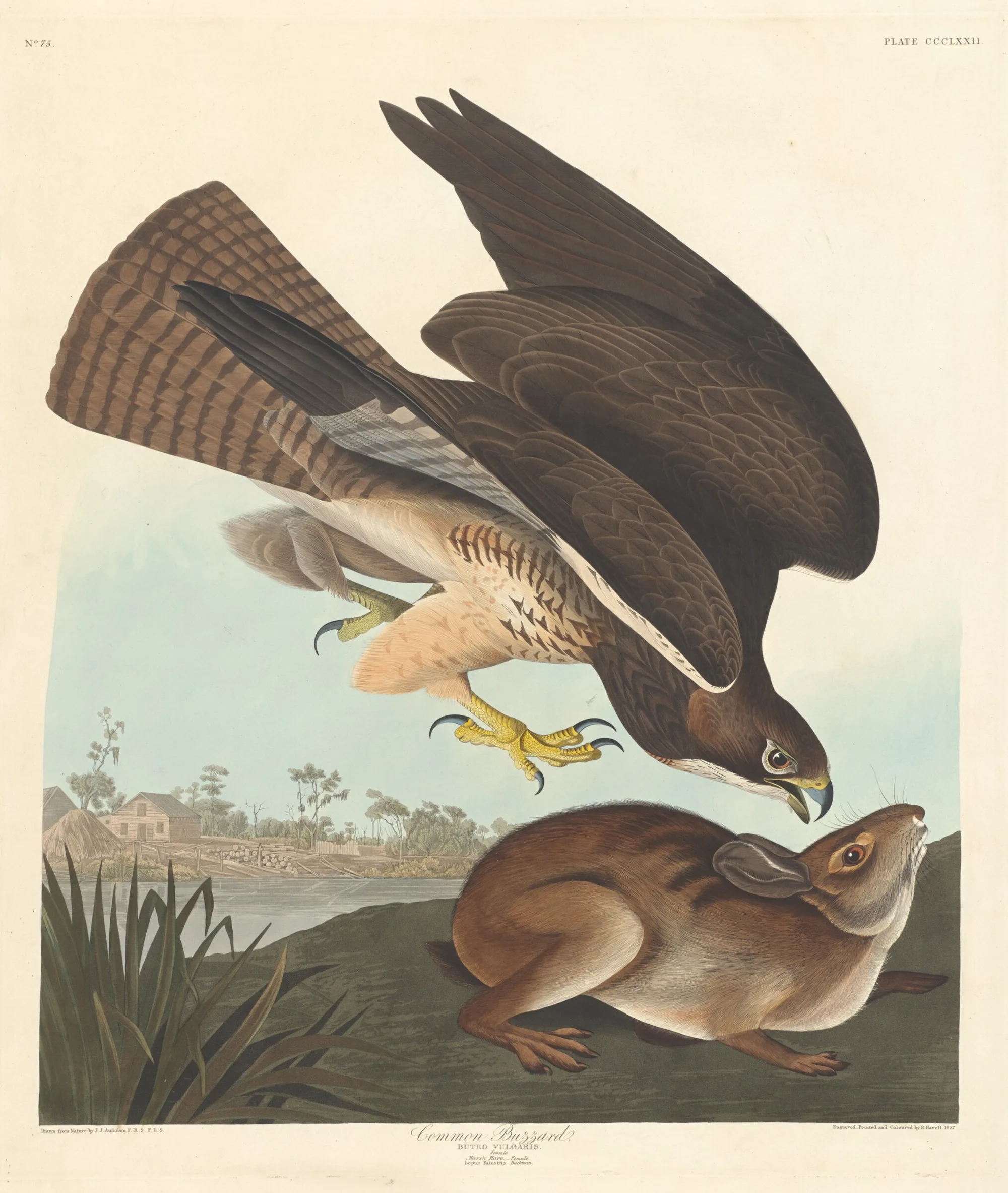
Audubon's “Common Buzzard”, The Birds of America, plate CCCLXXII
Click or press Enter to enlarge
Open the full-resolution image (3988 px, National Gallery of Art)
| Plate | 372 (CCCLXXII) |
|---|---|
| Audubon's name | Common Buzzard |
| Modern name | Swainson's Hawk |
| Scientific name | Buteo swainsoni |
| Status | Least Concern |
| Engraved by | Robert Havell, after Audubon's watercolor |
| Date | 1837 |
| Medium | Hand-colored engraving and aquatint on Whatman wove paper |
| Collections | Hawks, Eagles and Falcons |
| This impression | National Gallery of Art, Washington, 1945.8.372; Gift of Mrs. Walter B. James |
About this plate
Plate 372 shows a single female hawk. It is a large, broad-winged buteo hawk in dark plumage.
Audubon called it the Common Buzzard, Falco buteo, and believed it was the same species as the European Buzzard. Richardson and Swainson made the same mistake in the Fauna Boreali-Americana. The bird is now identified as Swainson's Hawk, Buteo swainsoni, a western American species named by Bonaparte in 1838, the year after this plate was issued. The European Buzzard does not occur in North America.
Swainson's Hawks breed in grassland, prairie and farmland across western North America. They eat mostly rodents in the breeding season but feed heavily on grasshoppers and other insects. They make one of the longest migrations of any American raptor, travelling in large flocks to the pampas of Argentina for the winter. Pesticide poisoning there killed thousands in the 1990s until the chemicals were restricted. The species is listed as Least Concern.
The specimen was shot by John Kirk Townsend on a rock near the Columbia River, where it had its nest. Townsend sent no notes on its habits, so Audubon quoted Richardson's account of the buzzard in the Fur Countries.
In Audubon's words
The specimen from which the figure before you was taken, was shot by Dr Townsend on a rock near the Columbia River, on which it had its nest. Unfortunately, however, he has not supplied me with any account of this species, and the only notice respecting its habits that I have seen, is that in the Fauna Boreali-Americana, by Dr Richardson:—“The Common Buzzard arriving in the Fur Countries in the middle of April very soon afterwards begins to build its nest; and, having reared its young, departs about the end of September. It haunts the low alluvial points of land which stretch out under the high banks of a river; and may be observed sitting for a long time motionless on the bough of a tree, watching patiently for some small quadruped, bird, or reptile, to pass within its reach.
John James Audubon, Ornithological Biography, vol. 4 (1838), “Common Buzzard”. Read the full chapter.