American Dipper (Plate 370)
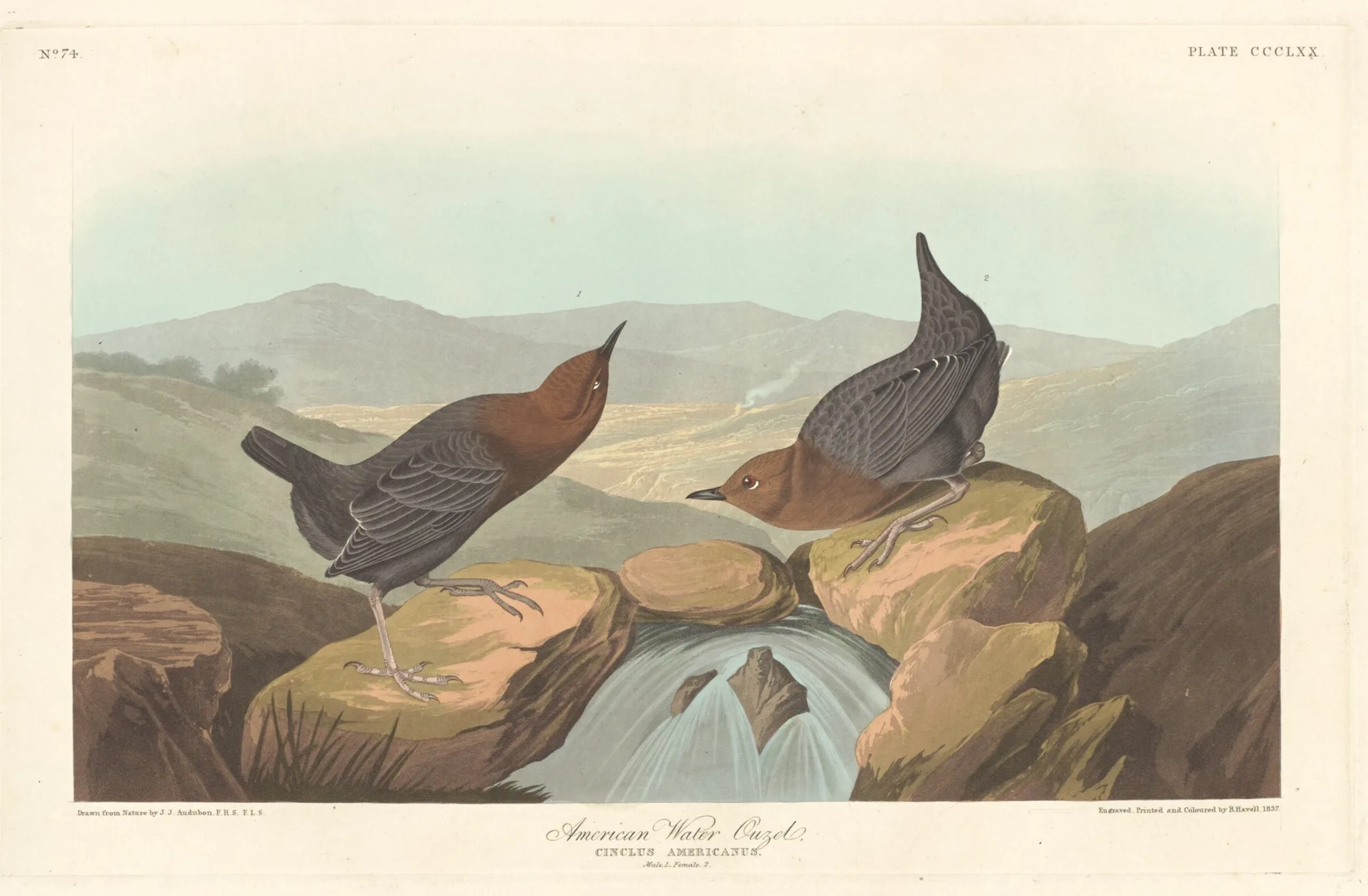
Audubon's “American Water Ouzel”, The Birds of America, plate CCCLXX
Click or press Enter to enlarge
Open the full-resolution image (2835 px, National Gallery of Art)
| Plate | 370 (CCCLXX) |
|---|---|
| Audubon's name | American Water Ouzel |
| Modern name | American Dipper |
| Scientific name | Cinclus mexicanus |
| Status | Least Concern |
| Engraved by | Robert Havell, after Audubon's watercolor |
| Date | 1837 |
| Medium | Hand-colored engraving and aquatint on Whatman wove paper |
| Collections | Songbirds |
| This impression | National Gallery of Art, Washington, 1945.8.370; Gift of Mrs. Walter B. James |
About this plate
Plate 370 shows a male and a female American Dipper. It is a plump, short-tailed slate-grey songbird. The sexes look alike, and a white eyelid flashes when the bird blinks.
Audubon titled the chapter American Dipper and preferred Swainson's name Cinclus americanus to Cinclus unicolor, since the bird is not quite one colour. The accepted name today is Cinclus mexicanus, which Swainson had published first, from a Mexican specimen. Water Ouzel was the popular name in the nineteenth century, made famous later by John Muir.
American Dippers live along fast, clear streams in the mountains of western North America, from Alaska to Panama. They walk and swim underwater against the current to catch insect larvae and small fish. They nest behind waterfalls or under bridges, in domes of moss kept damp by spray. The species is listed as Least Concern.
Audubon never saw the bird alive. His figures came from specimens taken in the Rocky Mountains on 15 June, when the birds were thought to be breeding. Because little was known of the American bird's habits, he filled the chapter with William MacGillivray's account of the European Dipper in Scotland.
In Audubon's words
The specimens from which the figures here given have been taken, were procured on the Rocky Mountains, on the 15th of June, when they were supposed to be breeding, so that they were probably adults in full plumage. Having little taste for critical discussions, I shall refrain from inflicting on the reader a long and elaborate review of all that has been said on the subject of this interesting but little-known bird, which was figured by the Prince of Musignano from a specimen obtained near the sources of the Athabasca River, under the name of Cinclus Pallasii; and has been described by Mr Swainson, first as C. Mexicanus, and again, in the Fauna Boreali-Americana, as C. Americanus. The latter name I prefer to that of C. unicolor, which is in fact incorrect, the bird not being of one single colour.
John James Audubon, Ornithological Biography, vol. 4 (1838), “American Dipper”. Read the full chapter.



