Trumpeter Swan (Plate 376)
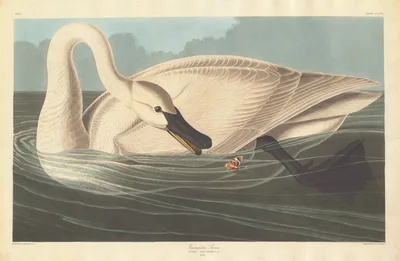
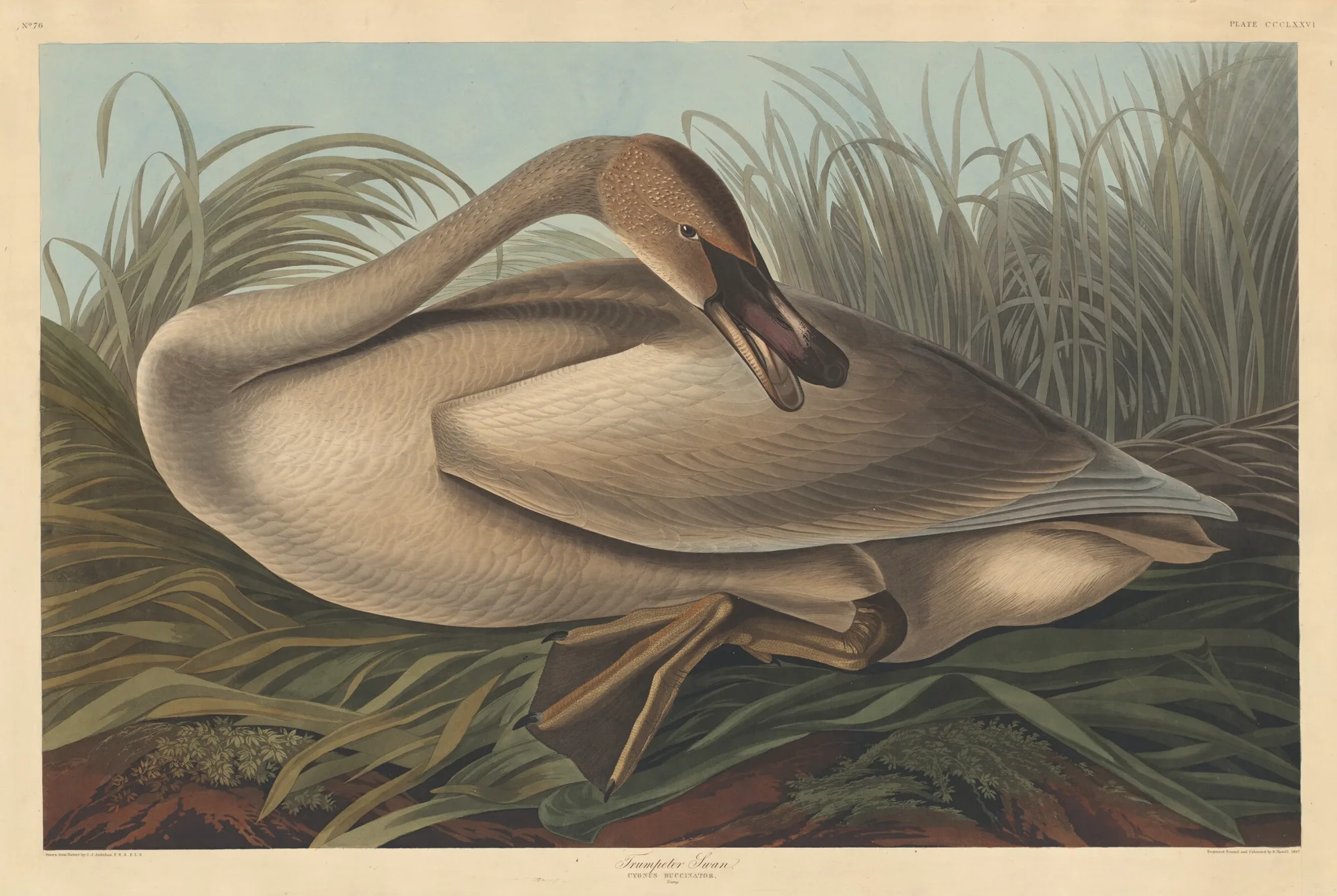
Audubon's “Trumpeter Swan”, The Birds of America, plate CCCLXXVI
Click or press Enter to enlarge
Open the full-resolution image (5429 px, National Gallery of Art)
| Plate | 376 (CCCLXXVI) |
|---|---|
| Audubon's name | Trumpeter Swan |
| Modern name | Trumpeter Swan |
| Scientific name | Cygnus buccinator |
| Status | Least Concern |
| Engraved by | Robert Havell, after Audubon's watercolor |
| Date | 1837 |
| Medium | Hand-colored engraving and aquatint on Whatman wove paper |
| Collections | Ducks, Geese and Swans |
| This impression | National Gallery of Art, Washington, 1945.8.376; Gift of Mrs. Walter B. James |
About this plate
Plate 376 shows a single young Trumpeter Swan in its first winter. It is grey-brown rather than white, with a dull pinkish bill. The adult appears on a separate plate.
Richardson named the Trumpeter Swan Cygnus buccinator, and the name is still in use. It is the largest native waterfowl in North America. Audubon complained that the American swans had been badly confused. He separated the Trumpeter from the smaller swan of Sharpless, Cygnus americanus, now the Tundra Swan. Lewis and Clark had already noted two sizes of swan on the Columbia.
Trumpeter Swans were hunted for skins, feathers and meat through the nineteenth century. By the early 1930s fewer than a hundred were known in the contiguous United States, mostly around Yellowstone. Protection, refuges and reintroductions have brought them back, and IUCN now lists the species as Least Concern. Alaska holds the largest population.
Audubon knew the Trumpeter from his years at Henderson on the Ohio, where flocks arrived each autumn. He drew this young bird at New Orleans, where Trumpeters were often sold in the markets. He wrote that the largest he examined weighed over thirty-eight pounds and spanned nearly ten feet. He used its quills as pens to draw the feet and claws of small birds.
In Audubon's words
The waters of the Arkansas and its tributaries are annually supplied with Trumpeter Swans, and the largest individual which I have examined was shot on a lake near the junction of that river with the Mississippi. It measured nearly ten feet in alar extent, and weighed above thirty-eight pounds. The quills, which I used in drawing the feet and claws of many small birds, were so hard, and yet so elastic, that the best steel-pen of the present day might have blushed, if it could, to be compared with them.
John James Audubon, Ornithological Biography, vol. 4 (1838), “Trumpeter Swan”. Read the full chapter.