Common Redpoll (Plate 375)
Audubon's “Lesser Red-poll”, The Birds of America, plate CCCLXXV
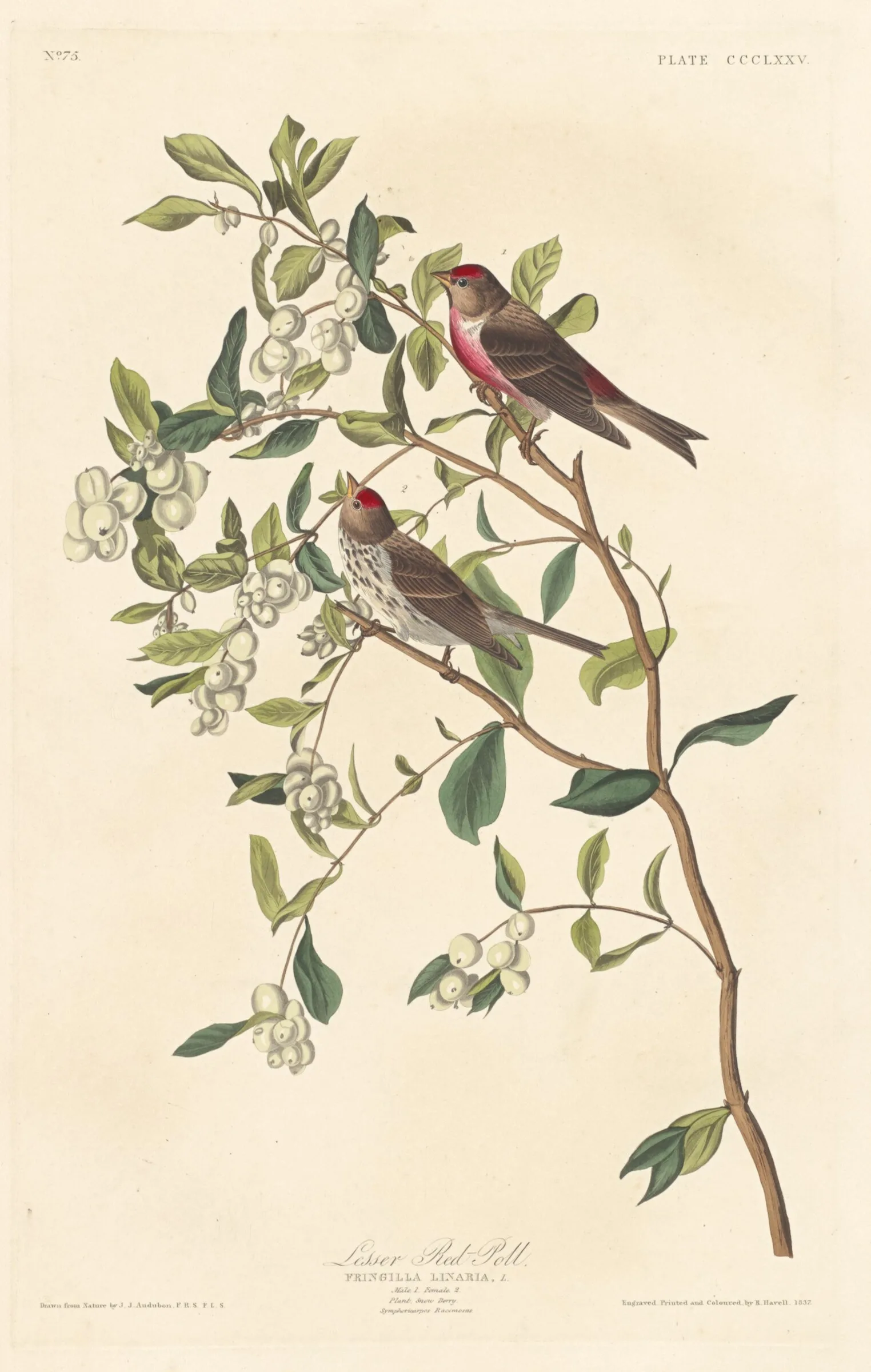
Click or press Enter to enlarge
Open the full-resolution image (2885 px, National Gallery of Art)
| Plate | 375 (CCCLXXV) |
|---|---|
| Audubon's name | Lesser Red-poll |
| Modern name | Common Redpoll |
| Scientific name | Acanthis flammea |
| Status | Least Concern |
| Engraved by | Robert Havell, after Audubon's watercolor |
| Date | 1837 |
| Medium | Hand-colored engraving and aquatint on Whatman wove paper |
| Collections | Songbirds |
| This impression | National Gallery of Art, Washington, 1945.8.375; Gift of Mrs. Walter B. James |
About this plate
Plate 375 shows a male and a female redpoll. They are small, streaky brown finches with a red cap, a black chin and white wing bars. The male has a pink wash on the breast.
Audubon called it the Lesser Redpoll, Fringilla linaria. In modern usage Lesser Redpoll is a smaller, browner bird of Britain and central Europe that does not occur in America. Audubon's Labrador birds were Common Redpolls, Acanthis flammea. Redpoll taxonomy has long been disputed. In 2024 the American Ornithological Society merged the Common and Hoary Redpolls into one species, simply called the Redpoll, while other world lists still keep them apart.
Redpolls breed in the birch and willow scrub of the far north, across Canada, Alaska and northern Eurasia. In some winters they move south in large flocks to the northern United States, where they feed on birch and alder seeds and visit feeders. The species is listed as Least Concern.
On 27 July 1833 Audubon's son and young companions shot eight birds of different sexes and ages in Labrador. Audubon went to the same place the next morning to watch the survivors. He noted that their calls were like a Siskin's, that family groups fed on alder cones, and that birds passed seeds from bill to bill.
In Audubon's words
When alighted they were quite unsuspecting, and so heedless as to allow a close approach, scarcely regarding my presence, but clinging to the branches, dexterously picking out the seeds of the alder-cones, and occasionally coming to the ground after some which had dropped. Few birds exhibit a more affectionate disposition than the Little Redpoll, and it was pleasing to see several on a twig feeding each other by passing a seed from bill to bill, one individual sometimes receiving food from his two neighbours at the same time. Occasionally, however, they shewed considerable pugnacity, and one would drive off its companion, inflicting some smart blows upon it with its bill, and uttering a low querulous chatter.
John James Audubon, Ornithological Biography, vol. 4 (1838), “Lesser Redpoll”. Read the full chapter.



