Snow Goose (Plate 381)
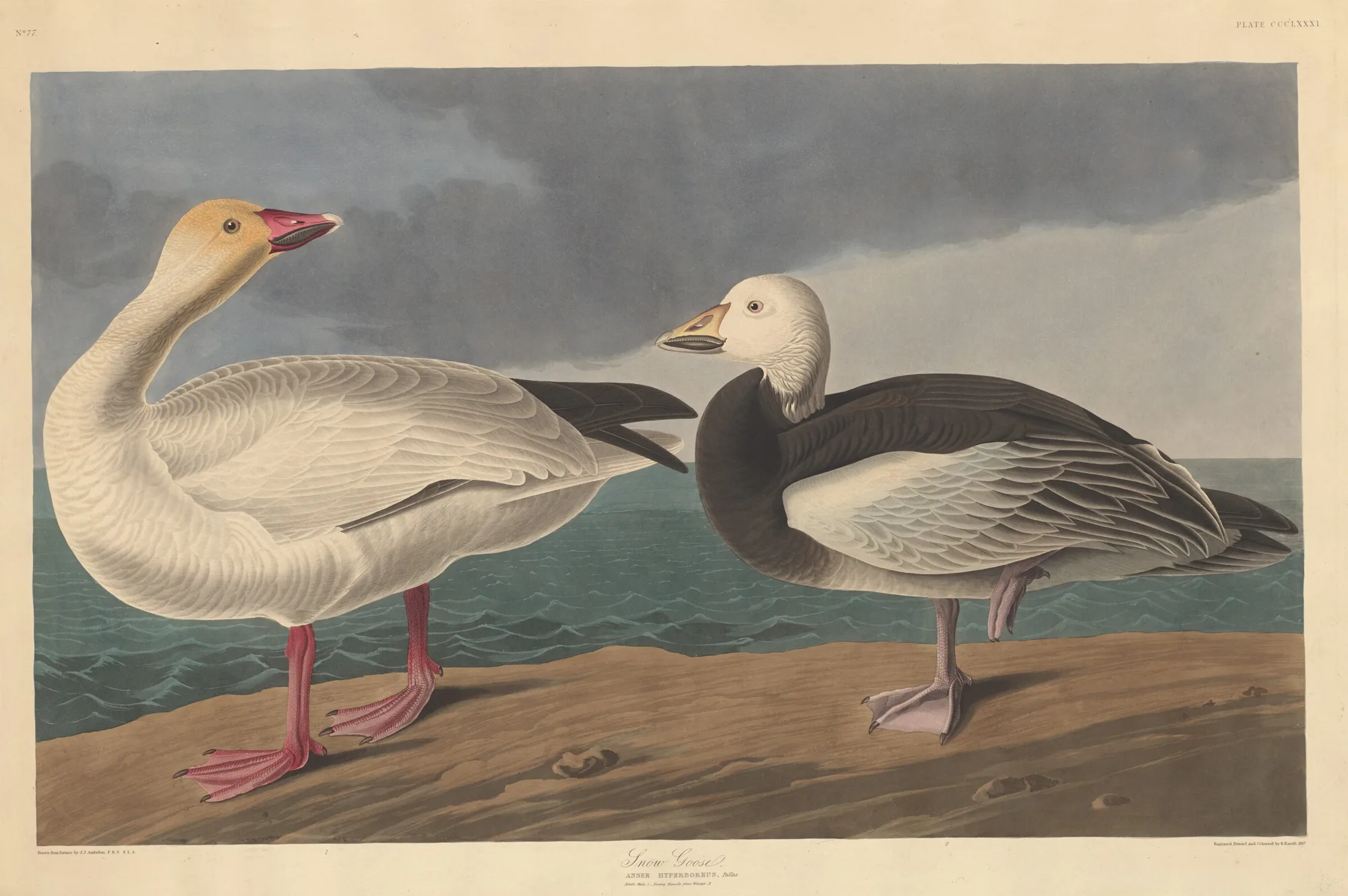
Audubon's “Snow Goose”, The Birds of America, plate CCCLXXXI
Click or press Enter to enlarge
Open the full-resolution image (5432 px, National Gallery of Art)
| Plate | 381 (CCCLXXXI) |
|---|---|
| Audubon's name | Snow Goose |
| Modern name | Snow Goose |
| Scientific name | Anser caerulescens |
| Status | Least Concern |
| Engraved by | Robert Havell, after Audubon's watercolor |
| Date | 1837 |
| Medium | Hand-colored engraving and aquatint on Whatman wove paper |
| Collections | Ducks, Geese and Swans |
| This impression | National Gallery of Art, Washington, 1945.8.381; Gift of Mrs. Walter B. James |
About this plate
Plate 381 shows two Snow Geese: an adult male, pure white with black wingtips and a pink bill with a black grin patch, and a young female in dusky grey first-winter plumage.
Audubon used Bonaparte's name Anser hyperboreus. The species is now Anser caerulescens. For a time it was placed in a separate genus, Chen. The Blue Goose, a dark form, was long treated as a separate species but is now known to be a colour morph of the Snow Goose.
Snow Geese breed in colonies on Arctic tundra from Siberia to Greenland and winter in huge flocks in farm fields and marshes of the United States and Mexico. They were scarce in the early twentieth century. Numbers have since exploded, helped by waste grain on farmland, and in places they now damage their Arctic breeding grounds. The species is listed as Least Concern.
Audubon watched Snow Geese arrive at the ponds near Henderson, Kentucky, each autumn. He noted that the grey young came about two weeks before the white adults and that the two age groups kept apart in separate flocks all winter. He found it in Texas and heard from Townsend that it was abundant on the Columbia. In Louisiana he saw it feeding on the prairies of the Attakapas and Opelousas.
In Audubon's words
While residing at Henderson on the Ohio, I never failed to watch the arrival of this and other species in the ponds of the neighbourhood, and generally found the young Snow Geese to make their appearance in the beginning of October, and the adult or white birds about a fortnight later. In like manner, when migrating northward, although the young and the adult birds set out at the same time, they travel in separate flocks, and, according to Captain Sir George Back, continue to do so even when proceeding to the higher northern latitudes of our continent. It is not less curious that, during the whole of the winter, these Geese remain equally divided, even if found in the same localities; and although young and old are often seen to repose on the same sand-bar, the flocks keep at as great a distance as possible.
John James Audubon, Ornithological Biography, vol. 4 (1838), “Snow Goose”. Read the full chapter.