Sharp-tailed Grouse (Plate 382)
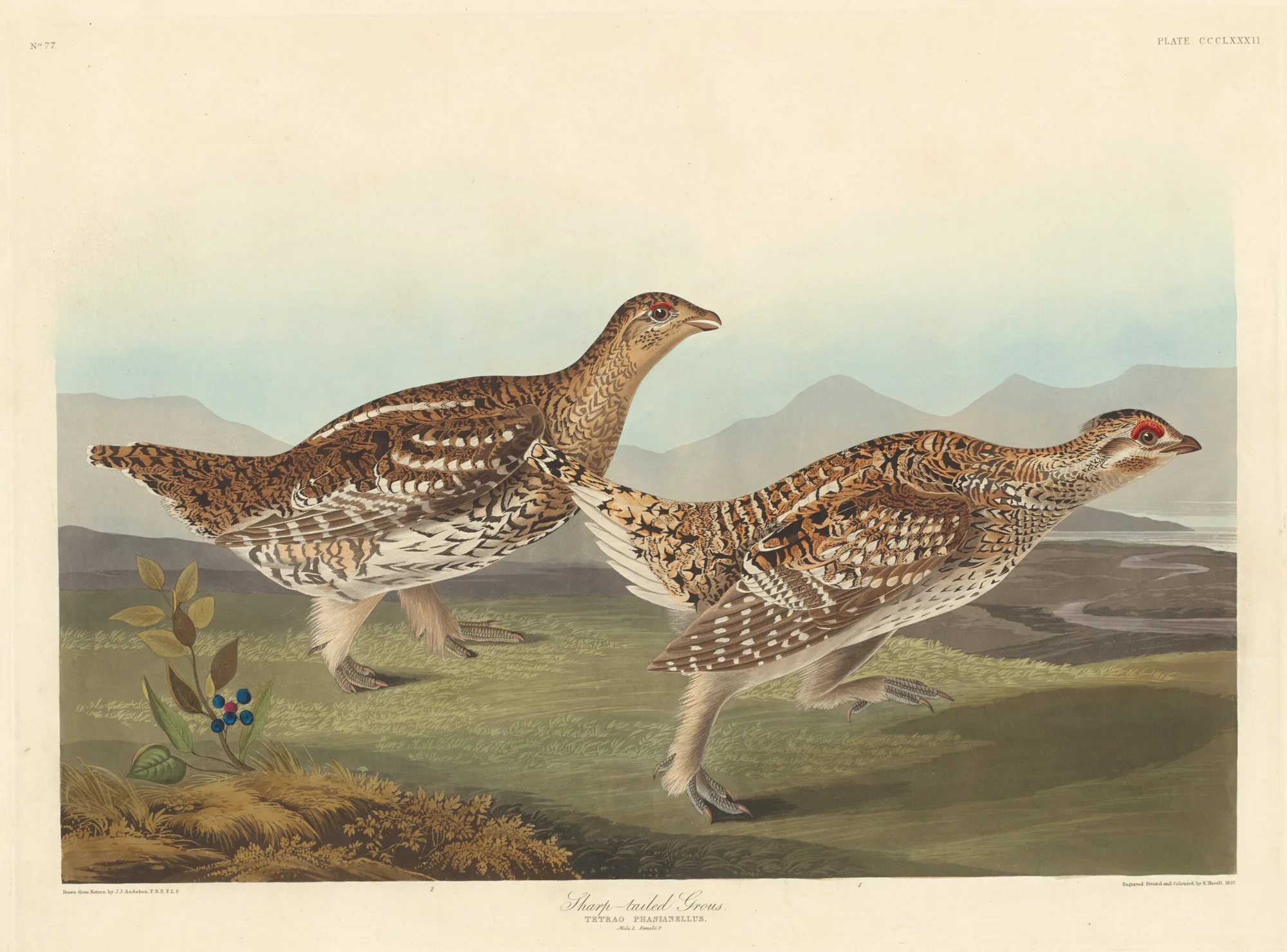
Audubon's “Sharp-tailed Grous”, The Birds of America, plate CCCLXXXII
Click or press Enter to enlarge
Open the full-resolution image (4185 px, National Gallery of Art)
| Plate | 382 (CCCLXXXII) |
|---|---|
| Audubon's name | Sharp-tailed Grous |
| Modern name | Sharp-tailed Grouse |
| Scientific name | Tympanuchus phasianellus |
| Status | Least Concern |
| Engraved by | Robert Havell, after Audubon's watercolor |
| Date | 1837 |
| Medium | Hand-colored engraving and aquatint on Whatman wove paper |
| Collections | Turkeys, Grouse and Game Birds |
| This impression | National Gallery of Art, Washington, 1945.8.382; Gift of Mrs. Walter B. James |
About this plate
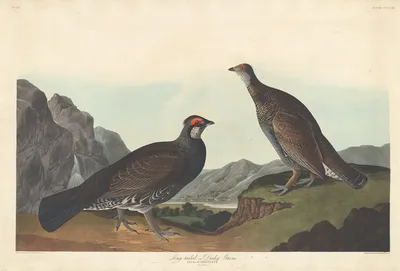
Plate 382 shows a male and a female Sharp-tailed Grouse. Both are pale, mottled brown and white grouse with V-shaped markings on the breast and a short, pointed tail with white outer feathers. The male has a yellow comb over the eye and a purplish neck patch that he inflates in display.
Linnaeus named it Tetrao phasianellus, and Audubon used that name. It is now Tympanuchus phasianellus, in the same genus as the prairie-chickens. Hybrids between Sharp-tailed Grouse and Greater Prairie-Chickens occur where their ranges meet.
Sharp-tailed Grouse live in grassland, sagebrush and brushy openings across the northern Great Plains, the Canadian prairies and into Alaska. In spring males gather at dancing grounds, where they stamp their feet rapidly, rattle their tails and circle each other. Several subspecies have declined sharply, but the species as a whole is listed as Least Concern.
Audubon wrote that he knew nothing of the bird's habits from his own experience. He quoted Richardson's description of the dances in the Fur Countries, where birds ran in circles on a trampled patch every morning for a month or more.
In Audubon's words
Early in spring, a family of these birds select a level spot, whereon they meet every morning, and run round in a circle of fifteen or twenty feet in diameter, so that the grass is worn quite bare. When any one approaches the circle, the birds squat close to the ground, but in a short time stretch out their necks to survey the intruder; and, if they are not scared by a nearer advance, soon resume their circular course, some running to the right, others to the left, meeting and crossing each other. These “Partridge dances” last for a month or more, or until the hens begin to hatch.
John James Audubon, Ornithological Biography, vol. 4 (1838), “Sharp-tailed Grous”. Read the full chapter.