Glossy Ibis (Plate 387)
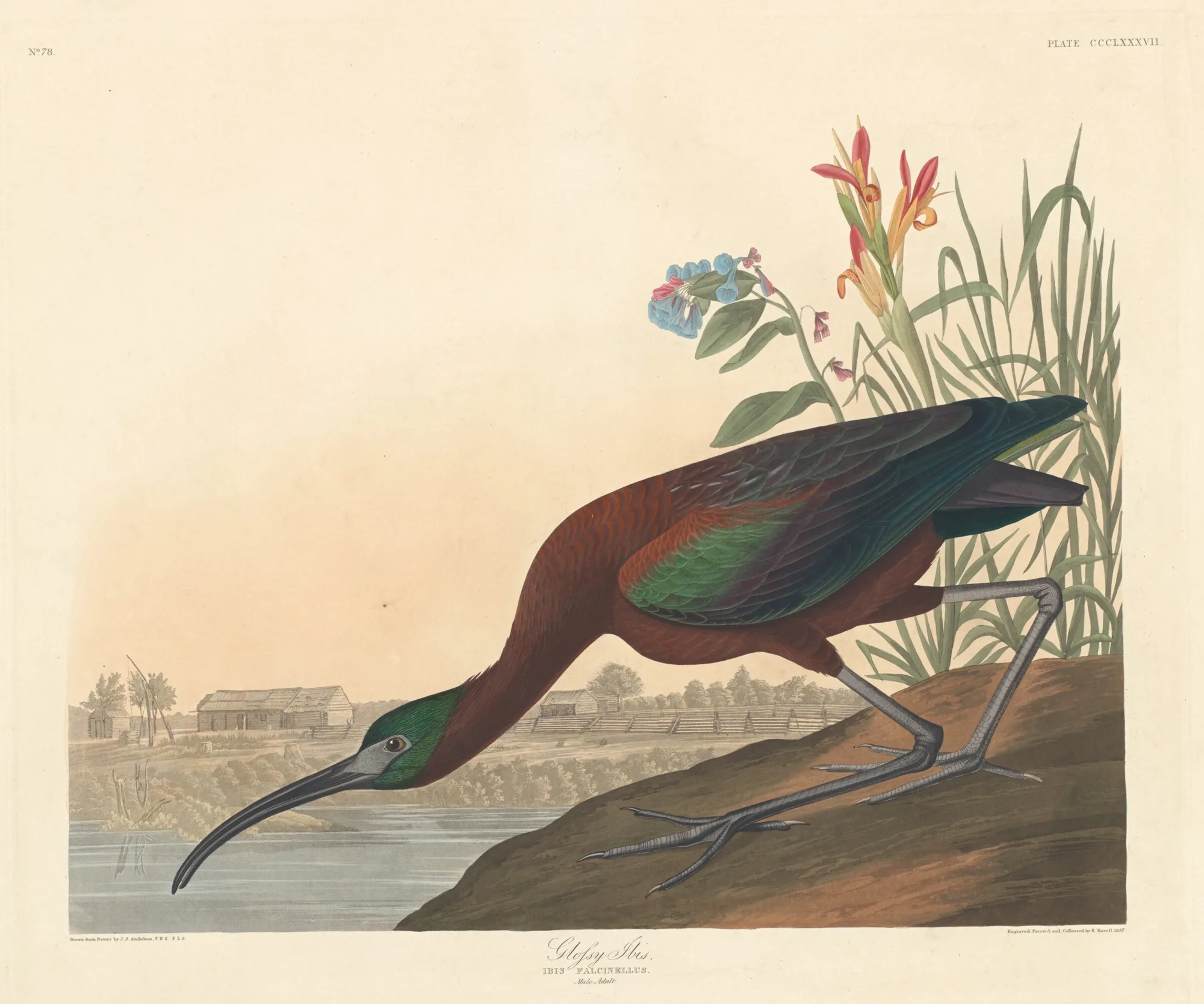
Audubon's “Glossy Ibis”, The Birds of America, plate CCCLXXXVII
Click or press Enter to enlarge
Open the full-resolution image (3732 px, National Gallery of Art)
| Plate | 387 (CCCLXXXVII) |
|---|---|
| Audubon's name | Glossy Ibis |
| Modern name | Glossy Ibis |
| Scientific name | Plegadis falcinellus |
| Status | Least Concern |
| Engraved by | Robert Havell, after Audubon's watercolor |
| Date | 1837 |
| Medium | Hand-colored engraving and aquatint on Whatman wove paper |
| Plants and setting | A wood-cutter's cabin in a Florida landscape in the background. |
| Collections | Florida and Wading Birds |
| This impression | National Gallery of Art, Washington, 1945.8.387; Gift of Mrs. Walter B. James |
About this plate
Plate 387 shows one male Glossy Ibis in high breeding plumage, its chestnut body and green-glossed wings set against a Florida landscape. Audubon says the bird was procured in Florida near a wood-cutter's cabin, and he included a view of that cabin in the background.
The species has kept its name and is now Plegadis falcinellus. Audubon defended the identity of American and Old World birds. He had compared American specimens with others from Europe, India and Mexico and found no difference, so he refused the Prince of Musignano's new name Ibis Ordii. Modern taxonomy agrees with him: the same species breeds in southern Europe, Africa, Asia, Australia and the Americas.
In Audubon's day the Glossy Ibis was a rare wanderer in the United States. He tells how George Ord first reported it from a specimen shot at Great Egg Harbor, New Jersey, in May 1817. Since the mid-1900s it has spread along the Atlantic coast and now breeds from Florida to Maine. It feeds by probing mud in marshes and rice fields and is listed as Least Concern.
Audubon saw flocks in Texas in the spring of 1837, feeding with White Ibises along grassy riverbanks and bayous. He notes that he had no chance to find its nests there and could only guess that it bred in mixed colonies like the White Ibis.
In Audubon's words
The Glossy Ibis is of exceedingly rare occurrence in the United States, where it appears only at long and irregular intervals, like a wanderer who has lost his way. It exists in Mexico, however, in vast numbers. In the spring of 1837, I saw flocks of it in the Texas; but even there it is merely a summer resident, associating with the White Ibis, along the grassy margins of the rivers and bayous, and apparently going to and returning from its roosting places in the interior of the country. Its flight resembles that of its companion, the White Ibis, and it is probable that it feeds on the same kinds of crustaceous animals, and breeds on low bushes in the same great associations as that species, but we unfortunately had no opportunity of verifying this conjecture.
John James Audubon, Ornithological Biography, vol. 4 (1838), “Glossy Ibis”. Read the full chapter.