Tricolored Blackbird, Yellow-headed Blackbird and Bullock's Oriole (Plate 388)
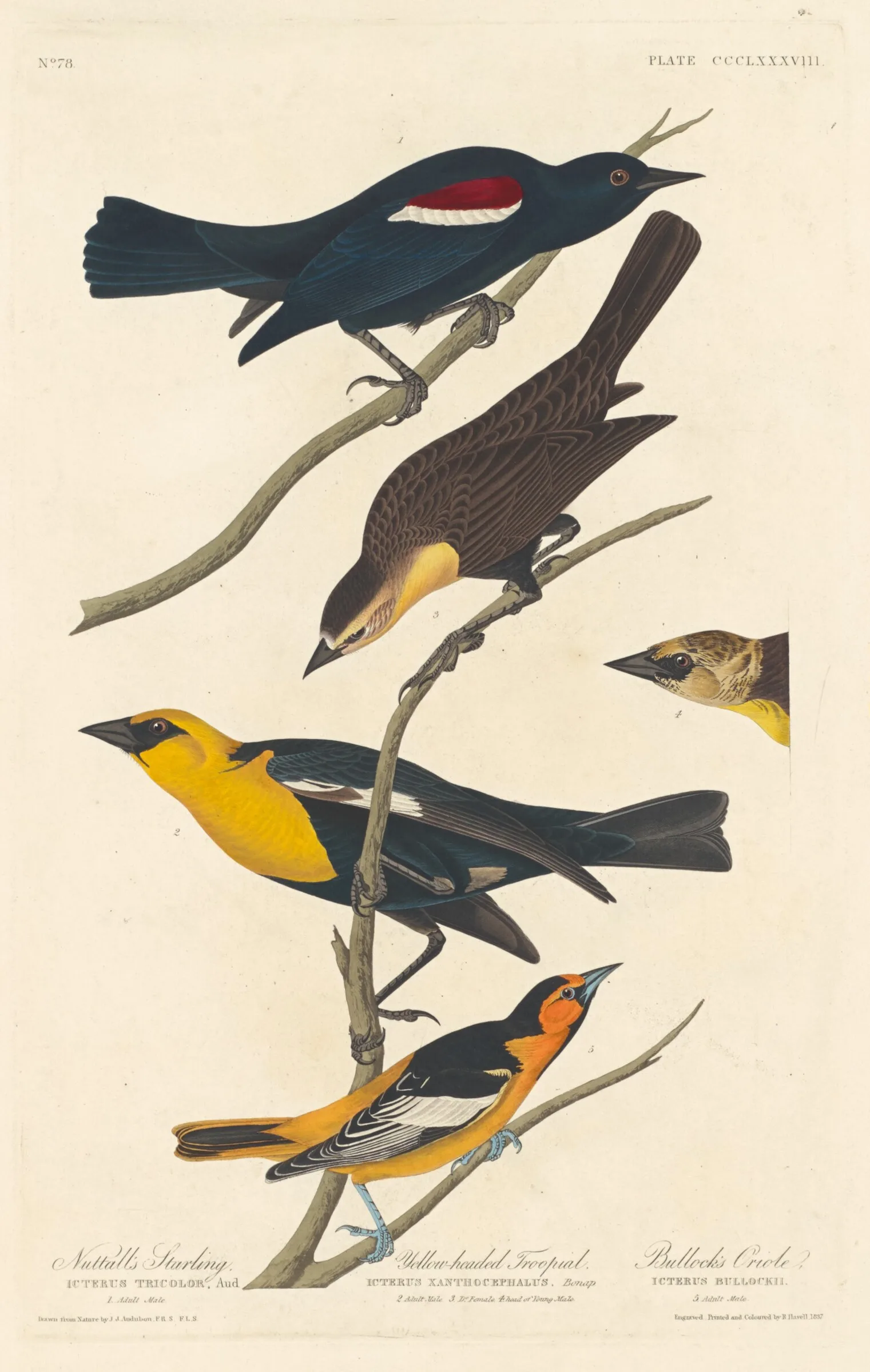
Audubon's “Nuttall's Starling, Yellow-headed Troopial and Bullock's Oriole”, The Birds of America, plate CCCLXXXVIII
Click or press Enter to enlarge
Open the full-resolution image (2876 px, National Gallery of Art)
| Plate | 388 (CCCLXXXVIII) |
|---|---|
| Audubon's name | Nuttall's Starling, Yellow-headed Troopial and Bullock's Oriole |
| Modern names | Tricolored Blackbird, Yellow-headed Blackbird, Bullock's Oriole |
| Scientific names | Agelaius tricolor, Xanthocephalus xanthocephalus, Icterus bullockii |
| Status | Endangered, Least Concern |
| Engraved by | Robert Havell, after Audubon's watercolor |
| Date | 1837 |
| Medium | Hand-colored engraving and aquatint on Whatman wove paper |
| Collections | Songbirds |
| This impression | National Gallery of Art, Washington, 1945.8.388; Gift of Mrs. Walter B. James |
About this plate
Plate 388 puts three western icterids on one sheet. Audubon shows a male Tricolored Blackbird, a male and female Yellow-headed Blackbird with the head of a young male, and a male Bullock's Oriole. All were drawn from skins sent by Thomas Nuttall and John Kirk Townsend after their 1834 journey across the Rocky Mountains, not from living birds.
Audubon's Nuttall's Starling, or Red-and-white-winged Troopial, is the Tricolored Blackbird, Agelaius tricolor. Nuttall found it near Santa Barbara in Upper California and sent Audubon the specimen. Its red shoulder patch has a white lower border, where the Red-winged Blackbird's is edged with yellow.
The Tricolored Blackbird is almost confined to California, where it nests in dense colonies that can hold tens of thousands of pairs. Many colonies now settle in grain fields that are harvested before the young can fly, and the species has declined sharply. The IUCN lists it as Endangered. The Yellow-headed Blackbird breeds in cattail marshes of the western and central interior, and Bullock's Oriole replaces the Baltimore Oriole across most of the West. Both are common.
The chapter opens with Audubon imagining Nuttall and Townsend crossing the Rockies, then quotes their field notes. Nuttall saw Yellow-headed Blackbirds digging for grubs at the Kansa agency in May and found a nest by a marsh on the Platte in June. He also watched Bullock's Orioles building beyond Laramie's Fork.
Birds on this plate
- Tricolored Blackbird Agelaius tricolor: Audubon's Nuttall's Starling (Red-and-white-winged Troopial) (male). Endangered
- Yellow-headed Blackbird Xanthocephalus xanthocephalus: Audubon's Yellow-headed Troopial (male, female and head of a young male). Least Concern
- Bullock's Oriole Icterus bullockii (male). Least Concern
In Audubon's words
How delightful, I have often exclaimed, must have been the feelings of those enthusiastic naturalists, my friends Nuttall and Townsend, while traversing the ridges of the Rocky Mountains! How grand and impressive the scenery presented to their admiring gaze, when from an elevated station they saw the mountain torrent hurling its foamy waters over the black crags of the rugged ravine, while on wide-spread wings the Great Vulture sailed overhead watching the departure of the travellers, that he might feast on the salmon, which in striving to ascend the cataract had been thrown on the stony beach!
John James Audubon, Ornithological Biography, vol. 5 (1839), “Red-and-White-Winged Troopial”. Read the full chapter.



