American Flamingo (Plate 431)
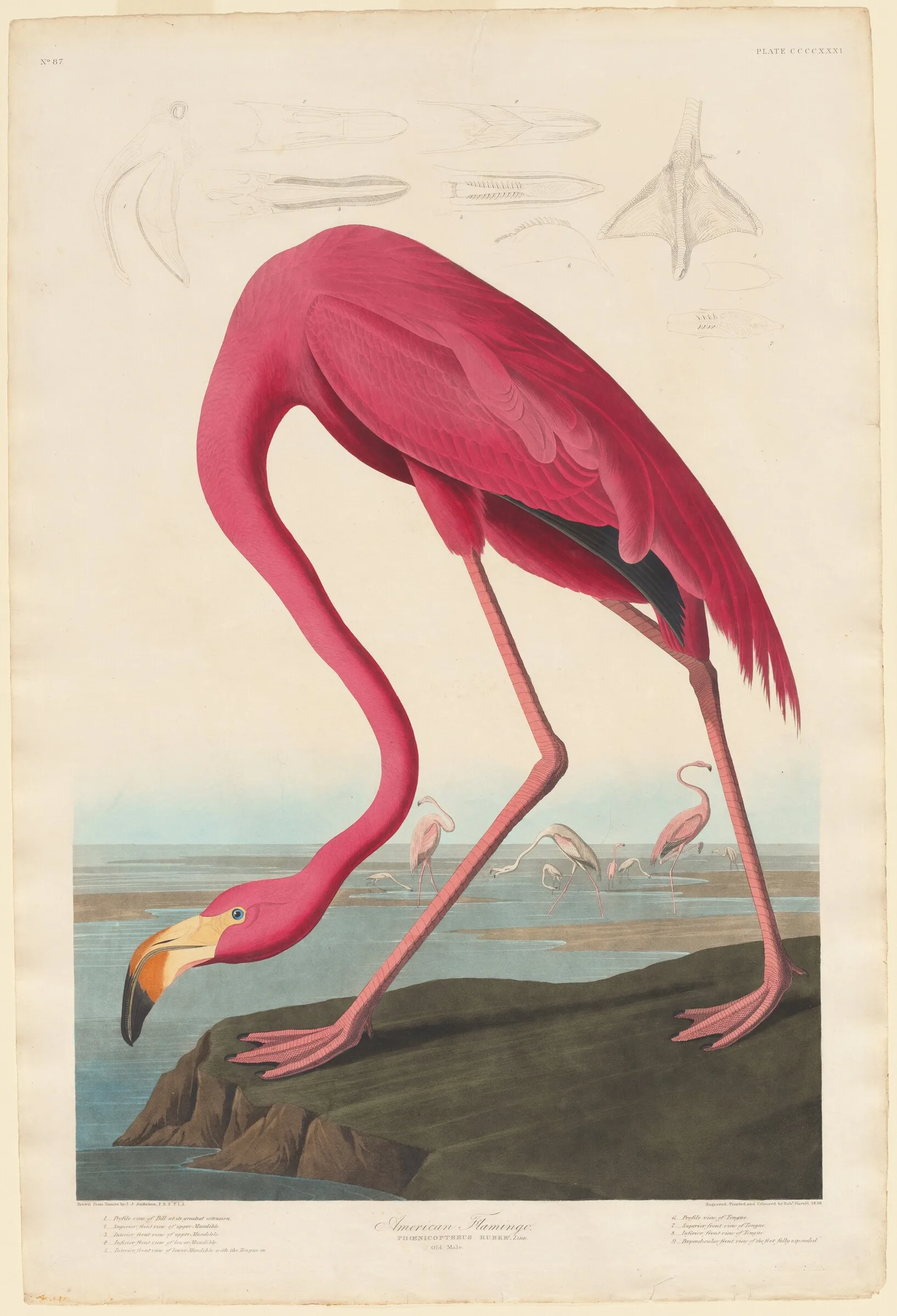
Audubon's “American Flamingo”, The Birds of America, plate CDXXXI
Click or press Enter to enlarge
Open the full-resolution image (7486 px, National Gallery of Art)
| Plate | 431 (CDXXXI) |
|---|---|
| Audubon's name | American Flamingo |
| Modern name | American Flamingo |
| Scientific name | Phoenicopterus ruber |
| Status | Least Concern |
| Engraved by | Robert Havell, after Audubon's watercolor |
| Date | 1838 |
| Medium | Hand-colored engraving and aquatint on Whatman wove paper |
| Size | image: 87.63 × 58.58 cm (34 1/2 × 23 1/16 in.) plate: 97 x 65 cm (38 3/16 x 25 9/16 in.) sheet: 101.3 x 68.3 cm (39 7/8 x 26 7/8 in.) |
| Plants and setting | Shallow coastal water with a distant flock of flamingos feeding in the background |
| Collections | Florida and Wading Birds |
| This impression | National Gallery of Art, Washington, 1945.8.431; Gift of Mrs. Walter B. James |
About this plate
Plate 431 shows a single adult male American Flamingo, deep pink-red with black flight feathers. To fit the life-size bird on the double elephant sheet, Audubon bent its long neck down until the head nearly touches the ground. The pose has made it one of the best known images in The Birds of America. A small flock of flamingos feeds in the shallows behind it.
The species is the American or Caribbean Flamingo, Phoenicopterus ruber, the reddest of the world's flamingos. It was long treated as one species with the Greater Flamingo of the Old World and has been separated again. Its colour comes from carotenoid pigments in the shrimp and algae it filters from salty water, feeding with its head upside down.
Flamingos breed in large colonies in the Caribbean, the Yucatán, the Galápagos and northern South America, and build mud-mound nests. In Audubon's time flocks visited the Florida Keys and Florida Bay. Hunting for plumes and food made them rare there, and for much of the 1900s Florida birds were treated as strays or escapes. Recent studies have accepted a small native presence. The species is listed as Least Concern.
Audubon first saw flamingos on 7 May 1832, sailing from Indian Key: a flock in 'Indian line' that veered away before his pilot could fire. He admits that in all his time in Florida he never shot one. His text collects reports from Key West and Cuba on their nests and young.
In Audubon's words
On the 7th of May 1832, while sailing from Indian Key, one of the numerous islets that skirt the south-eastern coast of the Peninsula of Florida, I for the first time saw a flock of Flamingoes. It was on the afternoon of one of those sultry days which, in that portion of the country, exhibit towards evening the most glorious effulgence that can be conceived. The sun, now far advanced toward the horizon, still shone with full splendour, the ocean around glittered in its quiet beauty, and the light fleecy clouds that here and there spotted the heavens, seemed flakes of snow margined with gold. Our bark was propelled almost as if by magic, for scarcely was a ripple raised by her bows as we moved in silence. Far away to seaward we spied a flock of Flamingoes advancing in "Indian line," with well-spread wings, outstretched necks, and long legs directed backwards.
John James Audubon, Ornithological Biography, vol. 5 (1839), “American Flamingo”. Read the full chapter.
American Flamingo (Plate 431): the story behind one of the most famous plates in the collection →