Scarlet Ibis (Plate 397)
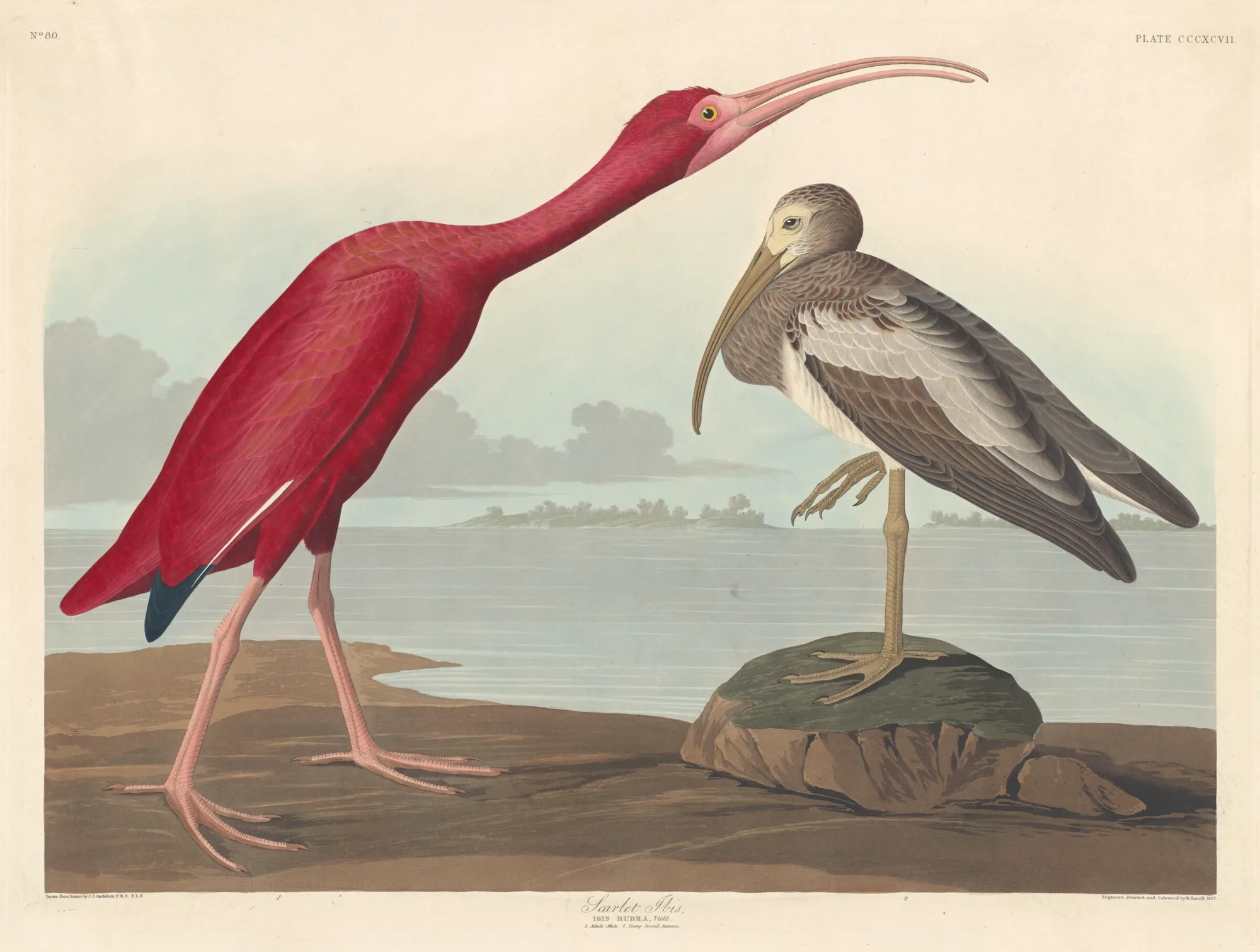
Audubon's “Scarlet Ibis”, The Birds of America, plate CCCXCVII
Click or press Enter to enlarge
Open the full-resolution image (4171 px, National Gallery of Art)
| Plate | 397 (CCCXCVII) |
|---|---|
| Audubon's name | Scarlet Ibis |
| Modern name | Scarlet Ibis |
| Scientific name | Eudocimus ruber |
| Status | Least Concern |
| Engraved by | Robert Havell, after Audubon's watercolor |
| Date | 1837 |
| Medium | Hand-colored engraving and aquatint on Whatman wove paper |
| Collections | Florida and Wading Birds |
| This impression | National Gallery of Art, Washington, 1945.8.397; Gift of Mrs. Walter B. James |
About this plate
Plate 397 shows an adult male Scarlet Ibis in full red plumage with black wingtips, and a young bird in brown and white. Audubon says both drawings were made from specimens obtained outside the United States, since he never had one in hand at home.
The bird keeps its name, Scarlet Ibis, and is now placed in Eudocimus with the White Ibis. The two are so closely related that they hybridize where they meet. Some authorities have treated them as one species. Its red colour comes from carotenoid pigments in the crabs and shrimp it eats.
The Scarlet Ibis lives in mangroves and coastal mudflats of northern South America and Trinidad, where it is a national bird. In the United States it is only a rare stray, and some sightings involve escaped captive birds. The species is listed as Least Concern.
Audubon admitted the bird to his fauna on slender grounds. He saw three flying in a line over the trees at Bayou Sara, Louisiana, on 3 July 1821, and judged them to be this species from that brief view. He corrected Wilson's belief that it was fairly common in the South, saying he found it scarcer even than the Glossy Ibis.
In Audubon's words
It was supposed by Wilson, and since his time by others, that this brilliantly coloured Ibis is not uncommon in the southern parts of the United States. This opinion however is quite erroneous, and I have found the Scarlet Ibis less numerous than even the Glossy Ibis; indeed I have not met with more than three individuals in a state of liberty, in the whole range of the United States. These birds occurred at Bayou Sara, in Louisiana, on the 3d of July 1821. They were travelling in a line, in the manner of the White Ibis, above the tops of the trees. Although I had only a glimpse of them, I saw them sufficiently well to be assured of their belonging to the present species, and therefore I have thought it proper to introduce it into our Fauna.
John James Audubon, Ornithological Biography, vol. 5 (1839), “Scarlet Ibis”. Read the full chapter.