Great Egret (Plate 386)
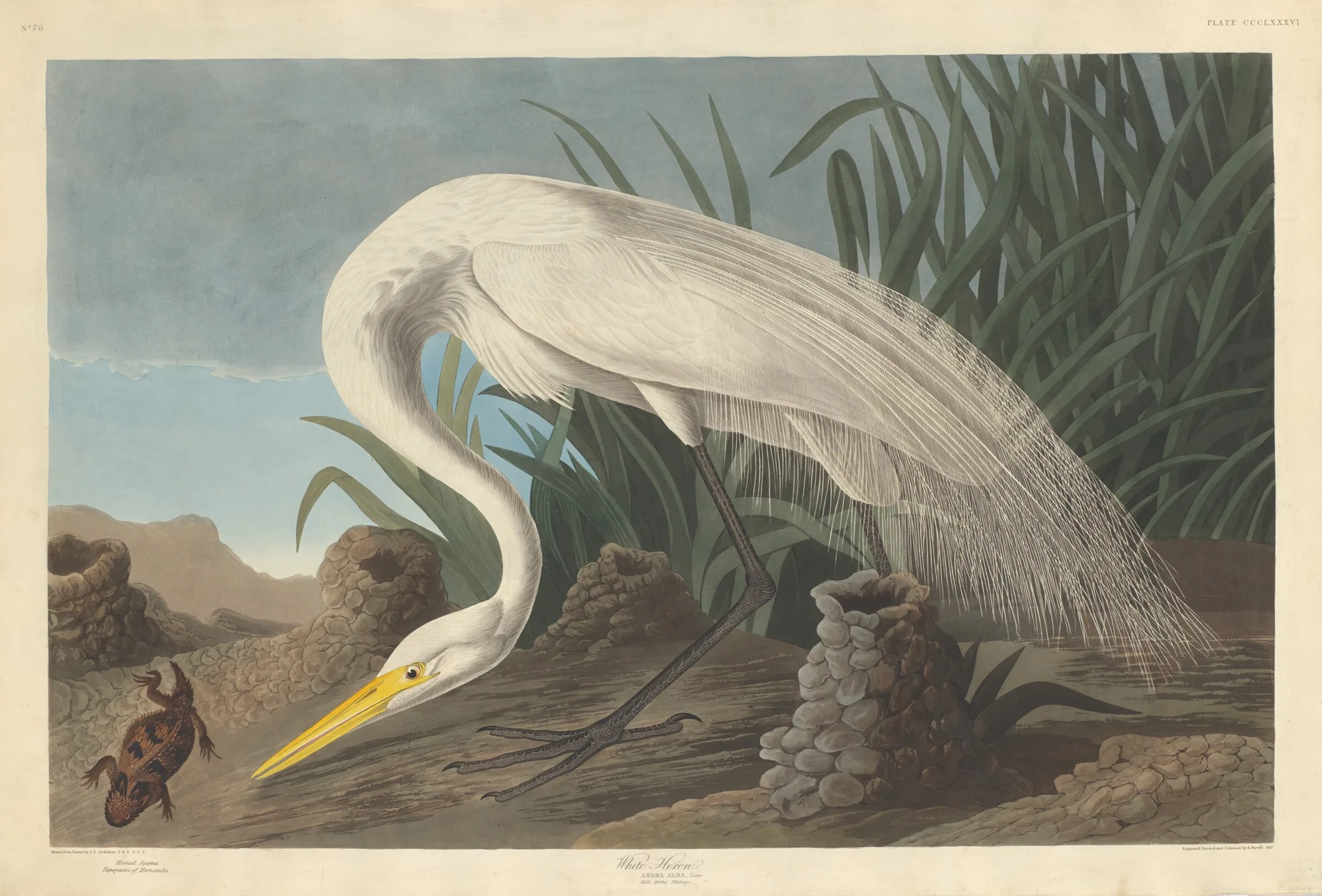
Audubon's “White Heron”, The Birds of America, plate CCCLXXXVI
Click or press Enter to enlarge
Open the full-resolution image (5382 px, National Gallery of Art)
| Plate | 386 (CCCLXXXVI) |
|---|---|
| Audubon's name | White Heron |
| Modern name | Great Egret |
| Scientific name | Ardea alba |
| Status | Least Concern |
| Engraved by | Robert Havell, after Audubon's watercolor |
| Date | 1837 |
| Medium | Hand-colored engraving and aquatint on Whatman wove paper |
| Plants and setting | No plant; a horned lizard (the Tapayaxin, Phrynosoma) is shown with the egret. |
| Collections | Herons and Egrets, Florida and Wading Birds |
| This impression | National Gallery of Art, Washington, 1945.8.386; Gift of Mrs. Walter B. James |
About this plate
Plate 386 shows a single male Great Egret in full breeding dress, the long lacy train of back plumes falling past its tail. A horned lizard shares the sheet. Audubon identified it as the Tapayaxin of Hernandez (Phrynosoma orbiculare) and drew it from a specimen that Thomas Nuttall had found in California and given to Dr Richard Harlan, who lent it to Audubon.
Audubon called the bird the Great American Egret, Ardea egretta, in the Ornithological Biography, but engraved it as the White Heron. It is the bird now called the Great Egret, Ardea alba, a species found on every continent except Antarctica. It should not be confused with his Great White Heron of plate 281, a white form of the Great Blue Heron.
The plumes shown here nearly ended the species. Through the late 1800s egrets were shot at their nesting colonies for the millinery trade, and protest over the killing helped launch the early Audubon societies. The Great Egret later became the emblem of the National Audubon Society. It is now common and listed as Least Concern.
Audubon knew the bird in Florida, Georgia and South Carolina, and met it again on the Texas coast and around Galveston Island in the spring of 1837. Near John Bulow's plantation in East Florida he hid within a hundred yards of a courtship gathering and watched the males swell their throats and raise their plumes for most of a day.
In Audubon's words
Near the plantation of John Bulow, Esq. in East Florida, I had the pleasure of witnessing this sort of tournament or dress-ball from a place of concealment not more than a hundred yards distant. The males, in strutting round the females, swelled their throats, as Cormorants do at times, emitted gurgling sounds, and raising their long plumes almost erect, paced majestically before the fair ones of their choice. Although these snowy beaux were a good deal irritated by jealousy, and conflicts now and then took place, the whole time I remained, much less fighting was exhibited than I had expected from what I had already seen in the case of the Great Blue Heron, Ardea Herodias. These meetings took place about ten o'clock in the morning, or after they had all enjoyed a good breakfast, and continued until nearly three in the afternoon, when, separating into flocks of eight or ten individuals, they flew off to search for food.
John James Audubon, Ornithological Biography, vol. 4 (1838), “Great American Egret”. Read the full chapter.