Brant (Plate 391)
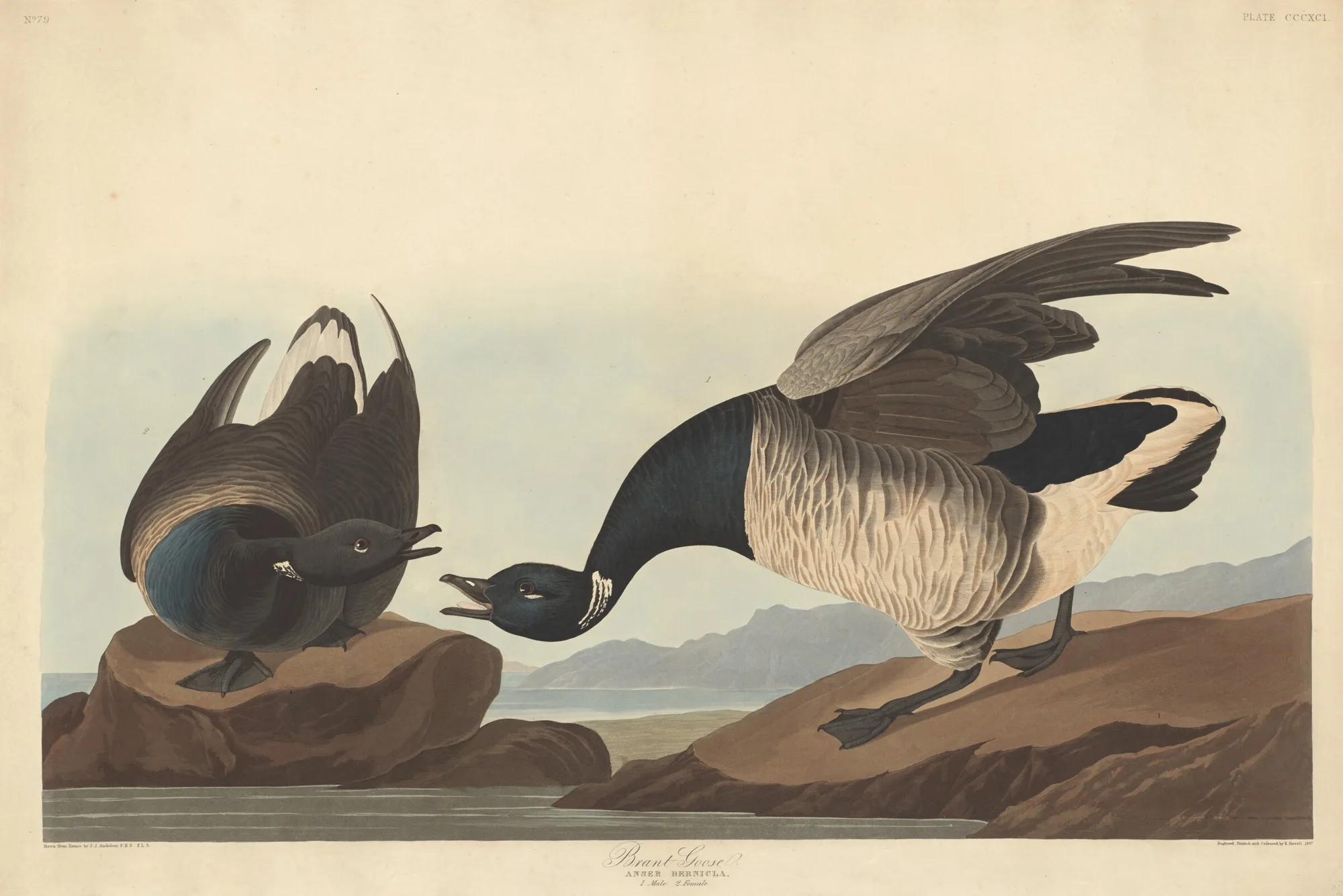
Audubon's “Brant Goose”, The Birds of America, plate CCCXCI
Click or press Enter to enlarge
Open the full-resolution image (5327 px, National Gallery of Art)
| Plate | 391 (CCCXCI) |
|---|---|
| Audubon's name | Brant Goose |
| Modern name | Brant |
| Scientific name | Branta bernicla |
| Status | Least Concern |
| Engraved by | Robert Havell, after Audubon's watercolor |
| Date | 1837 |
| Medium | Hand-colored engraving and aquatint on Whatman wove paper |
| Collections | Ducks, Geese and Swans |
| This impression | National Gallery of Art, Washington, 1945.8.391; Gift of Mrs. Walter B. James |
About this plate
Plate 391 shows a pair of Brant, a small, dark goose with a black head and neck and a narrow white collar. Audubon says he chose a pair shot in spring, when the birds' movements along the coast were most regular.
Audubon wrote the name as Brent Goose and used Anser bernicla. The bird is now Branta bernicla, in the same genus as the Canada Goose. North America has two main forms: the pale-bellied Atlantic Brant of the East Coast and the dark-bellied Black Brant of the Pacific.
Brant breed on the high Arctic tundra and winter along sea coasts. They depend heavily on eelgrass. When a disease wiped out most Atlantic eelgrass beds in the early 1930s, the Atlantic population crashed. It recovered as the birds learned to eat sea lettuce and to graze coastal lawns and golf courses. The species is listed as Least Concern.
Audubon knew the Brant as a salt-water bird of the Atlantic coast in autumn and winter. He noted that it seldom flies over land and prefers to round capes and headlands. He also says the young birds were as prized by Boston epicures as the Canvasback was in Baltimore. The chapter adds a letter from Thomas McCulloch of Nova Scotia about a wounded Brant that would eat only barley.
In Audubon's words
The flesh of this bird I consider as excellent food. The young in autumn, or about the time of their first appearance on our eastern coast, Massachusetts for example, are tender, juicy, and fat; and are as well known to the epicures of Boston as the more celebrated Canvass-back is to those of Baltimore. Its flight resembles that of our other Geese, being in ordinary circumstances rather slow and sedate. As to its cry, although I have often seen hundreds of individuals at a time, I have not been able to tune my ears so as to liken its cacklings to the sounds produced by "a pack of hounds in full cry," as alleged by Wilson. The Brent Goose is a shy bird, not easily approached; it swims well, and when wounded can dive with great expertness, as I have more than once witnessed.
John James Audubon, Ornithological Biography, vol. 5 (1839), “Brent Goose”. Read the full chapter.