Harris's Hawk (Plate 392)
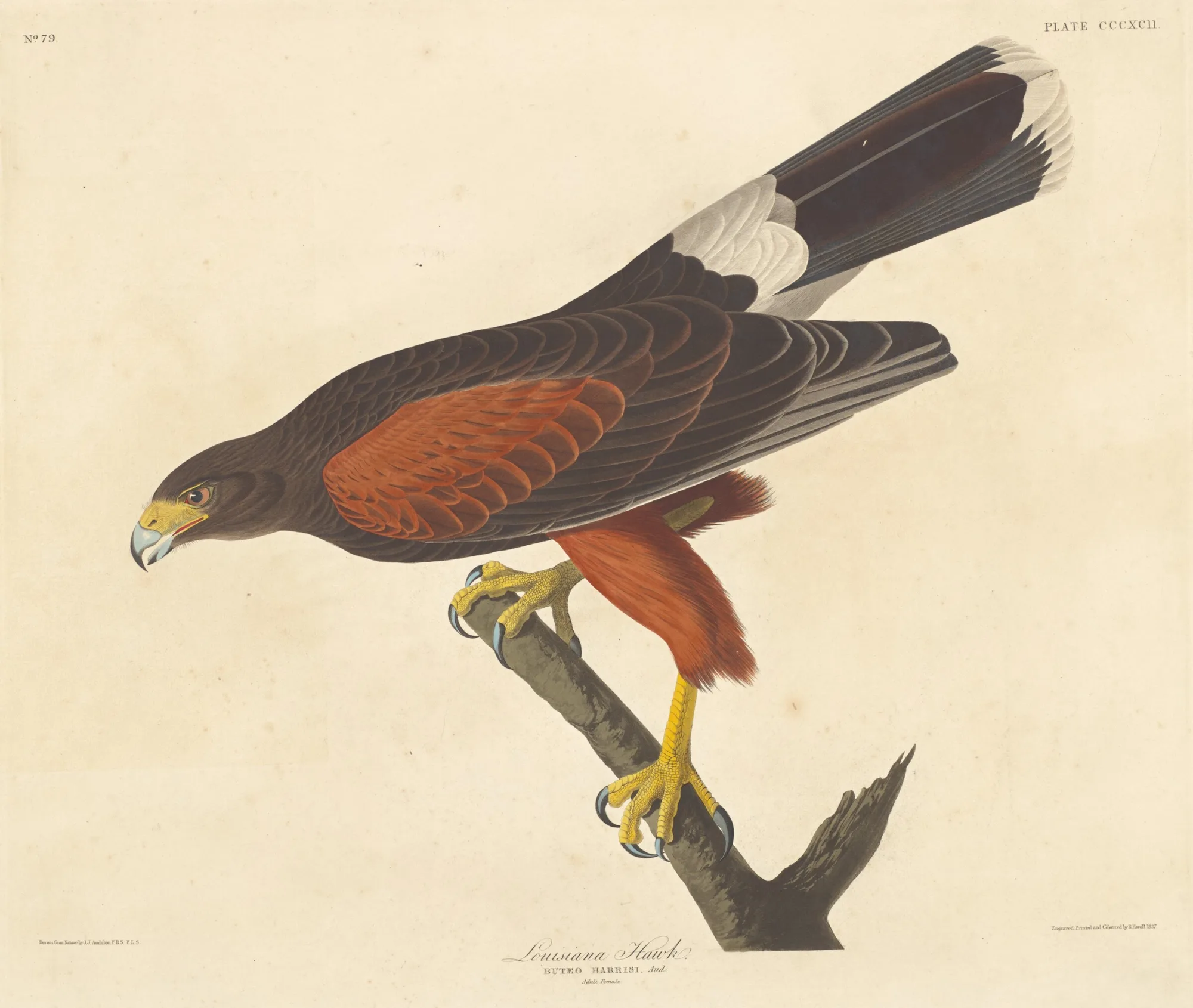
Audubon's “Louisiana Hawk”, The Birds of America, plate CCCXCII
Click or press Enter to enlarge
Open the full-resolution image (3682 px, National Gallery of Art)
| Plate | 392 (CCCXCII) |
|---|---|
| Audubon's name | Louisiana Hawk |
| Modern name | Harris's Hawk |
| Scientific name | Parabuteo unicinctus |
| Status | Least Concern |
| Engraved by | Robert Havell, after Audubon's watercolor |
| Date | 1837 |
| Medium | Hand-colored engraving and aquatint on Whatman wove paper |
| Collections | Hawks, Eagles and Falcons |
| This impression | National Gallery of Art, Washington, 1945.8.392; Gift of Mrs. Walter B. James |
About this plate
Plate 392 shows an adult female Harris's Hawk. It is a dark brown hawk with chestnut shoulders and thighs and a white band at the base and tip of the tail. Audubon drew it from a specimen shot by a gentleman in Louisiana between Bayou Sara and Natchez. A label on the leg identified it as a female.
Audubon engraved it as the Louisiana Hawk but named it Falco harrisi in the text, after his friend and patron Edward Harris. Harris had helped him when he was close to destitute, and he travelled with Audubon to Florida, Texas and later the Missouri River. The species is now Parabuteo unicinctus. Harris's name survives in its English name.
Harris's Hawk lives in the deserts and dry scrub of the southwestern United States, Mexico and South America. It is best known for hunting in family groups, which take turns flushing and chasing rabbits. This cooperative habit and its calm temperament have made it a favourite falconry bird. A record from Louisiana is unusual today. The species is listed as Least Concern.
Most of the chapter is Audubon's essay on the flight of hawks. He argues that speed depends on how fast and how hard a bird moves its wings, not on their length, and he sorts American raptors by their style of flight. He places this species among the 'indolent or heavy-flying' hawks.
In Audubon's words
The species now before you belongs to the group of what may be called indolent or heavy-flying Hawks. The specimen from which I made my drawing, was procured by a gentleman residing in Louisiana, who shot it between Bayou Sara and Natchez. A label attached to one of its legs authorizes me to say that it was a female; but I have received no information respecting its habits; nor can I at present give you the name of the donor, however anxious I am to compliment him upon the valuable addition he has made to our Fauna, by thus enabling me to describe and portray it. I have much pleasure in naming it after my friend Edward Harris, Esq., a gentleman who, independently of the aid which he has on many occasions afforded me, in prosecuting my examination of our birds, merits this compliment as an enthusiastic Ornithologist.
John James Audubon, Ornithological Biography, vol. 5 (1839), “Louisiana Hawk”. Read the full chapter.