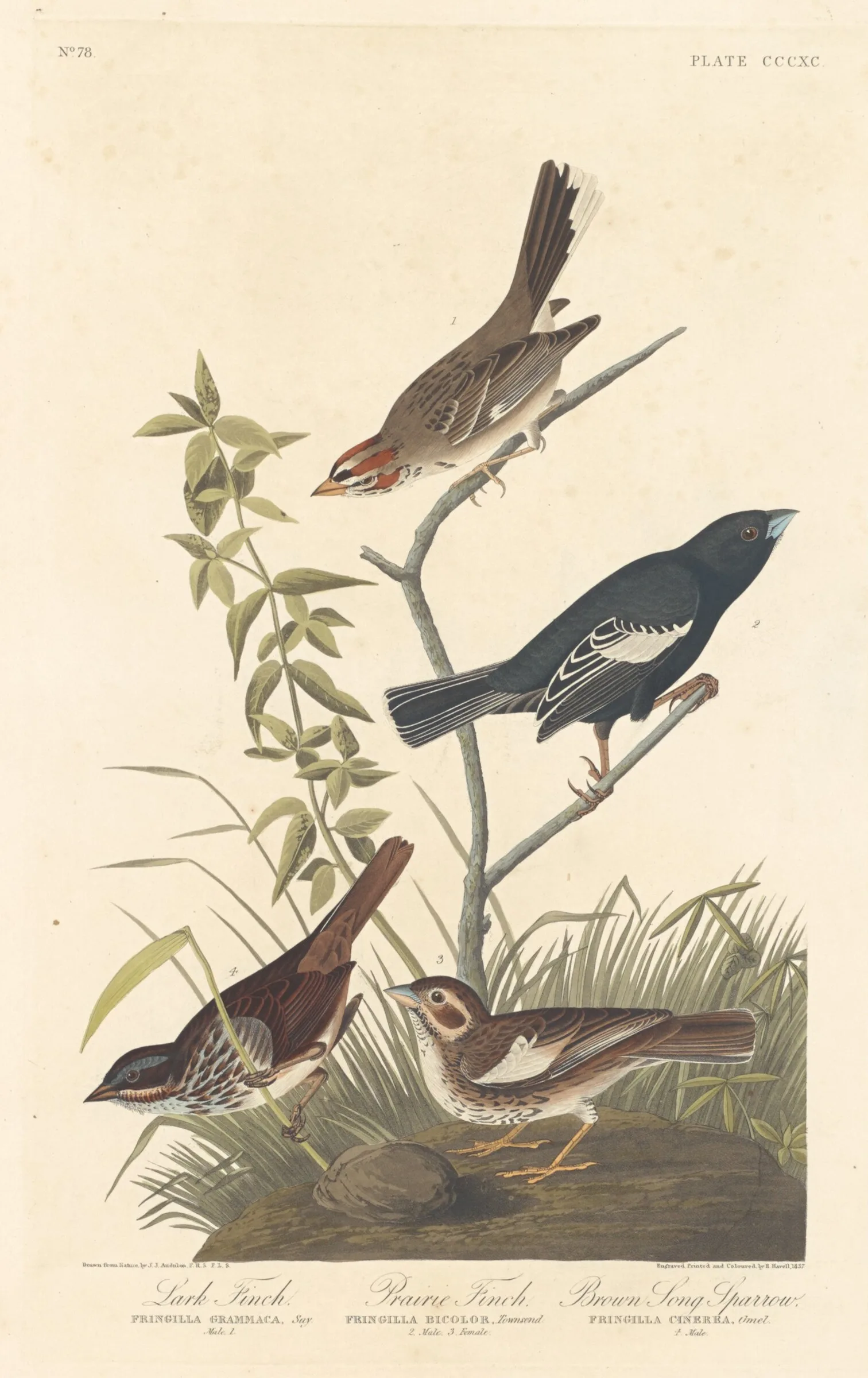
Lark Sparrow, Lark Bunting and Song Sparrow (Plate 390)
Audubon's “Lark Finch, Prairie Finch and Brown Song Sparrow”, The Birds of America, plate CCCXC
Click or press Enter to enlarge
Open the full-resolution image (2835 px, National Gallery of Art)
| Plate | 390 (CCCXC) |
|---|---|
| Audubon's name | Lark Finch, Prairie Finch and Brown Song Sparrow |
| Modern names | Lark Sparrow, Lark Bunting, Song Sparrow (dark Pacific Northwest form) |
| Scientific names | Chondestes grammacus, Calamospiza melanocorys, Melospiza melodia |
| Status | Least Concern |
| Engraved by | Robert Havell, after Audubon's watercolor |
| Date | 1837 |
| Medium | Hand-colored engraving and aquatint on Whatman wove paper |
| Collections | Songbirds |
| This impression | National Gallery of Art, Washington, 1945.8.390; Gift of Mrs. Walter B. James |
About this plate
Plate 390 groups three sparrows of the West. Audubon shows a male Lark Sparrow with its chestnut and white face pattern, a male and female Lark Bunting, and a dark brown Song Sparrow from the Pacific Northwest. He drew them all from skins collected by others.
The Lark Finch is the Lark Sparrow, first collected on Major Long's 1819-20 expedition and named Fringilla grammaca by Thomas Say. The Prairie Finch is the Lark Bunting. Nuttall and Townsend discovered it on the plains of the Platte in 1834, and Townsend named it Fringilla bicolor. Audubon's Brown Song Sparrow, Fringilla cinerea, is not a separate species. It is one of the dark, heavily streaked coastal forms of the Song Sparrow, a bird that varies greatly across its range.
The Lark Bunting breeds on the shortgrass prairie of the Great Plains. In spring the male turns black with large white wing patches and sings while fluttering above the grass. It is the state bird of Colorado. Its numbers have fallen sharply as grassland has been plowed, though the IUCN still lists it as Least Concern.
Townsend described flocks of sixty to a hundred Lark Buntings rising before the caravan, with males hovering overhead to sing. Nuttall heard them soon after crossing the north fork of the Platte on 24 May 1834. He compared the song to a mix of Bobolink and Skylark.
Birds on this plate
- Lark Sparrow Chondestes grammacus: Audubon's Lark Finch (male). Least Concern
- Lark Bunting Calamospiza melanocorys: Audubon's Prairie Finch (male and female). Least Concern
- Song Sparrow (dark Pacific Northwest form) Melospiza melodia: Audubon's Brown Song Sparrow (male). Least Concern
In Audubon's words
As the large flocks, consisting of from sixty to a hundred individuals, were started from the ground by our caravan in passing, the piebald appearance of the males and females promiscuously intermingled, presented a curious, but by no means unpleasing, effect. While the flock is engaged in feeding, the males are frequently observed to rise suddenly to a considerable height in the air, and poising themselves over their companions, with their wings in constant and rapid motion, they become nearly stationary. In this situation they pour forth a number of very lively and sweetly modulated notes, and at the expiration of about a minute descend to the ground, and course about as before. I never observed this bird to the west of the Black Hills.
John James Audubon, Ornithological Biography, vol. 5 (1839), “Prairie Finch”. Read the full chapter.



