Glaucous Gull (Plate 396)
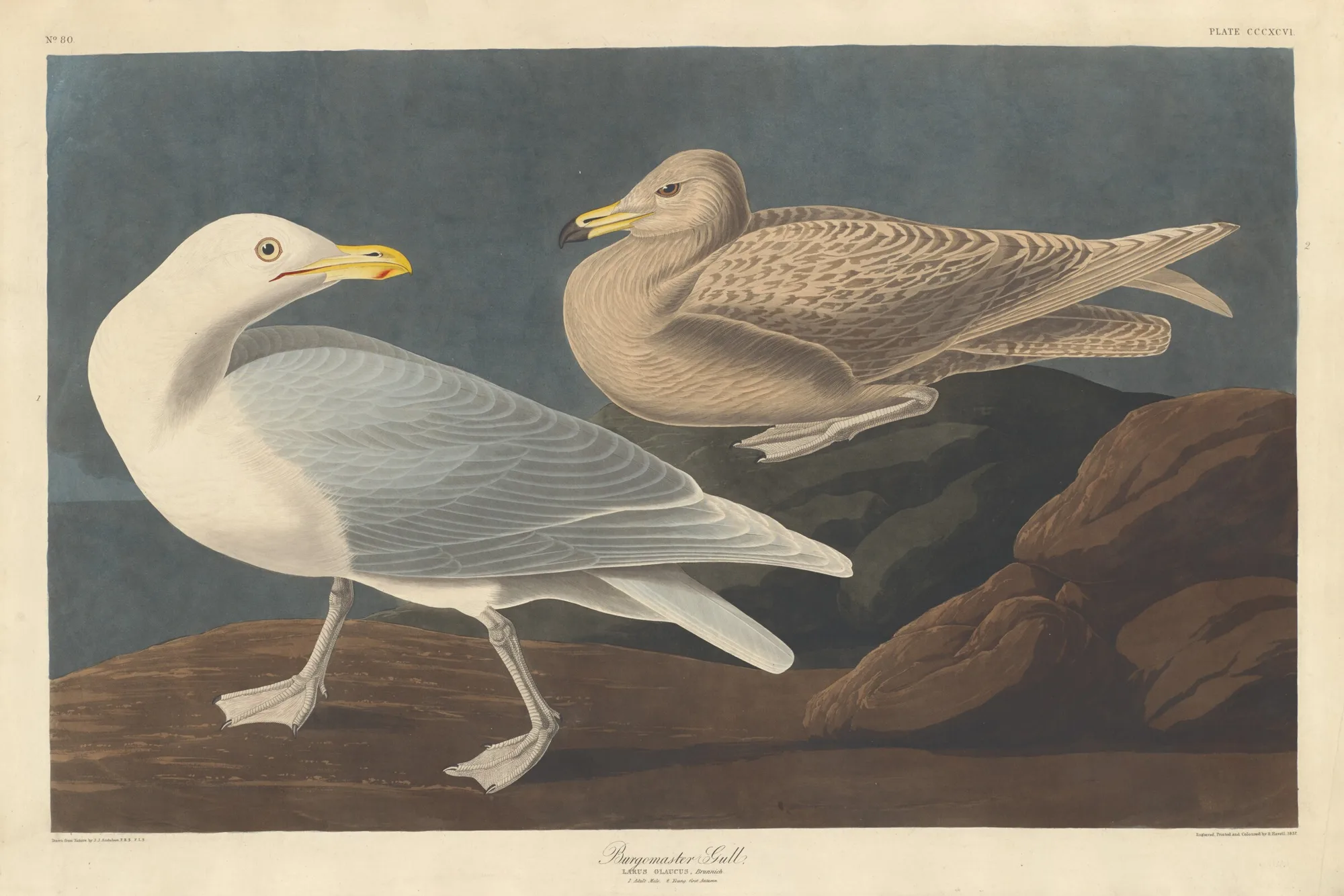
Audubon's “Burgomaster Gull”, The Birds of America, plate CCCXCVI
Click or press Enter to enlarge
Open the full-resolution image (5339 px, National Gallery of Art)
| Plate | 396 (CCCXCVI) |
|---|---|
| Audubon's name | Burgomaster Gull |
| Modern name | Glaucous Gull |
| Scientific name | Larus hyperboreus |
| Status | Least Concern |
| Engraved by | Robert Havell, after Audubon's watercolor |
| Date | 1837 |
| Medium | Hand-colored engraving and aquatint on Whatman wove paper |
| Collections | Seabirds |
| This impression | National Gallery of Art, Washington, 1945.8.396; Gift of Mrs. Walter B. James |
About this plate
Plate 396 shows an adult male Glaucous Gull, pale grey above with pure white wingtips, and a young bird in mottled brown first-year plumage. Audubon says his figures were taken from specimens presented by Captain James Clark Ross of the Royal Navy, the Arctic explorer.
'Burgomaster' is an old Dutch whalers' name for the bird. Audubon used Larus glaucus. It is now Larus hyperboreus. It is one of the two 'white-winged' gulls with no black in the wingtips, the other being the smaller Iceland Gull.
The Glaucous Gull breeds around the Arctic, on sea cliffs and tundra coasts, and winters south along northern coasts and the Great Lakes. It is a powerful predator and scavenger. It takes eggs, chicks and small seabirds as well as fish and carrion. The species is listed as Least Concern.
Audubon met it only on the coast of Labrador in July 1833, where he saw a few pairs but found them too shy to study and failed to find their nests. He doubted reports that it reached Boston and New York, since the birds he was shown there proved to be large Herring Gulls. Richardson's account, quoted in the chapter, tells of one shot on Ross's expedition that disgorged an auk.
In Audubon's words
I found this species on the coast of Labrador in very small numbers, all paired, in the month of July; but our endeavours to discover their nests were unavailing, and their shyness, which surpassed even that of the Great Black-backed Gull, prevented us from seeing much of their habits. I have never met with one on any part of our Atlantic coast, and I am much disposed to believe that those which may retire from the Arctic regions, where they are numerous, follow the north-west shores of America, as is indeed the case with many of the hyperborean birds, they giving an unaccountable preference to that side of the continent. It is true that I have often been told at Boston and New York that the Glaucous Gull had not unfrequently been procured there; but in no instance could I place any reliance upon the report, for when the supposed Glaucous Gull was shown to me, it proved to be merely a large specimen of the Herring Gull, Larus argentatus.
John James Audubon, Ornithological Biography, vol. 5 (1839), “Glaucous Gull or Burgomaster”. Read the full chapter.