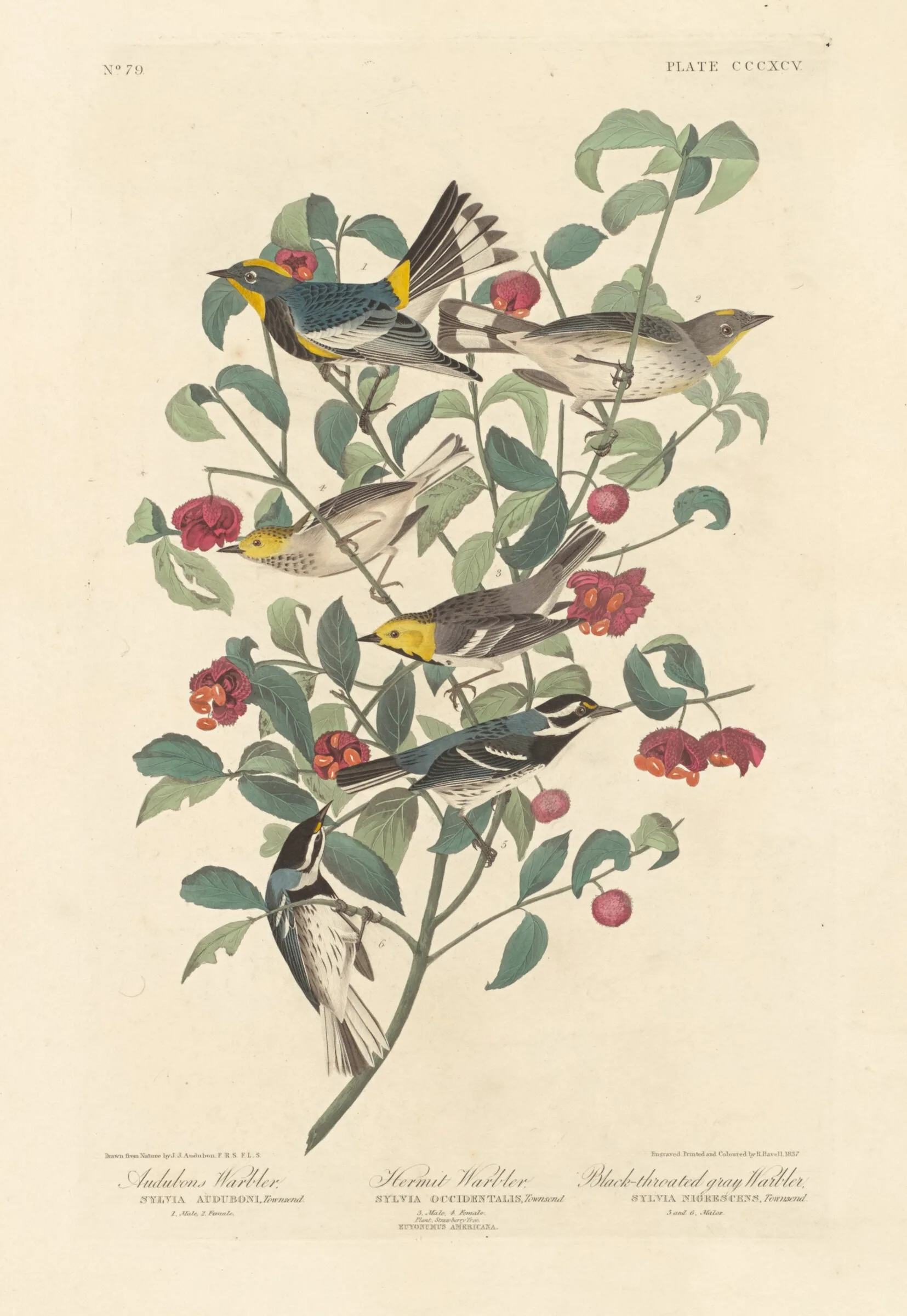
Yellow-rumped (Audubon's) Warbler, Hermit Warbler and Black-throated Gray Warbler (Plate 395)
Audubon's “Audubon's Warbler, Hermit Warbler and Black-throated Gray Warbler”, The Birds of America, plate CCCXCV
Click or press Enter to enlarge
Open the full-resolution image (3022 px, National Gallery of Art)
| Plate | 395 (CCCXCV) |
|---|---|
| Audubon's name | Audubon's Warbler, Hermit Warbler and Black-throated Gray Warbler |
| Modern names | Yellow-rumped Warbler (Audubon's), Hermit Warbler, Black-throated Gray Warbler |
| Scientific names | Setophaga coronata auduboni, Setophaga occidentalis, Setophaga nigrescens |
| Status | Least Concern |
| Engraved by | Robert Havell, after Audubon's watercolor |
| Date | 1837 |
| Medium | Hand-colored engraving and aquatint on Whatman wove paper |
| Plants and setting | Strawberry-bush (Euonymus americanus), painted by Maria Martin |
| Collections | Songbirds |
| This impression | National Gallery of Art, Washington, 1945.8.395; Gift of Mrs. Walter B. James |
About this plate
Plate 395 shows five western warblers on a fruiting branch of strawberry-bush. There is a male and female Audubon's Warbler, a male and female Hermit Warbler and a male Black-throated Gray Warbler. The birds come from Townsend's Columbia River skins. Maria Martin, Audubon's frequent collaborator in Charleston, painted the plant, as he acknowledges in the text.
Townsend discovered the yellow-throated western form of the Myrtle Warbler and named it Sylvia auduboni after Audubon. It was treated as a full species until 1973, when it was merged with the Myrtle Warbler into the Yellow-rumped Warbler, Setophaga coronata. Audubon's Warbler remains the name of the western subspecies group. Townsend also named the Hermit Warbler and the Black-throated Gray Warbler.
Audubon's Warbler breeds in western mountain conifer forests and winters as far south as Central America. The Hermit Warbler breeds high in the tall firs of the Pacific Northwest and California and is hard to see. The Black-throated Gray prefers drier oak and mixed woods. All three are listed as Least Concern.
The notes are Nuttall's and Townsend's. Nuttall met Audubon's Warbler in mid-April along the Oregon and heard in it the song of the Yellow Warbler 'in an improved state.' He saw young out of the nest by 8 June. The plant is the strawberry-bush, Euonymus americanus, a southern shrub with warty scarlet fruit.
Birds on this plate
- Yellow-rumped Warbler (Audubon's) Setophaga coronata auduboni: Audubon's Audubon's Warbler (male and female). Least Concern
- Hermit Warbler Setophaga occidentalis (male and female). Least Concern
- Black-throated Gray Warbler Setophaga nigrescens (male). Least Concern
In Audubon's words
But what was my surprise to hear the accustomed note of the Summer Yellow-Bird delivered in an improved state by this new Warbler, clad in a robe so different but yet so beautiful. Like that species, also he was destined to become our summer acquaintance, breeding and rearing his offspring in the shady firs by the borders of the prairie openings, where he could at all times easily obtain a supply of insects or their larvae. On the 8th of June the young of this species, at that time so much like those of the Yellow-Rump, were already out in small roving and busy flocks, solicitously attended and occasionally fed by the still watchful parents.
John James Audubon, Ornithological Biography, vol. 5 (1839), “Audubon's Warbler”. Read the full chapter.



