Black-throated Green Warbler, Blackburnian Warbler and MacGillivray's Warbler (Plate 399)
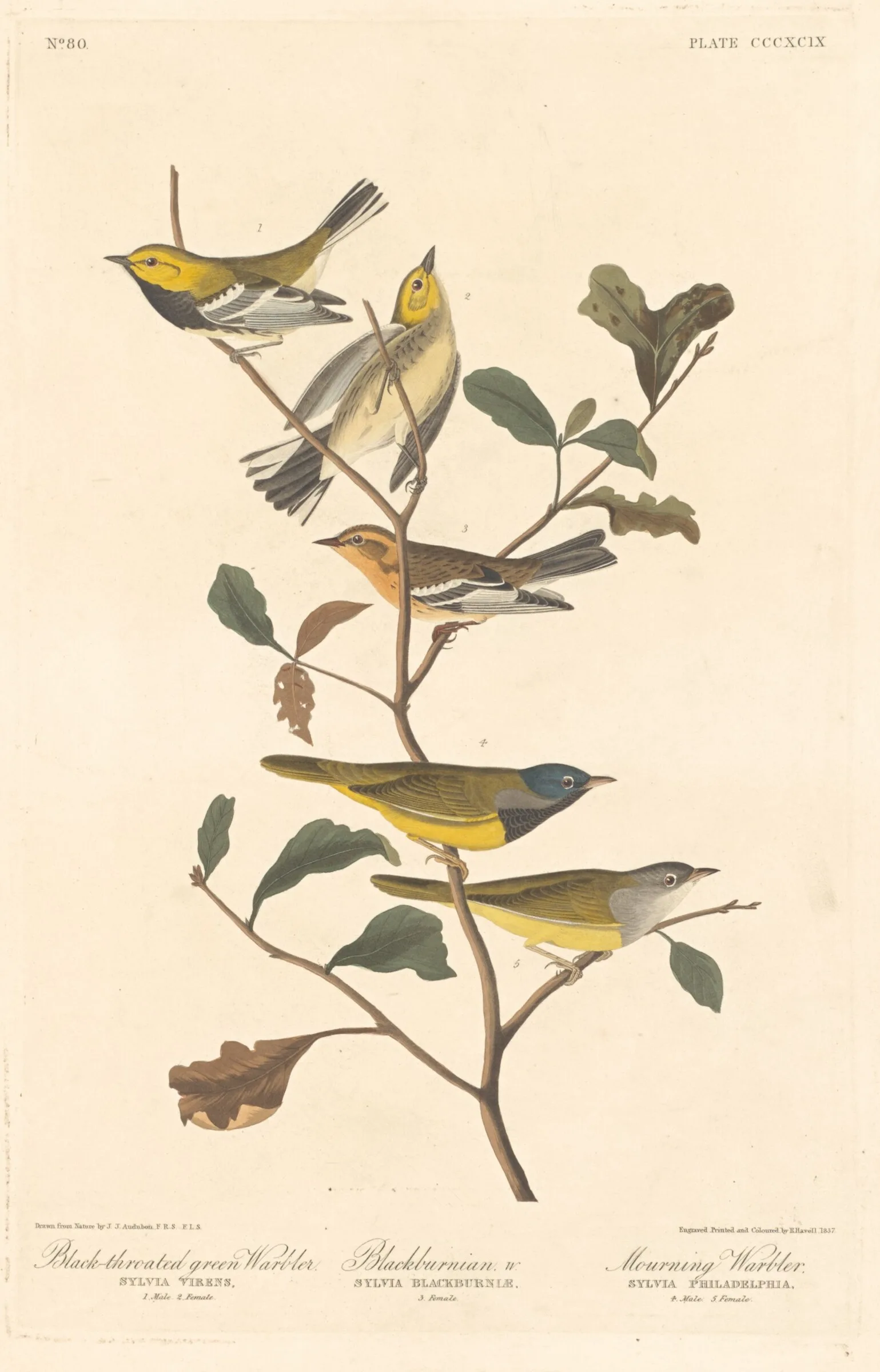
Audubon's “Black-throated Green Warbler, Blackburnian Warbler and Mourning Warbler”, The Birds of America, plate CCCXCIX
Click or press Enter to enlarge
Open the full-resolution image (2850 px, National Gallery of Art)
| Plate | 399 (CCCXCIX) |
|---|---|
| Audubon's name | Black-throated Green Warbler, Blackburnian Warbler and Mourning Warbler |
| Modern names | Black-throated Green Warbler, Blackburnian Warbler, MacGillivray's Warbler |
| Scientific names | Setophaga virens, Setophaga fusca, Geothlypis tolmiei |
| Status | Least Concern |
| Engraved by | Robert Havell, after Audubon's watercolor |
| Date | 1837 |
| Medium | Hand-colored engraving and aquatint on Whatman wove paper |
| Collections | Songbirds |
| This impression | National Gallery of Art, Washington, 1945.8.399; Gift of Mrs. Walter B. James |
About this plate
Plate 399 shows five warblers: a male and female Black-throated Green Warbler, a female Blackburnian Warbler, and a male and female of the bird engraved as the Mourning Warbler. Audubon believed this was the first published figure of the female Black-throated Green, and also of the female Blackburnian.
The plate contains a naming error that Audubon himself corrected. The grey-hooded pair came from Townsend's Columbia River skins. Audubon first took them for Wilson's Mourning Warbler, and the engraving went out under that name. After comparing them with eastern Mourning Warblers collected by Edward Harris, he decided they were a new species. In the text he named it Sylvia macgillivrayi after the Scottish naturalist William MacGillivray, who helped him write the Ornithological Biography. Townsend had already published the name Sylvia tolmiei, so the bird is now Geothlypis tolmiei but keeps MacGillivray's name in English.
MacGillivray's Warbler skulks in dense thickets and regrowing clearings across the western mountains. It shows broken white eye-arcs that the eastern Mourning Warbler lacks. The Black-throated Green Warbler breeds in northeastern and Appalachian forests, and the Blackburnian in tall conifers. All are listed as Least Concern.
Audubon wrote that he had found the Black-throated Green Warbler most plentiful around Eastport, Maine, in May. Thomas Brewer of Boston sent him a description of a Blackburnian Warbler's nest found in Massachusetts in 1837.
Birds on this plate
- Black-throated Green Warbler Setophaga virens (male and female). Least Concern
- Blackburnian Warbler Setophaga fusca (female). Least Concern
- MacGillivray's Warbler Geothlypis tolmiei: Audubon's Mourning Warbler (male and female). Least Concern
In Audubon's words
When I first saw the specimens of this bird, which had been transmitted by Dr Townsend to the Academy of Natural Sciences of Philadelphia, I considered them as identical with Sylvia Philadelphia of Wilson; but on subsequently comparing them with a number of individuals of the latter species, procured by my friend Edward Harris, Esq. in our Middle and Eastern Districts, I found differences sufficient to indicate their being specifically distinct. In consequence of this first impression, the two figures in the plate representing a male and a female procured on the Columbia River, were erroneously named "Mourning Warbler, Sylvia Philadelphia." But now, thinking that I cannot do better than dedicate this pretty little bird to my excellent friend William MacGillivray, Esq., I feel much pleasure in introducing it to the notice of the ornithological world, under a name which I trust will endure as long as the species itself.
John James Audubon, Ornithological Biography, vol. 5 (1839), “MacGillivray's Warbler”. Read the full chapter.



