Lazuli Bunting, Clay-colored Sparrow and Dark-eyed (Oregon) Junco (Plate 398)
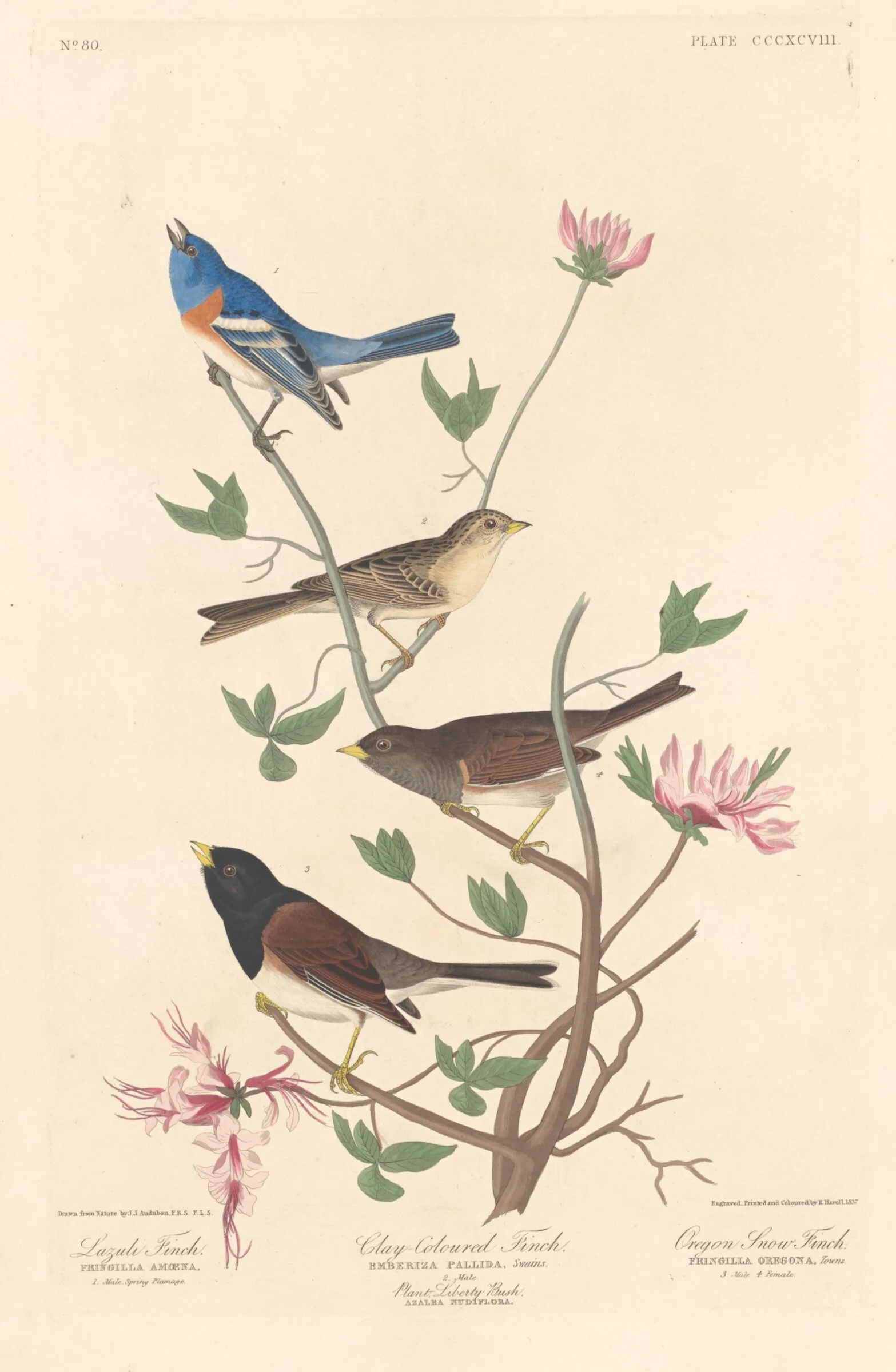
Audubon's “Lazuli Finch, Clay-colored Finch and Oregon Snow Finch”, The Birds of America, plate CCCXCVIII
Click or press Enter to enlarge
Open the full-resolution image (2905 px, National Gallery of Art)
| Plate | 398 (CCCXCVIII) |
|---|---|
| Audubon's name | Lazuli Finch, Clay-colored Finch and Oregon Snow Finch |
| Modern names | Lazuli Bunting, Clay-colored Sparrow, Dark-eyed Junco (Oregon) |
| Scientific names | Passerina amoena, Spizella pallida, Junco hyemalis oreganus |
| Status | Least Concern |
| Engraved by | Robert Havell, after Audubon's watercolor |
| Date | 1837 |
| Medium | Hand-colored engraving and aquatint on Whatman wove paper |
| Plants and setting | Liberty Bush or pinxter azalea (Azalea nudiflora, now Rhododendron periclymenoides), painted by Maria Martin |
| Collections | Songbirds |
| This impression | National Gallery of Art, Washington, 1945.8.398; Gift of Mrs. Walter B. James |
About this plate
Plate 398 shows four small western finches on a branch of flowering azalea. There is a male Lazuli Bunting, a male Clay-colored Sparrow, and a male and female of the Oregon form of the Dark-eyed Junco. Maria Martin painted the azalea, which Audubon calls the Liberty Bush, Azalea nudiflora.
The Lazuli Bunting was found by Thomas Say on Long's expedition. Audubon drew his male from a pair Townsend shot on the Columbia River on 3 June 1836, and the female appears on plate 424. The Clay-colored Bunting of Richardson and Swainson is the Clay-colored Sparrow, a plain prairie sparrow. Townsend's Oregon Snow-finch was later merged with several other juncos into the single species Dark-eyed Junco, Junco hyemalis. The dark-hooded, rusty-backed Oregon Junco is now one of its subspecies groups.
The Lazuli Bunting breeds in brushy hillsides and streamside thickets across the West, and hybridizes with the Indigo Bunting where their ranges meet on the Great Plains. The Clay-colored Sparrow breeds in shrubby prairie of the northern plains and Canada. All three species are listed as Least Concern.
Townsend told Audubon that the Chinook name for the Lazuli Bunting was Tilkonapaooks. Nuttall gave him a nest he had found on the Columbia, woven to the stem of a large fern, which Audubon measured and described. Nuttall also noted the Oregon Juncos flocking silently in the Columbia woods in autumn and winter.
Birds on this plate
- Lazuli Bunting Passerina amoena: Audubon's Lazuli Finch (male). Least Concern
- Clay-colored Sparrow Spizella pallida: Audubon's Clay-coloured Finch (Clay-coloured Bunting) (male). Least Concern
- Dark-eyed Junco (Oregon) Junco hyemalis oreganus: Audubon's Oregon Snow Finch (male and female). Least Concern
In Audubon's words
That enterprising naturalist has informed me, that "the Chinook Indians name this species Tilkonapaooks, and that it is rather a common bird on the Columbia, but is always shy and retiring in its habits, the female being very rarely seen. It possesses lively and pleasing powers of song, which it pours forth from the top branches of moderate-sized trees. Its nest, which is usually placed in the willows along the margins of the streams, is composed of small sticks, fine grasses, and cow or buffalo hair." A nest of this species presented to me by Mr Nuttall, who found it on the Columbia River, is fastened between the stem and two branches of a large fern, round which many of the fibres are woven. It is funnel-shaped, six inches in length, three inches in breadth externally at the mouth, from which it gradually tapers. Internally its diameter at the mouth is two inches, and its depth three. It is composed of fibrous lichens, mosses, decayed leaves and grasses, of coarse texture and rudely interwoven.
John James Audubon, Ornithological Biography, vol. 5 (1839), “Lazuli Finch”. Read the full chapter.



