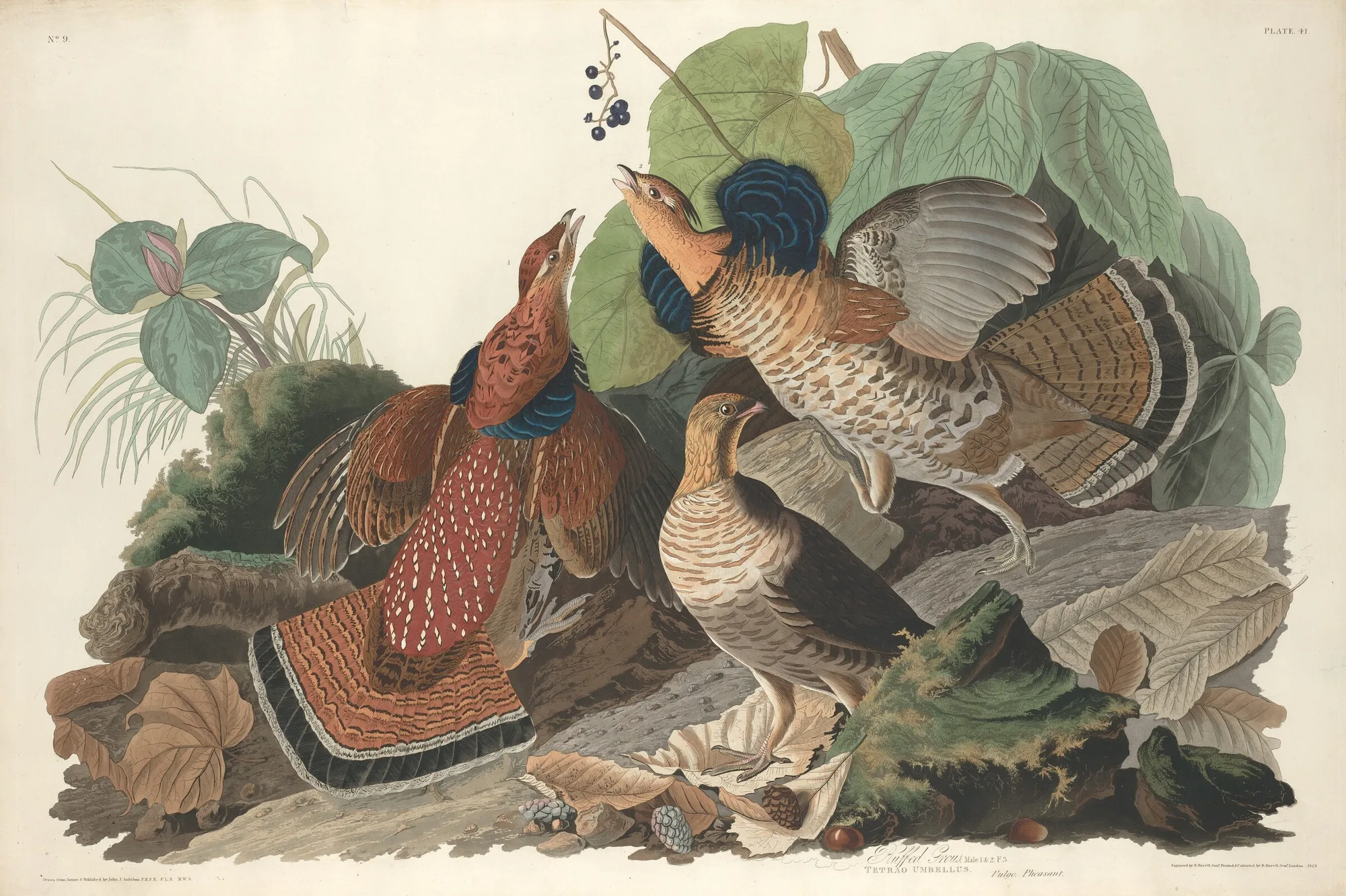
Ruffed Grouse (Plate 41)
Audubon's “Ruffed Grouse”, The Birds of America, plate XLI
Click or press Enter to enlarge
Open the full-resolution image (4811 px, National Gallery of Art)
| Plate | 41 (XLI) |
|---|---|
| Audubon's name | Ruffed Grouse |
| Modern name | Ruffed Grouse |
| Scientific name | Bonasa umbellus |
| Status | Least Concern |
| Engraved by | Robert Havell, after Audubon's watercolor |
| Date | 1828 |
| Medium | Hand-colored engraving and aquatint on Whatman wove paper |
| Collections | Turkeys, Grouse and Game Birds |
| This impression | National Gallery of Art, Washington, 1945.8.41; Gift of Mrs. Walter B. James |
About this plate
Plate 41 shows a male and female Ruffed Grouse. The male raises the black ruff on his neck and fans his barred tail with its dark band near the tip. The female is similar but with a shorter ruff and paler plumage, as Audubon noted in his description. The plate was engraved by Robert Havell in 1828.
Audubon thought the Ruffed Grouse the best land bird for the table after the Wild Turkey, better than the Pinnated Grouse preferred by eastern epicures. He wrote that settlers called it Pheasant in some districts and Partridge in others. He described autumn movements in which parties of grouse gathered on the north-west banks of the Ohio and Susquehanna, waited one or two weeks, then flew across. In October 1820 so many crossed from Ohio, Illinois and Indiana into Kentucky that they sold in the Cincinnati market for 12½ cents each.
The name is unchanged: Ruffed Grouse, Bonasa umbellus. Audubon used Linnaeus's name Tetrao umbellus. He noted that the loud whirr of its wings is made only when the bird is flushed, not when it flies of its own accord. The male's drumming display, made by beating the wings while standing on a log, is its best known behaviour.
The species lives in forests across Canada, Alaska and the northern United States, south in the Appalachians to Georgia. It depends on young forest and its numbers rise and fall in cycles. It has declined in parts of the East but is listed as Least Concern.
In Audubon's words
The Grouse approach the banks of the Ohio in parties of eight or ten, now and then of twelve or fifteen, and, on arriving there, linger in the woods close by for a week or a fortnight, as if fearful of encountering the danger to be incurred in crossing the stream. This usually happens in the beginning of October, when these birds are in the very best order for the table, and at this period great numbers of them are killed. If started from the ground, with or without the assistance of a dog, they immediately alight on the nearest trees, and are easily shot. At length, however, they resolve upon crossing the river; and this they accomplish with so much ease, that I never saw any of them drop into the water.
John James Audubon, Ornithological Biography, vol. 1 (1831), “The Ruffed Grouse”. Read the full chapter.