Orchard Oriole (Plate 42)
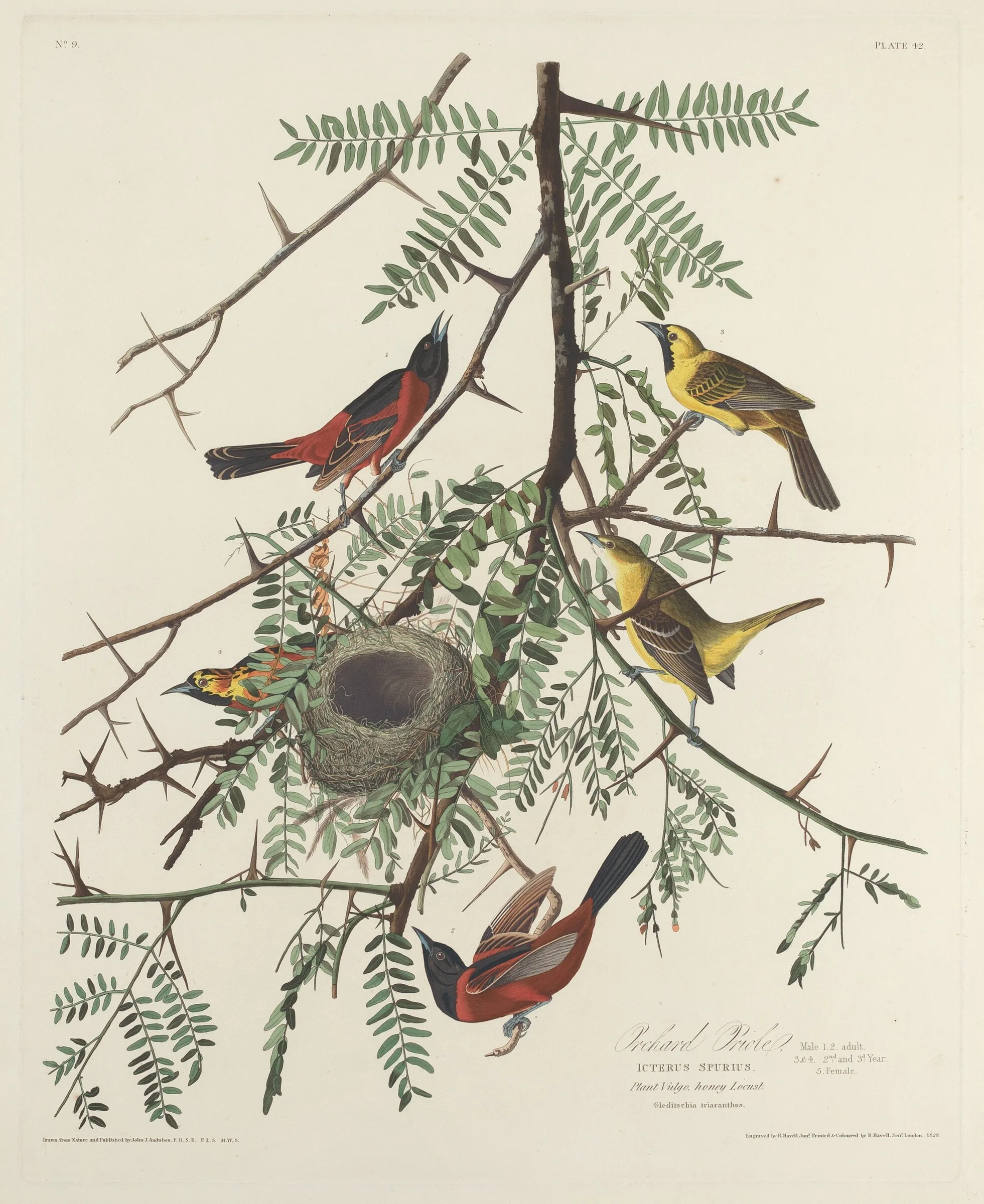
Audubon's “Orchard Oriole”, The Birds of America, plate XLII
Click or press Enter to enlarge
Open the full-resolution image (3299 px, National Gallery of Art)
| Plate | 42 (XLII) |
|---|---|
| Audubon's name | Orchard Oriole |
| Modern name | Orchard Oriole |
| Scientific name | Icterus spurius |
| Status | Least Concern |
| Engraved by | Robert Havell, after Audubon's watercolor |
| Date | 1828 |
| Medium | Hand-colored engraving and aquatint on Whatman wove paper |
| Size | plate: 65.6 x 53 cm (25 13/16 x 20 7/8 in.) sheet: 100 x 67.5 cm (39 3/8 x 26 9/16 in.) |
| Plants and setting | Honey Locust (Gleditsia triacanthos) |
| Collections | Songbirds |
| This impression | National Gallery of Art, Washington, 1945.8.42; Gift of Mrs. Walter B. James |
About this plate
Plate 42 shows Orchard Orioles in several plumages with a woven nest of grass hanging from a branch of Honey Locust, Gleditsia triacanthos, recognisable by its spines and pods. The adult male is black with deep chestnut underparts. The young male is yellow-green with a black throat. The female is plain yellow-green. The plate was engraved by Robert Havell in 1828.
Audubon opened the chapter with the plumage changes of birds and wrote that this species showed its gradual changes more clearly than any other land bird. Males take until their second year to gain adult colours. He described males singing in short flights above the treetops and pairs weaving deep, open nests of long grasses in apple trees or weeping willows. He noted that in Louisiana the nests were airy, while in the Middle States they were lined with warm materials.
The name is unchanged: Orchard Oriole, Icterus spurius. Spurius means false or bastard, because early writers thought the dull birds were a poor form of the Baltimore Oriole. Audubon stressed how sociable it was compared with the Baltimore. He once counted nine nests on a few acres.
The Orchard Oriole is the smallest oriole in North America. It breeds in open woodland, orchards and river edges across the eastern and central United States and winters from Mexico to northern South America. It arrives late and leaves early, often heading south by July. It is listed as Least Concern.
In Audubon's words
The sociality of the Orchard Oriole is quite remarkable, and in this respect that bird differs widely from the Baltimore, which will not suffer any other bird of its species to build a nest, or to remain within a considerable distance from the spot which it has selected for its own; whereas many nests of the species now before you may be observed in the same garden or orchard, and often within a few yards of the house. I have counted as many as nine of these nests on a few acres of ground, and the different pairs to which they belonged lived in great harmony.
John James Audubon, Ornithological Biography, vol. 1 (1831), “The Orchard Oriole”. Read the full chapter.



