American Redstart (Plate 40)
Audubon's “American Redstart”, The Birds of America, plate XL
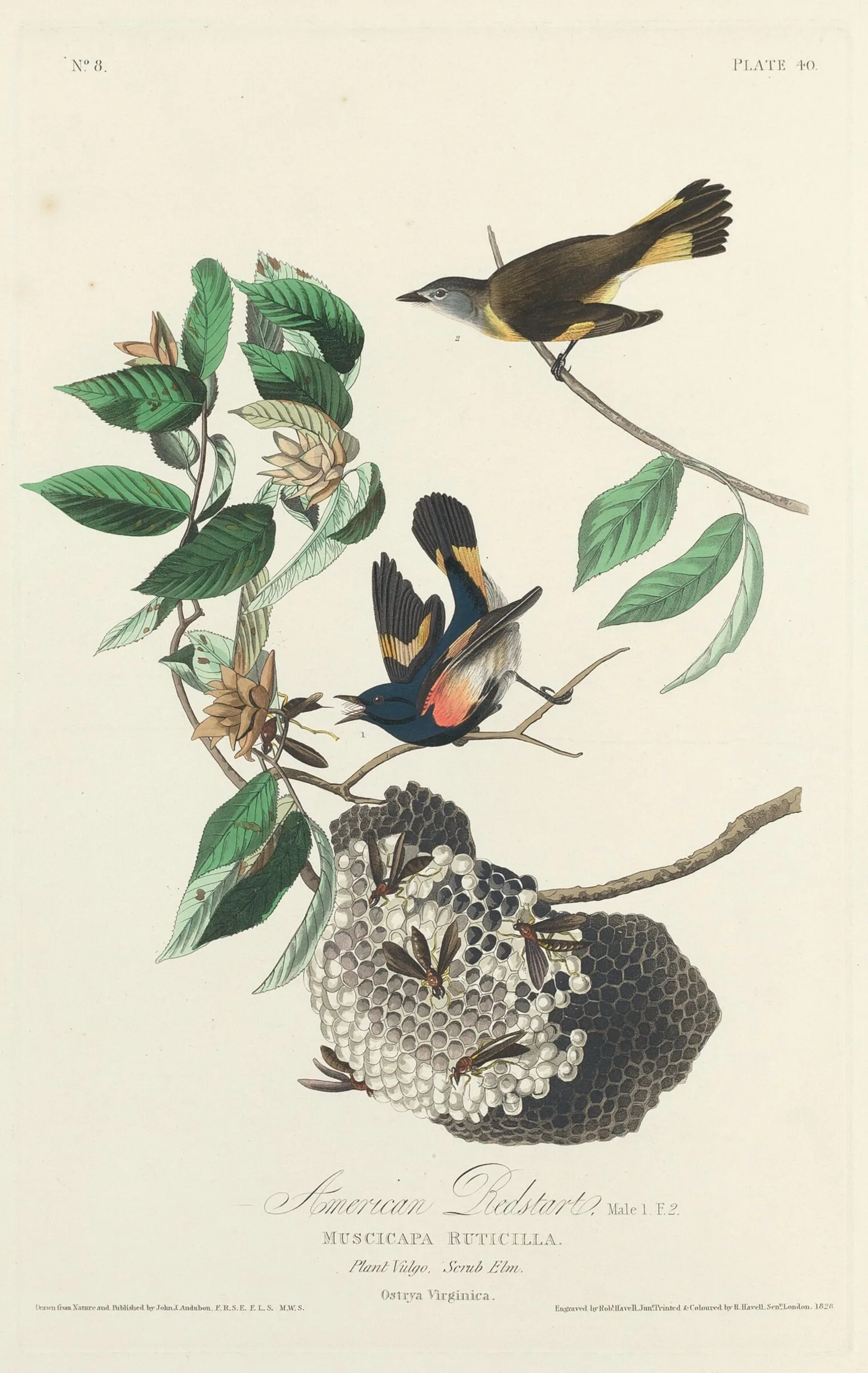
Click or press Enter to enlarge
Open the full-resolution image (2496 px, National Gallery of Art)
| Plate | 40 (XL) |
|---|---|
| Audubon's name | American Redstart |
| Modern name | American Redstart |
| Scientific name | Setophaga ruticilla |
| Status | Least Concern |
| Engraved by | Robert Havell, after Audubon's watercolor |
| Date | 1828 |
| Medium | Hand-colored engraving and aquatint on Whatman wove paper |
| Collections | Songbirds |
| This impression | National Gallery of Art, Washington, 1945.8.40; Gift of Mrs. Walter B. James |
About this plate
Plate 40 shows a male and female American Redstart. The adult male is black with bright orange patches on the wings, sides and tail. The female is grey and olive with yellow patches. Audubon wrote that the male is shown in the act of snapping at wasps around their nest. He described watching such attacks for minutes at a time. They failed because the wasps raised their stings. The plate was engraved by Robert Havell in 1828.
Audubon described the redstart as one of the liveliest and handsomest of the flycatchers. He wrote that it moved sideways along branches with drooping wings, fanning and closing its tail, and that its song sounded like tetee-whee. It arrived between early March and May depending on the region and left in late September and October. He described a slight nest of lichens and plant fibres in a low bush or sapling.
Audubon placed it among the flycatchers as Muscicapa ruticilla. It is a wood warbler, now Setophaga ruticilla. Setophaga was originally created for this species alone, and in 2011 most of the eastern wood warblers were moved into it. Young males look like females until their second year.
The American Redstart breeds in deciduous and mixed forest across Canada and the eastern and northern United States and winters from Mexico to northern South America and the Caribbean. It is listed as Least Concern.
In Audubon's words
I have looked for several minutes at a time on the ineffectual attacks which this bird makes on wasps while busily occupied about their own nests. The bird approaches and snaps at them, but in vain; for the wasp elevating its abdomen, protrudes its sting, which prevents its being seized. The male bird is represented in the plate in this posture.
Its nest is generally made on a low bush or sapling, and has the appearance of hanging to the twigs. It is slight, and is composed of lichens and dried fibres of rank weeds or grape vines, nicely lined with soft cottony materials. The female lays from four to six white eggs, sprinkled with ash-grey and blackish dots. It rears only a single brood in a season. The old birds, I am inclined to think, leave the United States a month or three weeks before the young, some of which linger in the deep swamps of the States of Mississippi and Louisiana until the beginning of November.
John James Audubon, Ornithological Biography, vol. 1 (1831), “The American Redstart”. Read the full chapter.



