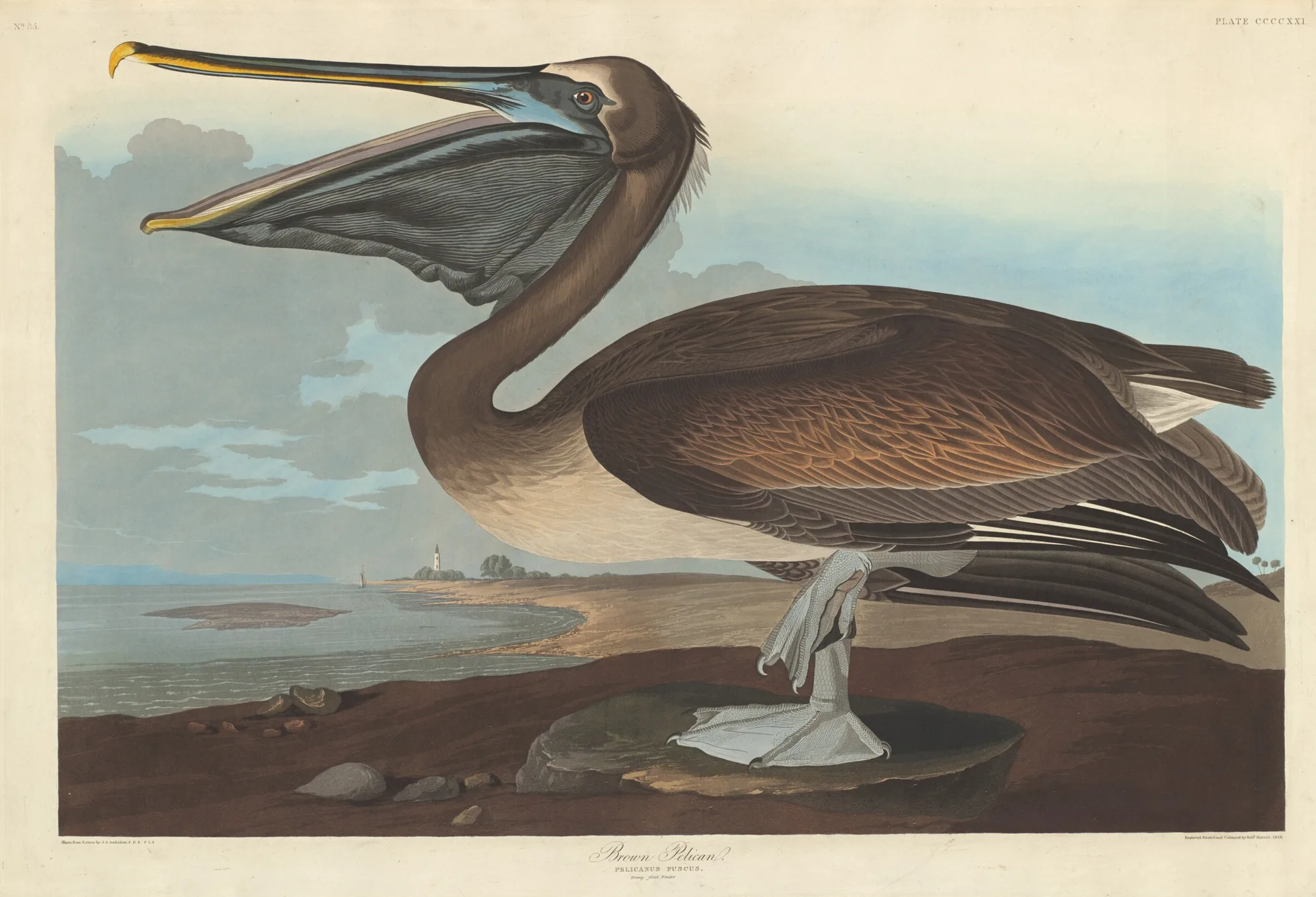
Brown Pelican (immature) (Plate 421)
Audubon's “Brown Pelican”, The Birds of America, plate CDXXI
Click or press Enter to enlarge
Open the full-resolution image (5385 px, National Gallery of Art)
| Plate | 421 (CDXXI) |
|---|---|
| Audubon's name | Brown Pelican |
| Modern name | Brown Pelican (immature) |
| Scientific name | Pelecanus occidentalis |
| Status | Least Concern |
| Engraved by | Robert Havell, after Audubon's watercolor |
| Date | 1838 |
| Medium | Hand-colored engraving and aquatint on Whatman wove paper |
| Collections | Seabirds |
| This impression | National Gallery of Art, Washington, 1945.8.421; Gift of Mrs. Walter B. James |
About this plate
Plate 421 shows a young Brown Pelican in its plain grey-brown plumage, with a white belly and none of the chestnut and white head markings of the adult. It is Audubon's second plate of the species. The first, plate 251, shows an adult male in breeding dress.
The chapter is a correction. In his earlier account Audubon had said adult males and females differed in plumage. On the Texas coast in 1837 he examined birds taken on the nest and found that the sexes look alike. He also learned that pelicans take several years to reach full adult plumage. The species, Pelecanus fuscus to Audubon, is now Pelecanus occidentalis.
The Brown Pelican is the only pelican that plunges from the air to catch fish. It nests in colonies on coastal islands, in trees or on the ground. In the 1960s DDT thinned its eggshells and the population collapsed; it disappeared as a breeding bird from Louisiana, which has it as its state bird. After DDT was banned the species recovered, and it was removed from the U.S. endangered species list in 2009. It is listed as Least Concern.
Audubon found it nesting on the ground on small islets in the bays of Texas. During a gale on 7 April 1836 he watched a flock of about thirty fish together in the surf, attended by Laughing Gulls.
In Audubon's words
During a severe gale, on the 7th of April 1836, the wind coming from the north-west, I saw a flock of about thirty of these birds flying only a few feet above the water, and against the gale. Having proceeded a few yards, they plunged into the water, generally to leeward, and threw their bodies round as soon as their bills were immersed, giving a very curious appearance to the wings, which seemed as if locked. On seizing a fish they kept the bill beneath the surface for a short time in a perpendicular direction, and drew it up gradually, when the water was seen to flow out, after which they raised the bill to a horizontal position, and swallowed the fish. In this way the whole flock kept dashing and plunging pell-mell, like Gannets, over a space of about one hundred yards, fishing at times in the very surf, and where the water could not be more than a very few feet deep. Each of them must have caught upwards of a score of fishes.
John James Audubon, Ornithological Biography, vol. 5 (1839), “Brown Pelican”. Read the full chapter.