Rough-legged Hawk (Plate 422)
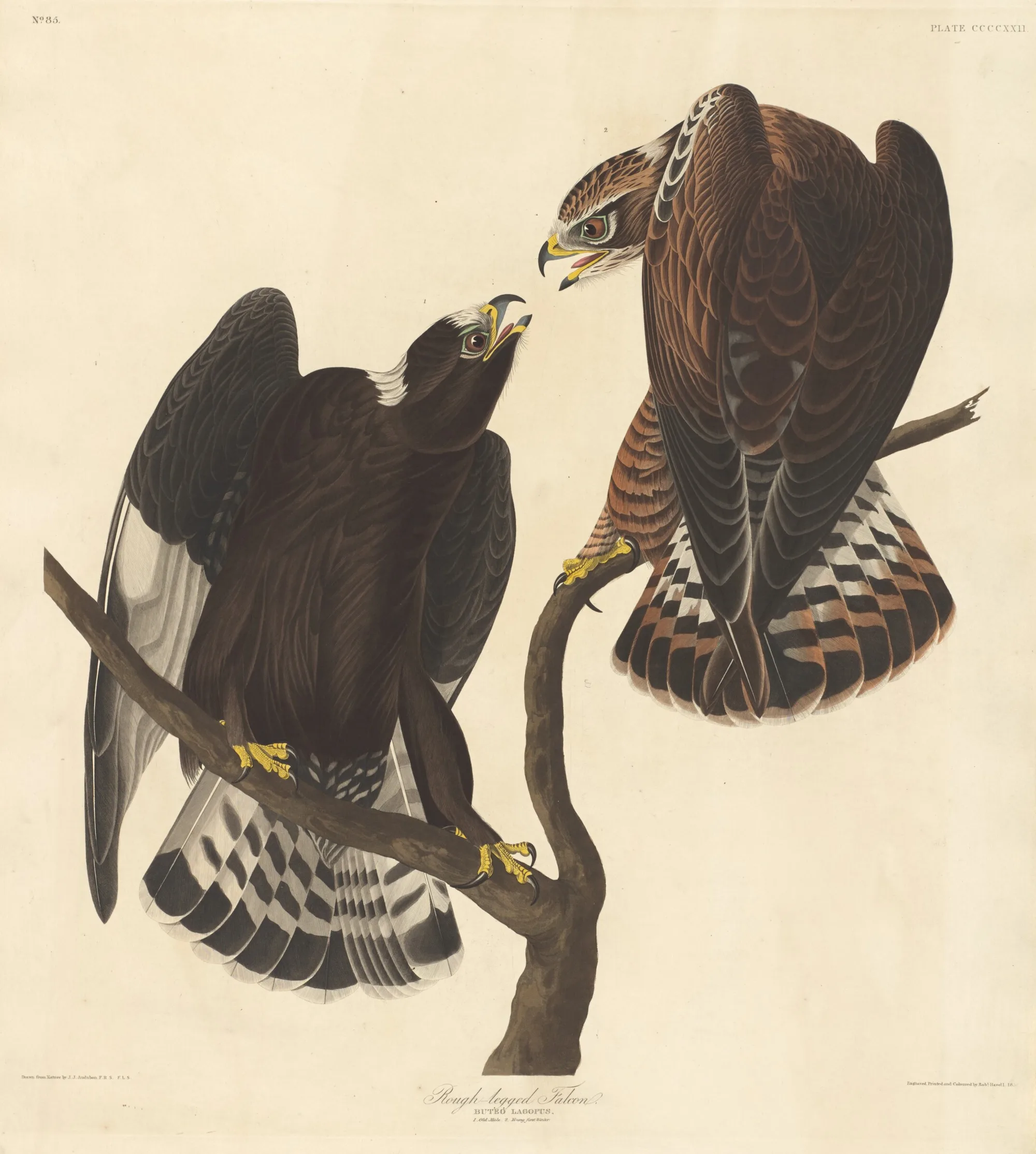
Audubon's “Rough-legged Falcon”, The Birds of America, plate CDXXII
Click or press Enter to enlarge
Open the full-resolution image (4095 px, National Gallery of Art)
| Plate | 422 (CDXXII) |
|---|---|
| Audubon's name | Rough-legged Falcon |
| Modern name | Rough-legged Hawk |
| Scientific name | Buteo lagopus |
| Status | Least Concern |
| Engraved by | Robert Havell, after Audubon's watercolor |
| Date | 1838 |
| Medium | Hand-colored engraving and aquatint on Whatman wove paper |
| Collections | Hawks, Eagles and Falcons |
| This impression | National Gallery of Art, Washington, 1945.8.422; Gift of Mrs. Walter B. James |
About this plate
Plate 422 shows two Rough-legged Hawks: a dark adult male and a young bird shot in November, brown and variegated with a pale head and dark belly band. Audubon said he chose them to prove two things. The dark and light birds were one species, and the American bird was the same as the Rough-legged Buzzard of Europe.
He was right on both counts. The dark birds had often been called the Black Hawk and treated as a separate species. The Rough-legged Hawk, Buteo lagopus, is now known to occur in light and dark morphs with many intermediates. In Britain the same bird is the Rough-legged Buzzard. The 'rough legs' are feathered to the toes, an adaptation to cold.
The Rough-legged Hawk breeds on Arctic tundra and cliffs around the northern hemisphere and depends on lemmings and voles. In winter it moves south into open fields across southern Canada and the northern and central United States. It often hovers in place while hunting. It is listed as Least Concern.
The chapter opens with an essay on migration. Audubon argued that young hawks reared in the far north travel farther south than their parents. He noted that adult Rough-legs rarely reach south of New Jersey, where young birds outnumber them fifty to one. Townsend wrote that he had found the species nesting in a willow on Bear River, west of the Rockies.
In Audubon's words
I have in this plate represented an old male and a young bird shot in November, to shew not only that the bird with dark plumage is specifically identical with that which is brown and variegated, but also that our Rough-legged Falcon is the same as that of Europe. Since the publication of my second volume, I have collected a great number of specimens in America, of which there are not two that precisely agree in the colours of their plumage, although in form and proportions they are similar. I have also compared them with several European specimens, and am quite satisfied as to the identity supposed by me to exist between them.
John James Audubon, Ornithological Biography, vol. 5 (1839), “Rough-Legged Falcon”. Read the full chapter.