California Condor (Plate 426)
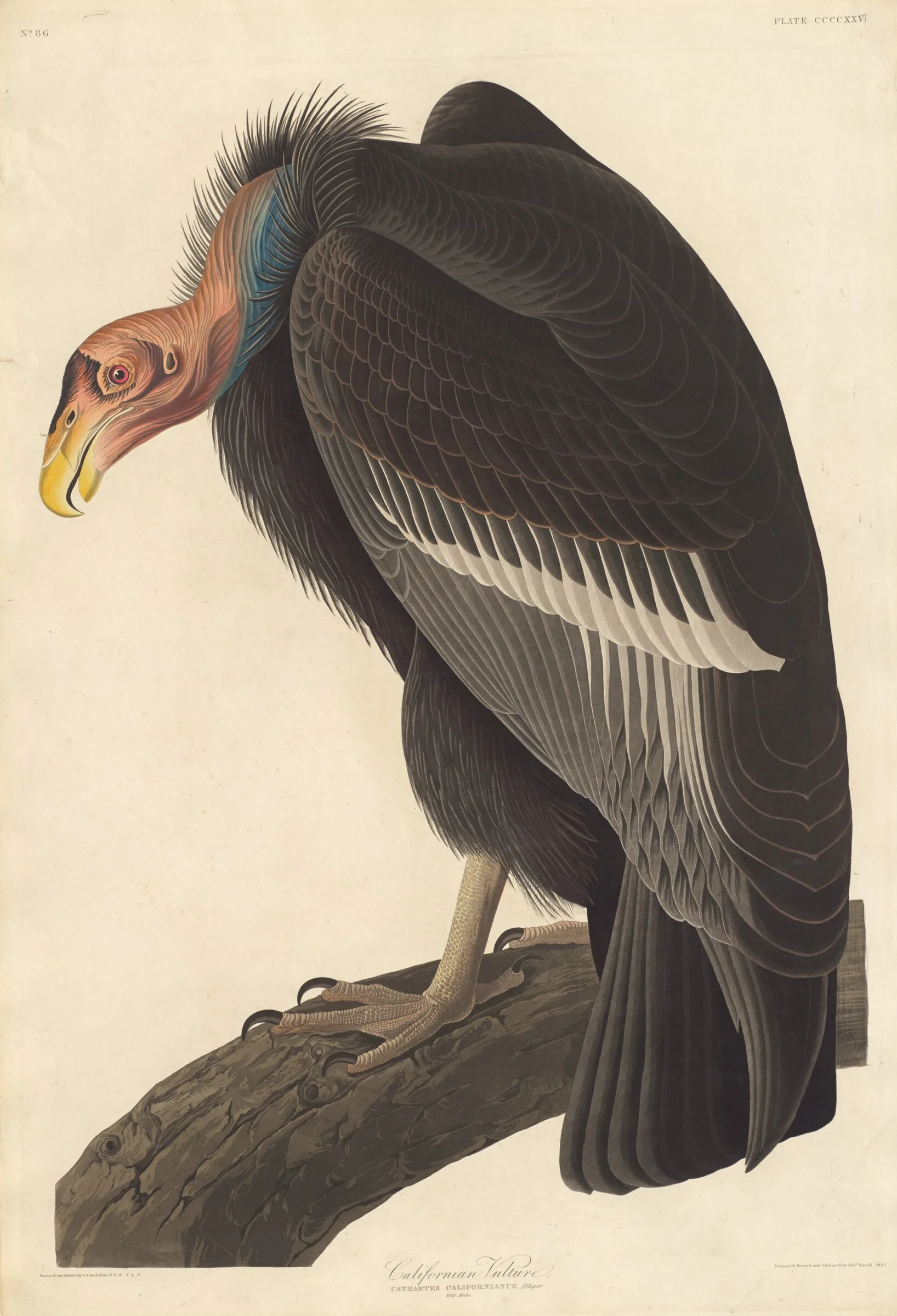
Audubon's “Californian Vulture”, The Birds of America, plate CDXXVI
Click or press Enter to enlarge
Open the full-resolution image (5426 px, National Gallery of Art)
| Plate | 426 (CDXXVI) |
|---|---|
| Audubon's name | Californian Vulture |
| Modern name | California Condor |
| Scientific name | Gymnogyps californianus |
| Status | Critically Endangered |
| Engraved by | Robert Havell, after Audubon's watercolor |
| Date | 1838 |
| Medium | Hand-colored engraving and aquatint on Whatman wove paper |
| Size | plate: 96.5 x 65.5 cm (38 x 25 13/16 in.) sheet: 100.6 x 68 cm (39 5/8 x 26 3/4 in.) |
| Collections | Hawks, Eagles and Falcons |
| This impression | National Gallery of Art, Washington, 1945.8.426; Gift of Mrs. Walter B. James |
About this plate
Plate 426 shows the California Condor, the bird Audubon called the Californian Vulture, with its bare orange head, black plumage and white wing linings. Audubon never saw a living condor. He drew it from specimens, and his text relies on notes from Townsend and the botanist David Douglas.
Audubon called it Cathartes californianus. It is now the only living species of Gymnogyps and belongs to the New World vultures, with the Turkey Vulture and the Andean Condor. With a wingspan of up to about nine and a half feet, it is the largest flying land bird in North America. Douglas gave 9 feet 3 inches for one bird.
In Audubon's day condors ranged from British Columbia to Baja California. Shooting, poisoning and above all lead from bullet fragments in carcasses drove them close to extinction. By 1987 only 27 remained, and the last wild bird was captured for a breeding programme that year. Releases began in California in 1992 and later extended to Arizona, Utah and Baja California. More than 300 now fly free, but lead poisoning remains the main threat, and the IUCN lists the species as Critically Endangered.
Townsend described condors on the Columbia River feeding on dead salmon below the falls, mixing with Turkey Vultures and Ravens. He saw two near Fort Vancouver feeding on a dead pig. He also noted that they ran several yards to take off.
In Audubon's words
Their food while on the Columbia is fish almost exclusively, as in the neighbourhood of the rapids and falls it is always in abundance; they also, like other Vultures, feed on dead animals. I once saw two near Fort Vancouver feeding on the carcass of a pig that had died. I have not seen them at roost. In walking they resemble a Turkey, strutting over the ground with great dignity; but this dignity is occasionally lost sight of, especially when two are striving to reach a dead fish, which has just been cast on the shore; the stately walk then degenerates into a clumsy sort of hopping canter, which is any thing but graceful. When about to rise, they always hop or run for several yards, in order to give an impetus to their heavy body, in this resembling the Condor of South America, whose well known habit furnishes the natives with an easy mode of capturing him by means of a narrow pen, in which a dead carcass has been deposited.
John James Audubon, Ornithological Biography, vol. 5 (1839), “Californian Vulture”. Read the full chapter.