Steller's Eider (Plate 429)
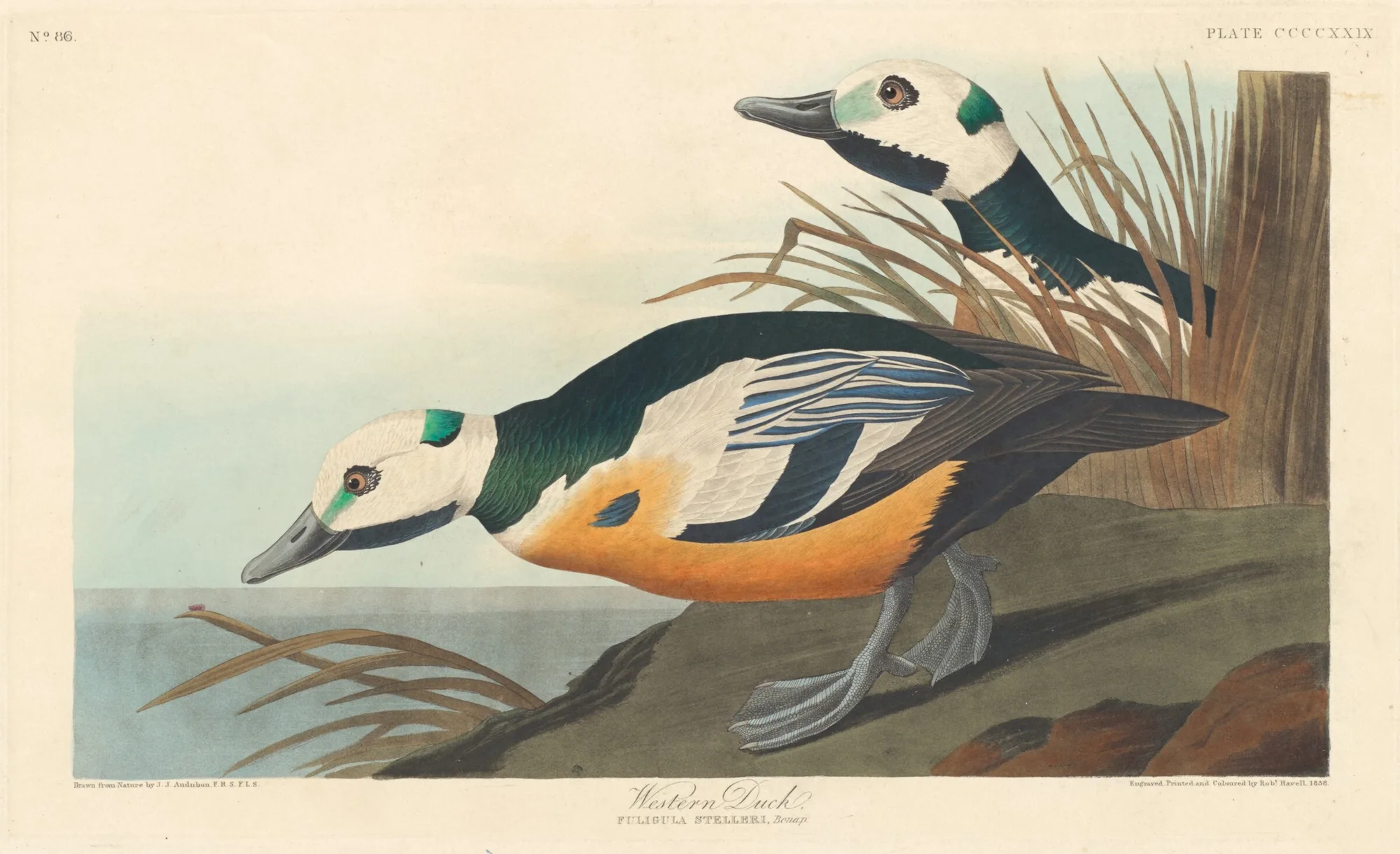
Audubon's “Western Duck”, The Birds of America, plate CDXXIX
Click or press Enter to enlarge
Open the full-resolution image (3073 px, National Gallery of Art)
| Plate | 429 (CDXXIX) |
|---|---|
| Audubon's name | Western Duck |
| Modern name | Steller's Eider |
| Scientific name | Polysticta stelleri |
| Status | Vulnerable |
| Engraved by | Robert Havell, after Audubon's watercolor |
| Date | 1838 |
| Medium | Hand-colored engraving and aquatint on Whatman wove paper |
| Collections | Ducks, Geese and Swans |
| This impression | National Gallery of Art, Washington, 1945.8.429; Gift of Mrs. Walter B. James |
About this plate
Plate 429 shows an adult male Steller's Eider in breeding plumage. It has a white head with a green tuft at the nape, a black chin and eye ring, a black collar and back, and a warm buff-orange breast and belly. The figure was drawn by Audubon's son John Woodhouse Audubon from a specimen in the museum at Norwich, England. That bird was said to have been shot at Yarmouth, Norfolk, in the winter of 1830.
Audubon used the English name of Thomas Pennant and John Latham, the Western Duck, with the scientific name Fuligula dispar. The bird now bears the name of Georg Wilhelm Steller, naturalist on Vitus Bering's expedition of the 1740s, who first recorded it. It is Polysticta stelleri, the smallest of the eiders and the only member of its genus.
Steller's Eider breeds on Arctic tundra in Siberia and northern Alaska and winters in the Bering Sea and along the coasts of Alaska and northern Europe. The Alaska breeding population has declined sharply and is listed as threatened in the United States. The IUCN lists the species as Vulnerable.
Audubon wrote that all his efforts to obtain a specimen had failed. He included the bird because it had been accepted as part of the North American fauna.
In Audubon's words
This beautiful species, which was discovered by Steller on the north-west coast of America, has never been known to visit our Atlantic shores. So very scarce indeed is it, that all my exertions to obtain a specimen have failed. It is surprising that it was not procured by any of the great navigators and travellers who have visited the northern and western coast within these fifteen years. As it has been acknowledged, however, as belonging to our Fauna, I have introduced a figure of it taken by my son John Woodhouse, from a beautiful specimen in the Museum of Norwich, in England. It is said to have been shot at Yarmouth, in the county of Norfolk, in the winter of 1830.
John James Audubon, Ornithological Biography, vol. 5 (1839), “Western Duck”. Read the full chapter.