Marbled Murrelet (Plate 430)
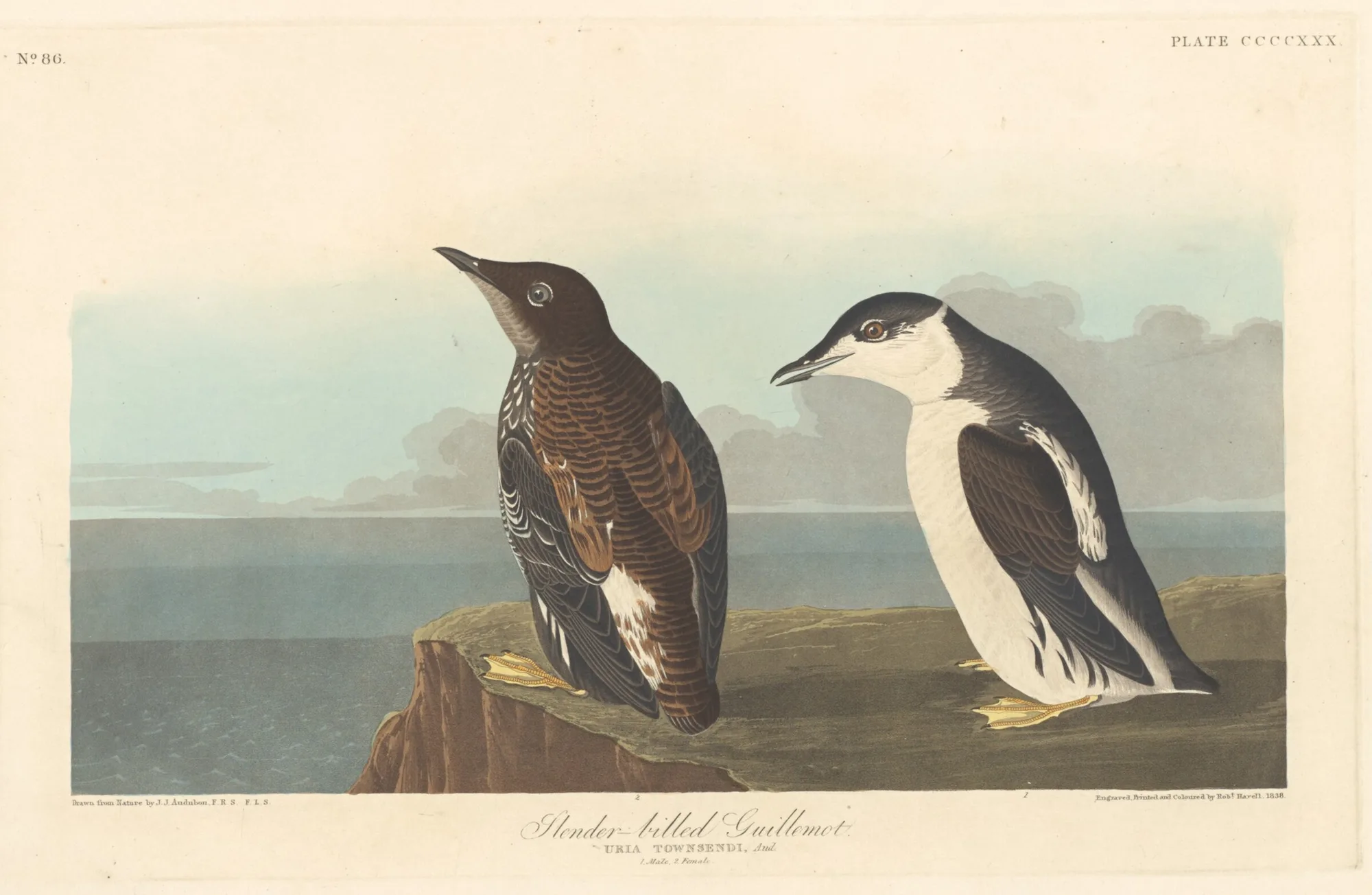
Audubon's “Slender-billed Guillemot”, The Birds of America, plate CDXXX
Click or press Enter to enlarge
Open the full-resolution image (2775 px, National Gallery of Art)
| Plate | 430 (CDXXX) |
|---|---|
| Audubon's name | Slender-billed Guillemot |
| Modern name | Marbled Murrelet |
| Scientific name | Brachyramphus marmoratus |
| Status | Endangered |
| Engraved by | Robert Havell, after Audubon's watercolor |
| Date | 1838 |
| Medium | Hand-colored engraving and aquatint on Whatman wove paper |
| Collections | Seabirds |
| This impression | National Gallery of Art, Washington, 1945.8.430; Gift of Mrs. Walter B. James |
About this plate
Plate 430 shows two small, chunky seabirds, black above and white below, with a white band across the shoulders. Audubon drew them from four specimens sent by Townsend from near the mouth of the Columbia River. He supposed one was an adult and the other a young bird in its first plumage.
Audubon named the bird Uria townsendi, the Slender-billed Guillemot. The plumage he describes, blackish above with a white collar and white scapular stripes, matches the Marbled Murrelet in winter, Brachyramphus marmoratus. That species had already been described by Gmelin in 1789. In summer the Marbled Murrelet turns mottled brown, the 'marbled' plumage of its name.
The Marbled Murrelet is unusual among auks. Most pairs nest not on sea cliffs but high in old-growth conifers, laying a single egg on a wide mossy branch, sometimes many miles inland. The first tree nest was not found until 1974. Logging of old-growth forest has reduced its numbers from California to Alaska. It is listed as threatened in the United States and as Endangered by the IUCN.
Audubon's chapter adds nothing on its habits. It is a short note on the specimens followed by a technical description.
In Audubon's words
I have received not less than four specimens of this small Guillemot from Dr Townsend, who procured them on the north-west coast of America, not very far from the mouth of the Columbia River. The changes of colour in birds of this genus are well known to be considerable; and I have represented two individuals, supposing one to be an adult, and the other a young bird in its first plumage.
John James Audubon, Ornithological Biography, vol. 5 (1839), “Slender-Billed Guillemot”. Read the full chapter.