Willow Flycatcher, Red-eyed Vireo, Western Wood-Pewee, Black Phoebe and two mystery birds (Plate 434)
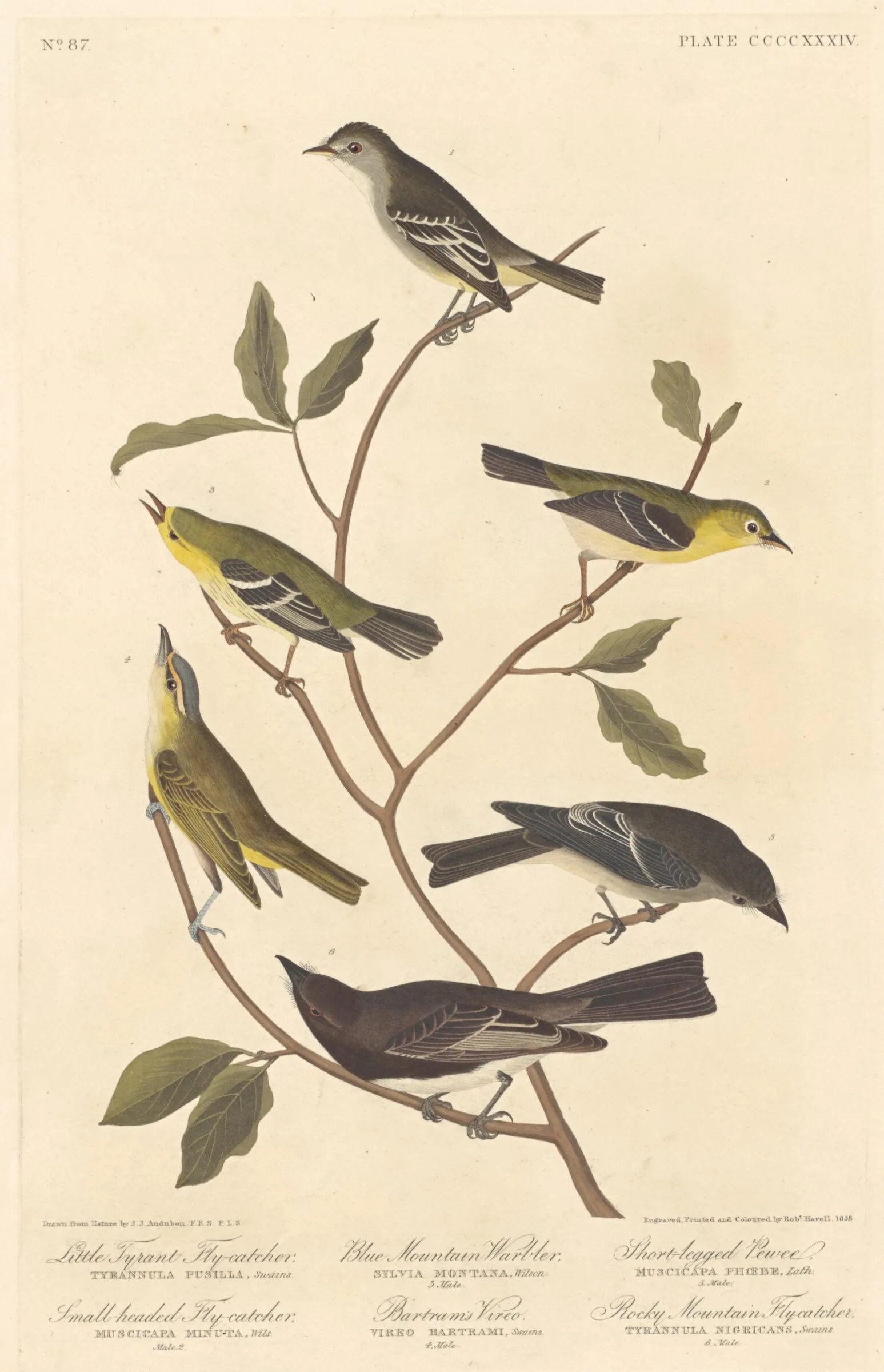
Audubon's “Little Tyrant Flycatcher, Small-Headed Flycatcher, Blue Mountain Warbler, Bartram's Vireo, Short-Legged Pewee, and Rocky Mountain Flycatcher”, The Birds of America, plate CDXXXIV
Click or press Enter to enlarge
Open the full-resolution image (2806 px, National Gallery of Art)
| Plate | 434 (CDXXXIV) |
|---|---|
| Audubon's name | Little Tyrant Flycatcher, Small-Headed Flycatcher, Blue Mountain Warbler, Bartram's Vireo, Short-Legged Pewee, and Rocky Mountain Flycatcher |
| Modern names | Willow Flycatcher (probable; often listed as Least Flycatcher), Small-headed Flycatcher (mystery bird), Blue Mountain Warbler (mystery bird), Red-eyed Vireo, Western Wood-Pewee, Black Phoebe |
| Scientific names | Empidonax traillii, Muscicapa minuta (unresolved), Sylvia montana (unresolved), Vireo olivaceus, Contopus sordidulus, Sayornis nigricans |
| Status | Least Concern |
| Engraved by | Robert Havell, after Audubon's watercolor |
| Date | 1838 |
| Medium | Hand-colored engraving and aquatint on Whatman wove paper |
| Collections | Songbirds |
| This impression | National Gallery of Art, Washington, 1945.8.434; Gift of Mrs. Walter B. James |
About this plate
Plate 434 holds six small birds, one figure each. Two are Audubon's famous unsolved birds. He says he drew the Small-headed Flycatcher at Louisville, Kentucky, in the spring of 1808, from a specimen found by a pond. The Blue Mountain Warbler, Wilson's Sylvia montana, had been seen only once, and Audubon lists it with the Carbonated Warbler and Cuvier's Kinglet as birds known from single specimens.
Neither mystery bird has been matched to a living species. Both had already been figured by Alexander Wilson, and some historians have argued that Audubon's versions draw on Wilson's. The Little Tyrant Flycatcher, from Swainson's Tyrannula pusilla, was collected by Nuttall on Wapato Island in the Columbia. It is often listed as the Least Flycatcher, but the name and locality fit the western Willow Flycatcher better. Bartram's Vireo, which Audubon separated from the Red-eyed Vireo, is generally taken to be a Red-eyed Vireo. The Short-legged Pewee, Swainson's Muscicapa richardsonii, is the Western Wood-Pewee. The Rocky Mountain Flycatcher, from a skin Nuttall took in northern California, is the Black Phoebe.
The Black Phoebe lives near water in the West and builds mud nests under bridges and eaves. The Western Wood-Pewee breeds in open western woodland and winters in South America. All the identified species are listed as Least Concern.
The Small-headed Flycatcher chapter recalls Audubon's early years. He made his first drawings for his wife, Lucy, and her relatives, and rats later destroyed his portfolios at Henderson.
Birds on this plate
- Willow Flycatcher (probable; often listed as Least Flycatcher) Empidonax traillii: Audubon's Little Tyrant Flycatcher (male). Least Concern
- Small-headed Flycatcher (mystery bird) Muscicapa minuta (unresolved): Audubon's Small-Headed Flycatcher (male). Unknown
- Blue Mountain Warbler (mystery bird) Sylvia montana (unresolved): Audubon's Blue Mountain Warbler (male). Unknown
- Red-eyed Vireo Vireo olivaceus: Audubon's Bartram's Vireo (male). Least Concern
- Western Wood-Pewee Contopus sordidulus: Audubon's Short-Legged Pewee (male). Least Concern
- Black Phoebe Sayornis nigricans: Audubon's Rocky Mountain Flycatcher (male). Least Concern
In Audubon's words
The sight of the figure of this species brings to my recollection a curious incident of long-past days, when I drew it at Louisville in Kentucky. It was in the early part of the spring of 1808, thirty years ago, that I procured a specimen of it while searching the margins of a pond. Had any one then suggested that it might yet be figured in London as part of a work comprising five hundred species of birds of the United States and British America, I should have smiled and shaken my head.
John James Audubon, Ornithological Biography, vol. 5 (1839), “Small-Headed Flycatcher”. Read the full chapter.



