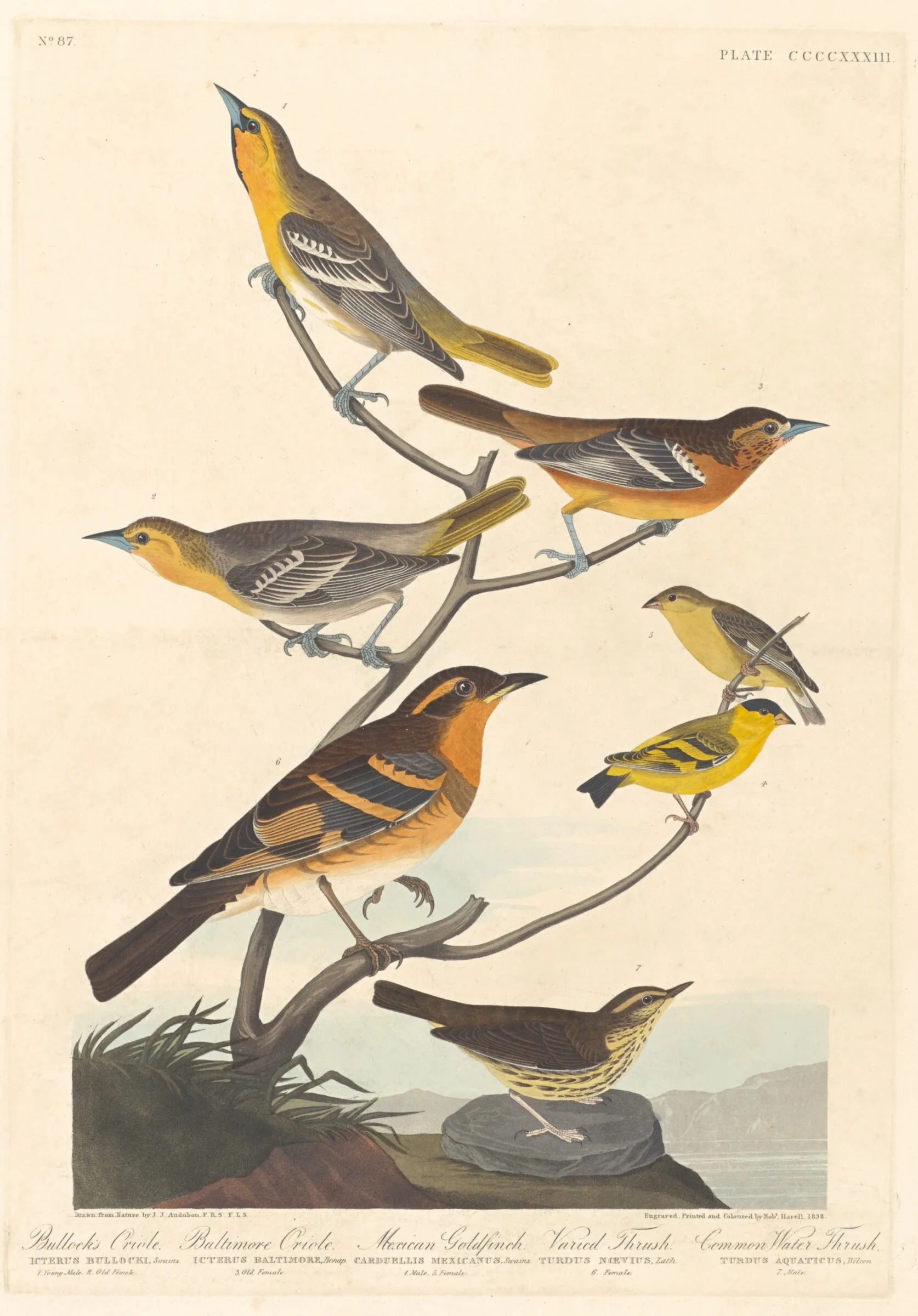
Bullock's Oriole, Baltimore Oriole, Lesser Goldfinch, Varied Thrush and Northern Waterthrush (Plate 433)
Audubon's “Bullock's Oriole, Baltimore Oriole, Mexican Goldfinch and Varied Thrush”, The Birds of America, plate CDXXXIII
Click or press Enter to enlarge
Open the full-resolution image (2996 px, National Gallery of Art)
| Plate | 433 (CDXXXIII) |
|---|---|
| Audubon's name | Bullock's Oriole, Baltimore Oriole, Mexican Goldfinch and Varied Thrush |
| Modern names | Bullock's Oriole, Baltimore Oriole, Lesser Goldfinch (black-backed form), Varied Thrush, Northern Waterthrush |
| Scientific names | Icterus bullockii, Icterus galbula, Spinus psaltria, Ixoreus naevius, Parkesia noveboracensis |
| Status | Least Concern |
| Engraved by | Robert Havell, after Audubon's watercolor |
| Date | 1838 |
| Medium | Hand-colored engraving and aquatint on Whatman wove paper |
| Collections | Songbirds |
| This impression | National Gallery of Art, Washington, 1945.8.433; Gift of Mrs. Walter B. James |
About this plate
Plate 433 gathers birds that complete earlier plates. It shows a young male and adult female Bullock's Oriole and an adult female Baltimore Oriole. There are a male and female of the Mexican Goldfinch, drawn from skins sent by William Swainson, and a female Varied Thrush to go with the male of an earlier plate. A Common Water Thrush completes the group.
The Mexican Goldfinch is the black-backed form of the Lesser Goldfinch, the same species as the green-backed Arkansaw Siskin of plate 400. Audubon admitted it on the grounds that it occurred in Upper California. The chapter on the Baltimore Oriole corrects Wilson. Audubon had watched hand-reared males reach full adult colour by their first autumn, not their third year.
The waterthrush chapter contains a mistake. Audubon had earlier described the Louisiana Water Thrush, plate 19, as distinct, but here he retracted it and treated both as one species. They are in fact two: the Louisiana Waterthrush of southern streams and the Northern Waterthrush, which breeds in northern bogs and swamps. The bird on this plate is the Northern Waterthrush, Parkesia noveboracensis. The Varied Thrush, an orange and slate thrush of wet Pacific forests, is now Ixoreus naevius. All the species here are listed as Least Concern.
Edward Harris and John Woodhouse Audubon collected waterthrushes migrating along the Texas coast in April and May 1837.
Birds on this plate
- Bullock's Oriole Icterus bullockii (young male and adult female). Least Concern
- Baltimore Oriole Icterus galbula (adult female). Least Concern
- Lesser Goldfinch (black-backed form) Spinus psaltria: Audubon's Mexican Goldfinch (male and female). Least Concern
- Varied Thrush Ixoreus naevius (female). Least Concern
- Northern Waterthrush Parkesia noveboracensis: Audubon's Common Water Thrush (male). Least Concern
In Audubon's words
Although I was for many years convinced that two distinct species have been confounded under the name of Water Thrush, yet a more strict examination of individuals of these supposed species has induced me to retract the opinion expressed at p. 99 of my first volume, and to consider the bird represented in Plate XIX, and that figured in Plate CCCCXXXIII, as belonging to one and the same species. The reasons for this amendment will be found below. The difference in the habits of these two alleged species may be accounted for by the southern birds having been observed by me at home as it were, while those seen in the northern parts were strangers only passing through the country.
John James Audubon, Ornithological Biography, vol. 5 (1839), “Common Water Thrush”. Read the full chapter.



