Wild Turkey Hen and Young (Plate 6)
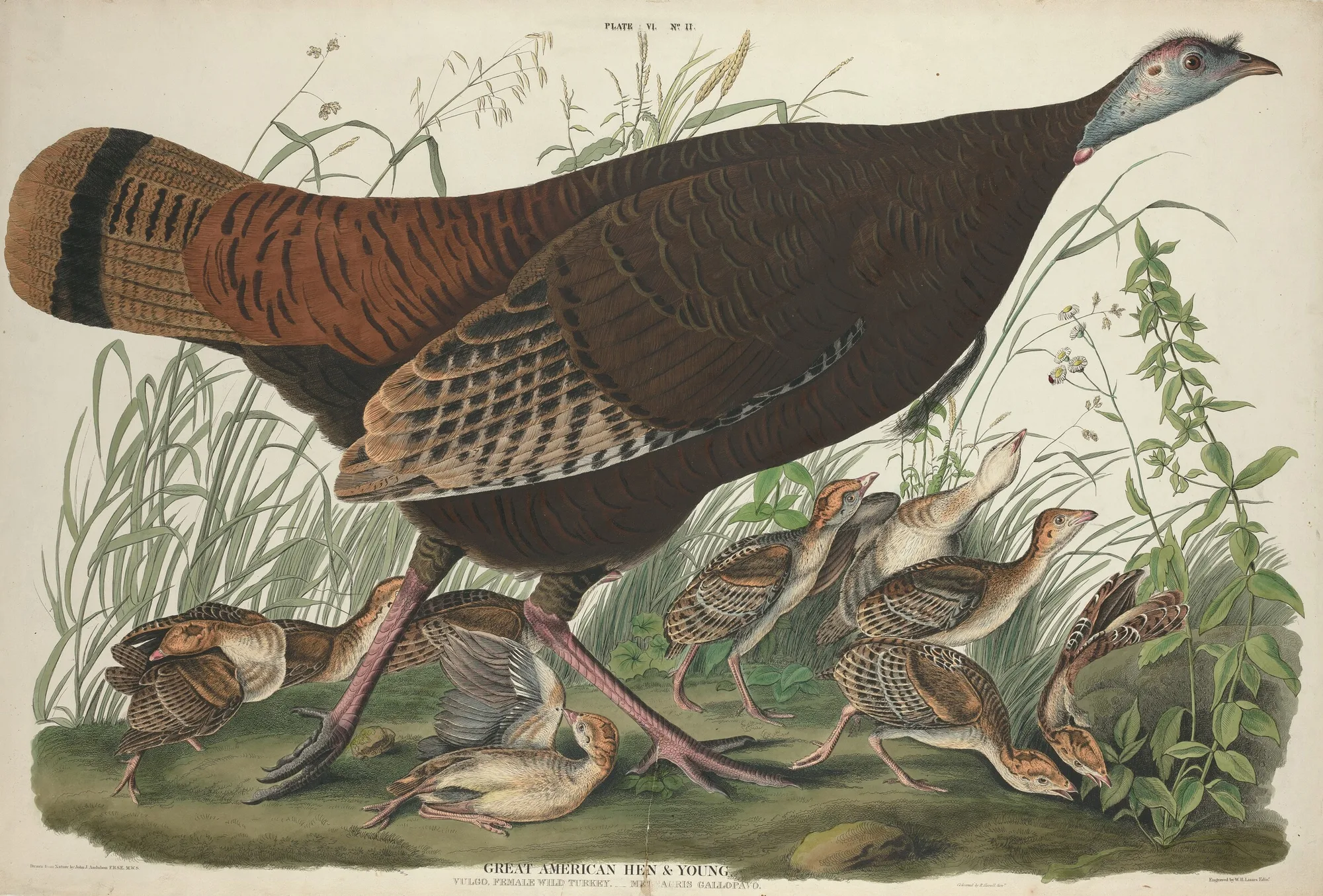
Audubon's “Great American Hen and Young”, The Birds of America, plate VI
Click or press Enter to enlarge
Open the full-resolution image (4933 px, National Gallery of Art)
| Plate | 6 (VI) |
|---|---|
| Audubon's name | Great American Hen and Young |
| Modern name | Wild Turkey |
| Scientific name | Meleagris gallopavo |
| Status | Least Concern |
| Engraved by | William Home Lizars, after Audubon's watercolor |
| Date | 1827 |
| Medium | Etching and engraving with hand coloring on Whatman paper |
| Collections | Turkeys, Grouse and Game Birds |
| This impression | National Gallery of Art, Washington, 1945.8.6; Gift of Mrs. Walter B. James |
About this plate
Plate 6 shows a Wild Turkey hen walking with her brood of downy chicks. Audubon described the scene himself: the chicks run among her feet chasing insects, one is picking at its first feathers, and another is removing a tick from its small wing. The hen walks with a measured step and a watchful eye. The plate was engraved by William Home Lizars in Edinburgh in 1827.
It is the companion to Plate 1, the Great American Cock. In this second chapter Audubon added notes on the turkey's flight. He wrote that it rises with strong wingbeats to the tops of large trees and then sails for hundreds of yards. On landing it must run a few yards because of its weight. He also recorded how hard it was to hold a wounded cock.
The species is the Wild Turkey, Meleagris gallopavo. The hen is smaller and duller than the male and lacks spurs and the large wattles. Audubon measured the female at just over three feet long with a wingspan of four feet six inches, and described the down of chicks a few days old as pale brownish yellow, spotted with black on the back.
Wild Turkeys nest on the ground. The hen alone incubates and leads the young, which can feed themselves within a day of hatching. The species was nearly eliminated from much of its range by the early 1900s. It has since been restored across most of the United States and is listed as Least Concern.
In Audubon's words
The Male Turkey has already been described, and you have seen that magnificent bird roaming in the forests, approaching the haunts of man, and performing all the offices for which he is destined in the economy of nature. Here you have his mate, now converted into a kind and anxious parent, leading her young progeny, with measured step and watchful eye, through the intricacies of the forest. The chickens, still covered with down, are running among her feet in pursuit of insects. One is picking its sprouting plumelets, while another is ridding itself of a tick which has fastened upon its little wing.
John James Audubon, Ornithological Biography, vol. 1 (1831), “The Wild Turkey”. Read the full chapter.