Common Grackle (Plate 7)
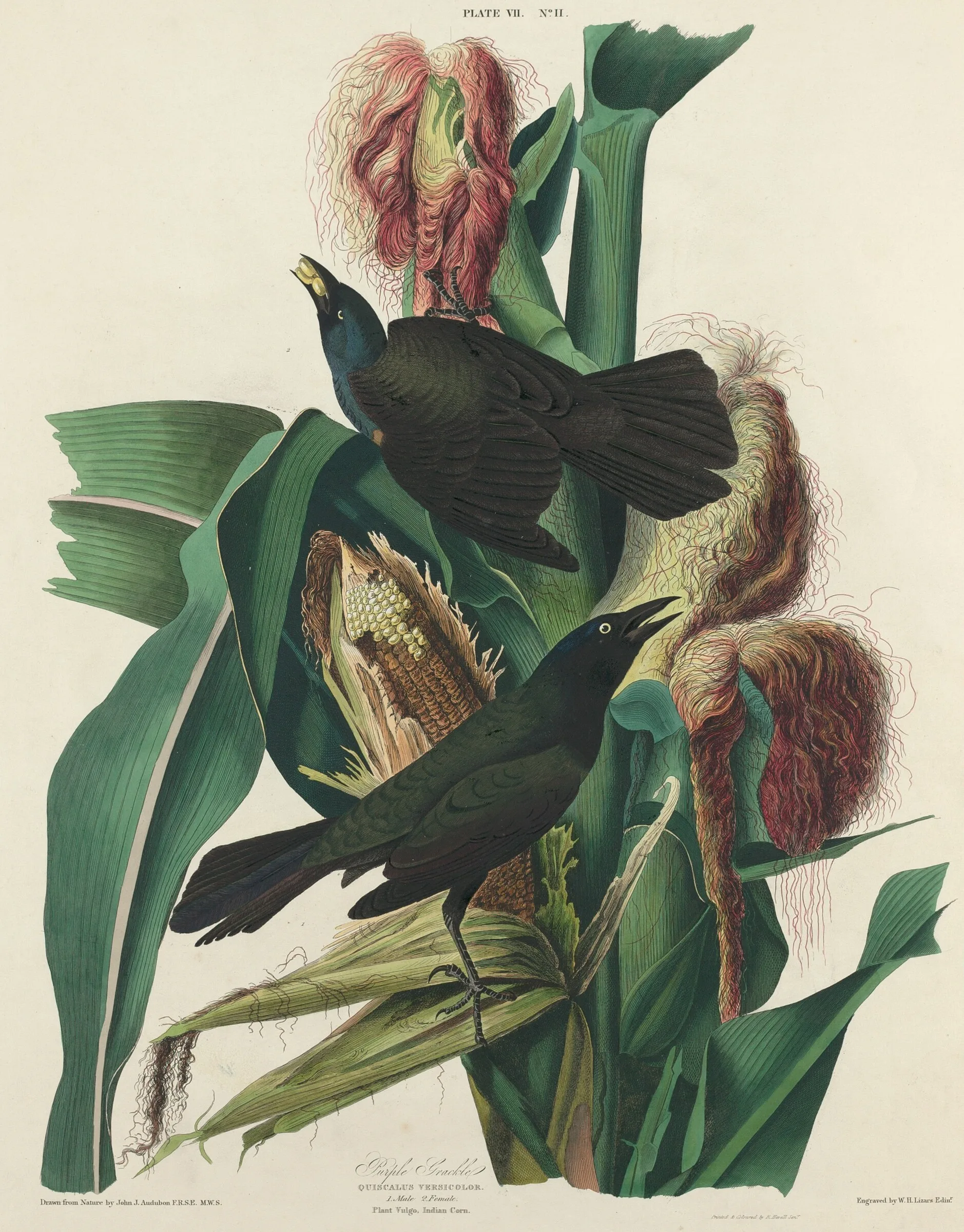
Audubon's “Purple Grackle”, The Birds of America, plate VII
Click or press Enter to enlarge
Open the full-resolution image (3227 px, National Gallery of Art)
| Plate | 7 (VII) |
|---|---|
| Audubon's name | Purple Grackle |
| Modern name | Common Grackle |
| Scientific name | Quiscalus quiscula |
| Status | Near Threatened |
| Engraved by | William Home Lizars, after Audubon's watercolor |
| Date | 1827 |
| Medium | Etching and engraving with hand coloring on Whatman paper |
| Plants and setting | Maize (corn), an ear with the husk torn open |
| Collections | Songbirds |
| This impression | National Gallery of Art, Washington, 1945.8.7; Gift of Mrs. Walter B. James |
About this plate
Plate 7 shows a male and female Common Grackle on an ear of green corn with the husk torn back and many grains eaten. Audubon explained the scene. The male has swelled his throat and is calling his companions to join the plunder, while the female, with a full bill, is about to fly off to her waiting brood. The plate was engraved by William Home Lizars in 1827.
Audubon knew the grackle as a year-round bird of Louisiana. He described flocks following the plough to eat grubs and worms, and argued that farmers should remember this service before shooting the birds when the corn ripened. In November huge flocks arrived from the eastern states and covered the trees at the edges of the forest.
Audubon's Purple Grakle is today's Common Grackle, Quiscalus quiscula. The name Purple Grackle survives for the purple-headed form of the southeast. Audubon used the scientific name Quiscalus versicolor.
The Common Grackle breeds across North America east of the Rocky Mountains and is still one of the most numerous birds on the continent. Its population has fallen by more than half since the 1970s, and the IUCN moved it from Least Concern to Near Threatened in 2018. It is still treated as a crop pest in parts of its range.
In Audubon's words
I could not think of any better mode of representing these birds than that which I have adopted, as it exhibits them in the exercise of their nefarious propensities. Look at them: The male, as if full of delight at the sight of the havoc which he has already committed on the tender, juicy, unripe corn on which he stands, has swelled his throat, and is calling in exultation to his companions to come and assist him in demolishing it. The female has fed herself, and is about to fly off with a well-loaded bill to her hungry and expectant brood, that, from the nest, look on their plundering parents, joyously anticipating the pleasures of which they shall ere long be allowed to participate. See how torn the husk is from the ear, and how nearly devoured the grains of corn already are! This is the tithe our Blackbirds take from our planters and farmers; but it was so appointed, and such is the will of the beneficent Creator.
John James Audubon, Ornithological Biography, vol. 1 (1831), “Purple Grakle or Common Crow-Blackbird”. Read the full chapter.



