Canada Warbler (Plate 5)
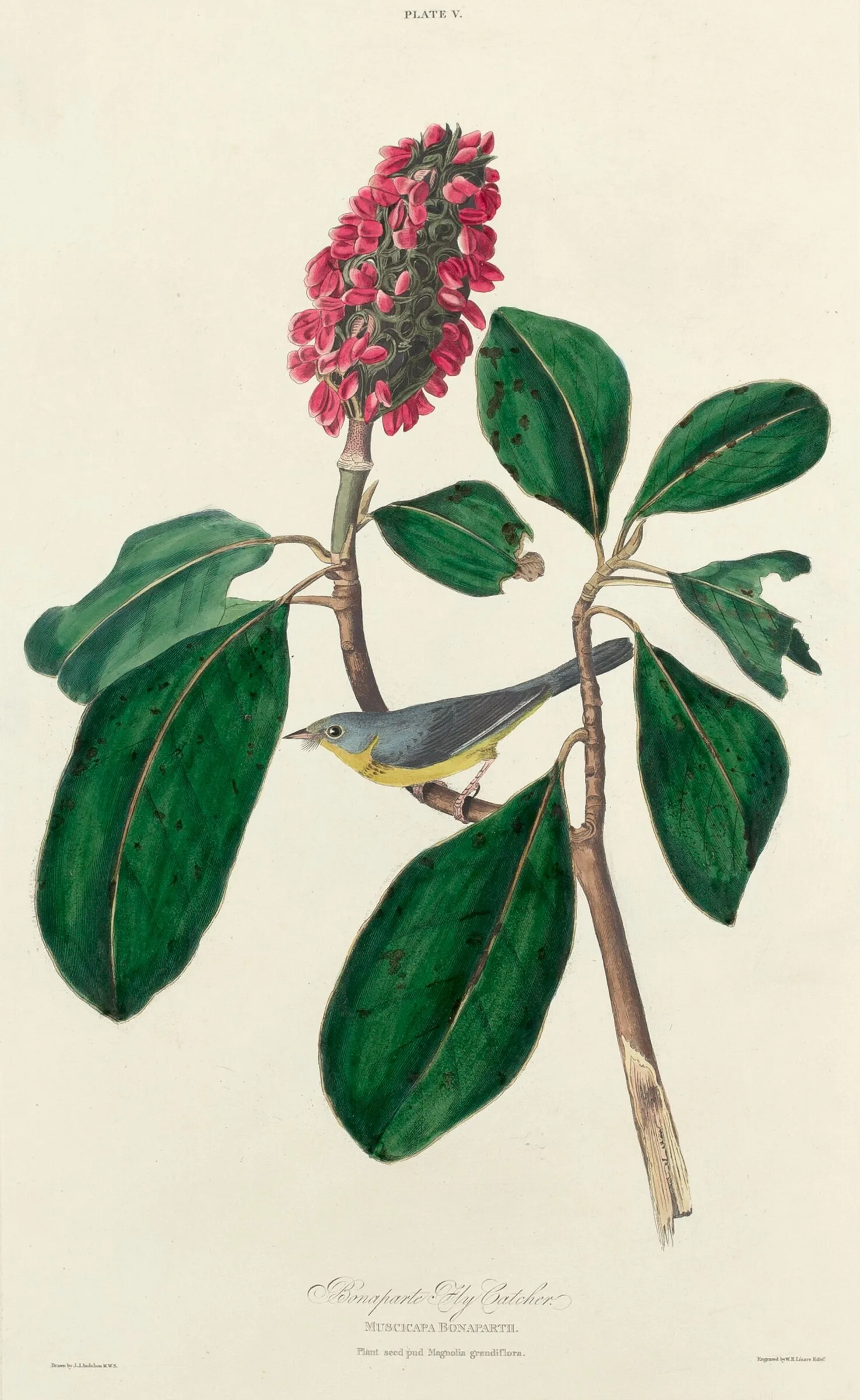
Audubon's “Bonaparte Fly Catcher”, The Birds of America, plate V
Click or press Enter to enlarge
Open the full-resolution image (2590 px, National Gallery of Art)
| Plate | 5 (V) |
|---|---|
| Audubon's name | Bonaparte Fly Catcher |
| Modern name | Canada Warbler (immature or female) |
| Scientific name | Cardellina canadensis |
| Status | Least Concern |
| Engraved by | William Home Lizars, after Audubon's watercolor |
| Date | 1827 |
| Medium | Etching and engraving with hand coloring on on Whatman paper |
| Plants and setting | Southern Magnolia (Magnolia grandiflora) with ripe fruit |
| Collections | Songbirds |
| This impression | National Gallery of Art, Washington, 1945.8.5; Gift of Mrs. Walter B. James |
About this plate
Plate 5 shows a small grey and yellow bird on a branch of Southern Magnolia, Magnolia grandiflora, with the ripe red-seeded fruit cone. Audubon later referred back to this plate for the fruit when he drew the magnolia flower in Plate 32. It was engraved by William Home Lizars in 1827.
Audubon named the bird after Charles Lucien Bonaparte, Prince of Musignano, as a new species. He admitted he knew nothing of its habits. His only record was a journal entry of 13 August 1821 from a cypress swamp about five miles from St Francisville, Louisiana, where he wounded one, carried it home, and drew it alive while it hopped around the room snapping its bill.
Bonaparte's Flycatcher is not a valid species. It is now treated as a Canada Warbler, Cardellina canadensis, in immature or female plumage, which lacks the bold black necklace of the adult male. The date fits, since young Canada Warblers pass through Louisiana in late summer on their way to South America. Audubon said he never saw another.
The Canada Warbler breeds in moist, shrubby forest across Canada and the northeastern United States and winters in northern South America. It is listed as Least Concern but has declined steadily over recent decades.
In Audubon's words
On reaching the spot, I found the bird was only wounded, and saw it standing still and upright as if stupified by its fall. When I approached it to pick it up, it spread its tail, opened its wings, and snapped its bill about twenty times sharply and in quick succession, as birds of the genus do when seizing insects on wing. I carried it home, and had the pleasure of drawing it while alive and full of spirit. It often made off from my hand, by starting suddenly, and then would hop round the room as quickly as a Carolina Wren, uttering its tweet, tweet, tweet all the while, and snapping its bill every time I took it up. I put it into a cage for a few minutes, but it obstinately thrust its head through the lower parts of the wires. I relieved it from this sort of confinement, and allowed it to go about the room. Next day it was very weak and ruffled up, so I killed it and put it in spirits.
John James Audubon, Ornithological Biography, vol. 1 (1831), “Bonaparte's Fly-catcher”. Read the full chapter.



