Cliff Swallow (Plate 68)
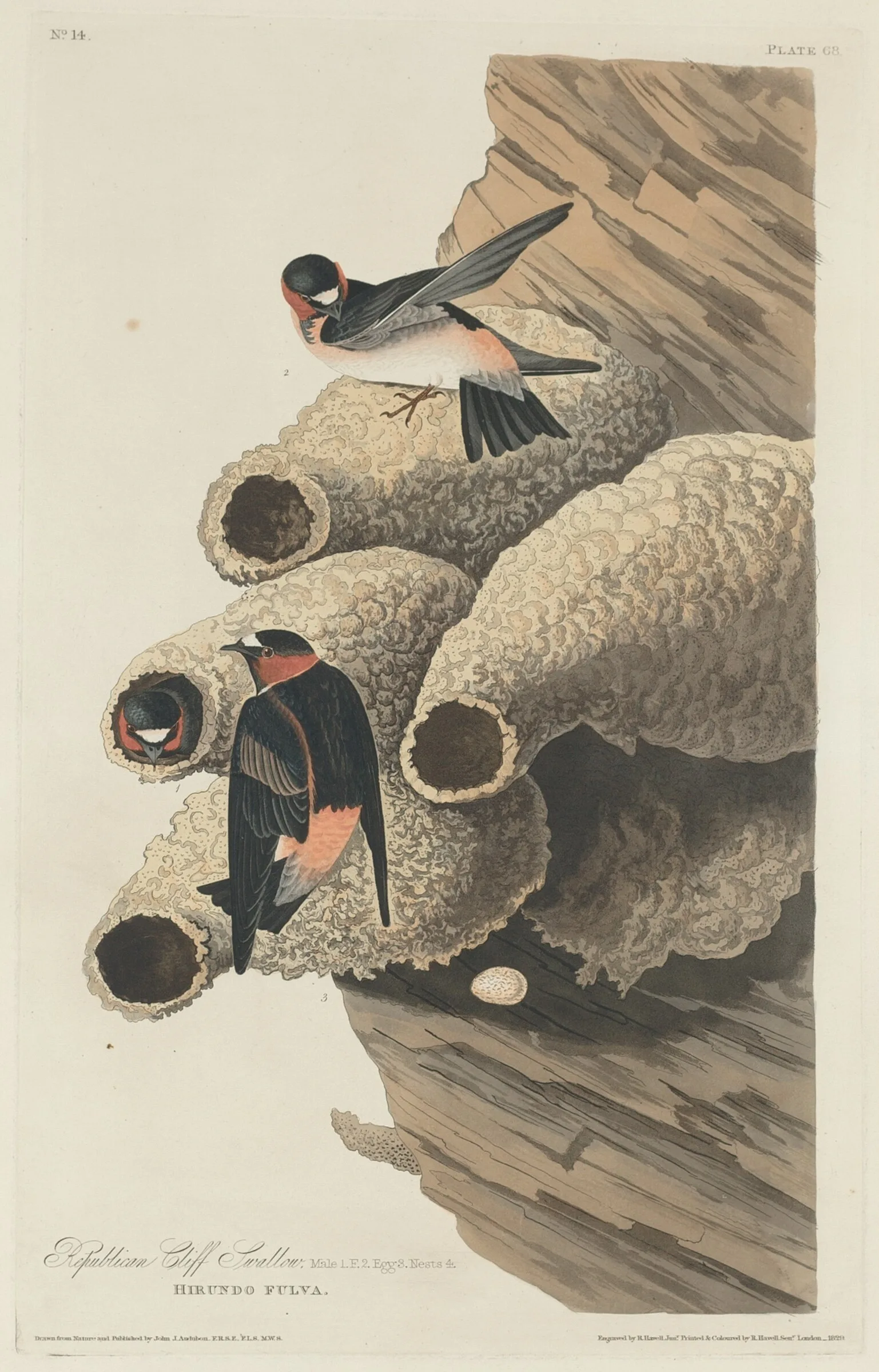
Audubon's “Republican Cliff Swallow”, The Birds of America, plate LXVIII
Click or press Enter to enlarge
Open the full-resolution image (2592 px, National Gallery of Art)
| Plate | 68 (LXVIII) |
|---|---|
| Audubon's name | Republican Cliff Swallow |
| Modern name | Cliff Swallow |
| Scientific name | Petrochelidon pyrrhonota |
| Status | Least Concern |
| Engraved by | Robert Havell, after Audubon's watercolor |
| Date | 1829 |
| Medium | Hand-colored engraving and aquatint on Whatman wove paper |
| Collections | Songbirds |
| This impression | National Gallery of Art, Washington, 1945.8.68; Gift of Mrs. Walter B. James |
About this plate
Plate 68 shows a male and female Cliff Swallow with a cluster of their gourd-shaped mud nests, each with a narrow entrance tube. Audubon named the bird the Republican Swallow because so many pairs build side by side and work together as a colony.
He first saw a few in spring 1815 at Henderson, Kentucky, on a morning so cold that most of them died. He wrote a description and named the species, but his assistant lost the specimens. In 1819 Robert Best, curator of the Western Museum in Cincinnati, told him of strange swallows building nests in clusters. Audubon crossed the Ohio to Newport, Kentucky, and found the colony on the walls of the army arsenal. Major Oldham, the commandant, told him the birds had first come in 1815 and now numbered several hundred.
Audubon's heading uses Vieillot's name Hirundo fulva, which today belongs to the Cave Swallow; the Cliff Swallow is Petrochelidon pyrrhonota. The species once nested mainly on western cliffs and spread east as barns, bridges and buildings gave it new sites. It gathers mud at puddles and riverbanks and breeds across most of North America, then migrates to southern South America. It is listed as Least Concern.
In Audubon's words
In the year 1819, my hopes were revived by Mr Robert Best, curator of the Western Cincinnati Museum, who informed me that a strange species of bird had made its appearance in the neighbourhood, building nests in clusters, affixed to the walls. In consequence of this information, I immediately crossed the Ohio to New Port, in Kentucky, where he had seen many nests the preceding season; and no sooner were we landed than the chirruping of my long-lost little strangers saluted my ear. Numbers of them were busily engaged in repairing the damage done to their nests by the storms of the preceding winter. Major Oldham of the United States' Army, then commandant of the garrison, politely offered us the means of examining the settlement of these birds, attached to the walls of the building under his charge.
John James Audubon, Ornithological Biography, vol. 1 (1831), “The Republican or Cliff Swallow”. Read the full chapter.



