Red-winged Blackbird (Plate 67)
Audubon's “Red-winged Starling”, The Birds of America, plate LXVII
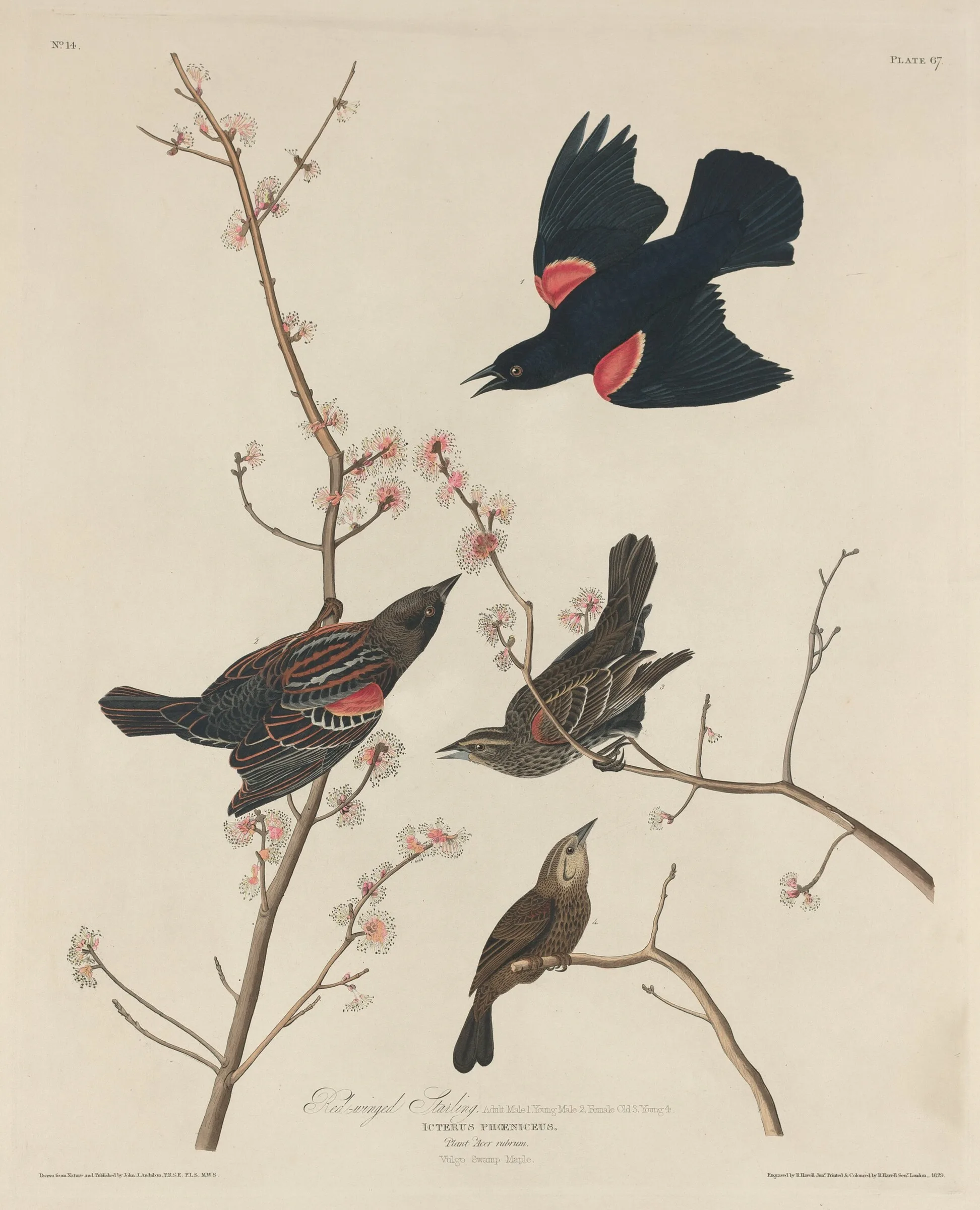
Click or press Enter to enlarge
Open the full-resolution image (3445 px, National Gallery of Art)
| Plate | 67 (LXVII) |
|---|---|
| Audubon's name | Red-winged Starling |
| Modern name | Red-winged Blackbird |
| Scientific name | Agelaius phoeniceus |
| Status | Least Concern |
| Engraved by | Robert Havell, after Audubon's watercolor |
| Date | 1829 |
| Medium | Hand-colored engraving and aquatint on Whatman wove paper |
| Size | plate: 66 x 53 cm (26 x 20 7/8 in.) sheet: 100 x 67.3 cm (39 3/8 x 26 1/2 in.) |
| Collections | Songbirds |
| This impression | National Gallery of Art, Washington, 1945.8.67; Gift of Mrs. Walter B. James |
About this plate
Plate 67 shows Red-winged Blackbirds at several ages: glossy black adult males with scarlet and buff shoulder patches, younger males still mottled, the streaked brown female, and young birds. Audubon wanted the plate to show how the male's plumage changes before it reaches full dress.
Audubon objected to the name starling, saying the bird resembles the European Starling only in flocking. He described the spring return in straggling flocks, males first and in full song, reaching the eastern states while snow still lay along the fences. He defended the bird against farmers: it does eat corn, rice and grain in late summer, but in spring it destroys great numbers of grubs, worms and caterpillars in the fields.
He also described autumn roosts in reed beds, where huge flocks settle at dusk, and noted that Pigeon Hawks and Hen-harriers follow them all winter in the South. The Red-winged Blackbird is one of the most abundant birds in North America. It breeds in marshes, wet ditches and hayfields from Alaska and Canada to Central America. Males defend territories with a gurgling song while spreading their red epaulets. It is listed as Least Concern.
In Audubon's words
As soon as spring makes its appearance, almost all the Redwings leave the Southern States, in small detached and straggling flocks, the males leading the way in full song, as if to invite the females to follow. Prodigious numbers make their appearance in the Eastern Districts, as winter recedes, and are often seen while piles of drifted snow still remain along the roads, under shelter of the fences. They frequently alight on trees of moderate size, spread their tail, swell out their plumage, and utter their clear and not unmusical notes, particularly in the early morning, before their departure from the neighbourhood of the places in which they have roosted; for their migrations, you must know, are performed entirely during the day.
John James Audubon, Ornithological Biography, vol. 1 (1831), “The Red-winged Starling, or Marsh Blackbird”. Read the full chapter.



