Henslow's Sparrow (Plate 70)
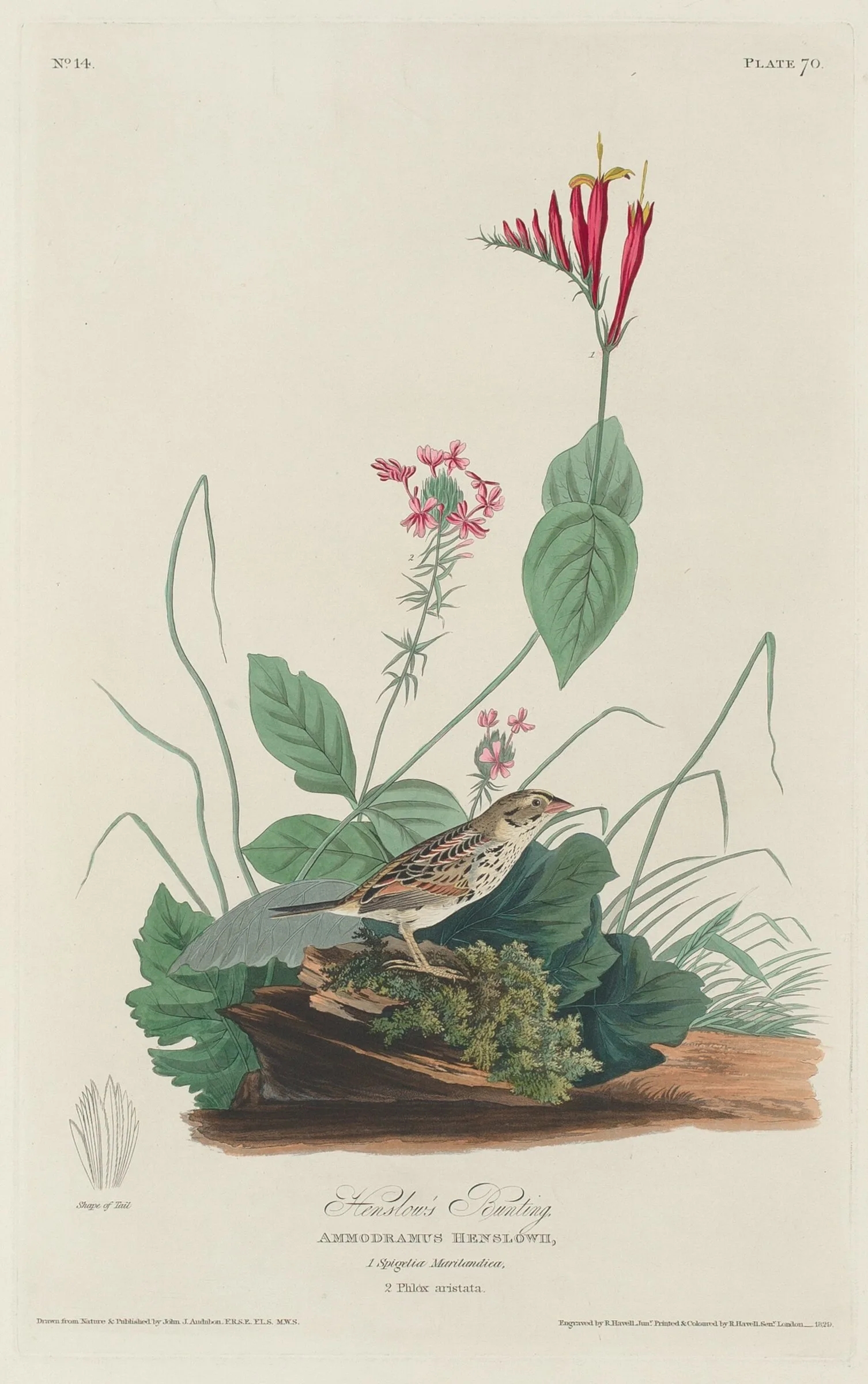
Audubon's “Henslow's Bunting”, The Birds of America, plate LXX
Click or press Enter to enlarge
Open the full-resolution image (2407 px, National Gallery of Art)
| Plate | 70 (LXX) |
|---|---|
| Audubon's name | Henslow's Bunting |
| Modern name | Henslow's Sparrow |
| Scientific name | Centronyx henslowii |
| Status | Least Concern |
| Engraved by | Robert Havell, after Audubon's watercolor |
| Date | 1829 |
| Medium | Hand-colored engraving and aquatint on Whatman wove paper |
| Collections | Songbirds |
| This impression | National Gallery of Art, Washington, 1945.8.70; Gift of Mrs. Walter B. James |
About this plate
Plate 70 shows a single Henslow's Sparrow, a small, short-tailed grassland sparrow with a flat olive head, streaked breast and rusty wings. Audubon wrote that he found it in tall grass on the Kentucky bank of the Ohio opposite Cincinnati in 1820, while out with Robert Best, curator of the Western Museum. Seeing it was new to him, he shot it and drew it the same day.
He named it for the Rev. John Stevens Henslow, professor of botany at Cambridge, who had been kind to him in England and agreed to the name. Henslow is now best known as the teacher who recommended Charles Darwin for the voyage of the Beagle. Audubon placed the bird among the buntings for want of a better genus and said its habits were unknown. It is now in the genus Centronyx.
Henslow's Sparrow lives in tall, dense grassland, wet meadows and old hayfields in the Midwest and East, and winters in pine savannas and grassy openings of the Southeast. It is secretive and is most often detected by the male's short hiccup of a song, one of the shortest of any songbird. It declined sharply with the loss of native grassland but has used some conservation grasslands and reclaimed mines. It is listed as Least Concern.
In Audubon's words
I obtained the bird represented in this plate opposite Cincinnati, in the State of Kentucky, in the year 1820, whilst in the company of Mr Robert Best, then Curator of the Western Museum. It was on the ground, amongst tall grass, and exhibited the usual habits of its tribe. Perceiving it to be different from any which I had seen, I immediately shot it, and the same day made an accurate drawing of it. In naming it after the Rev. Professor Henslow of Cambridge, a gentleman so well known to the scientific world, and who has permitted me so to designate it, my object has been to manifest my gratitude for the many kind attentions which he has shewn towards me. Its history and habits are unknown. In appearance it differs so little from the Buntings, that, for the present, I shall refer it to that genus.
John James Audubon, Ornithological Biography, vol. 1 (1831), “Henslow's Bunting”. Read the full chapter.



