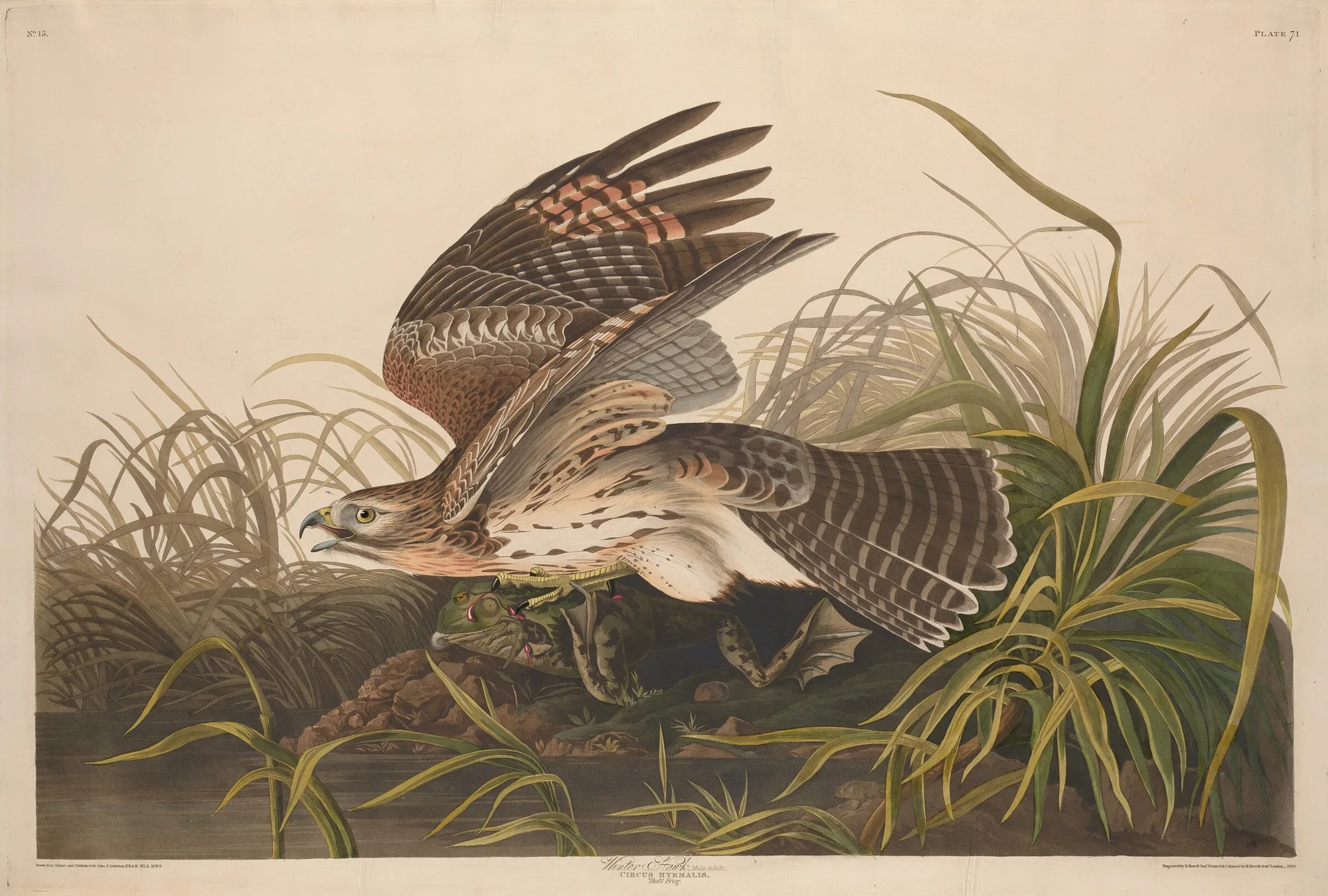
Red-shouldered Hawk (immature) (Plate 71)
Audubon's “Winter Hawk”, The Birds of America, plate LXXI
Click or press Enter to enlarge
Open the full-resolution image (4556 px, National Gallery of Art)
| Plate | 71 (LXXI) |
|---|---|
| Audubon's name | Winter Hawk |
| Modern name | Red-shouldered Hawk (immature) |
| Scientific name | Buteo lineatus |
| Status | Least Concern |
| Engraved by | Robert Havell, after Audubon's watercolor |
| Date | 1829 |
| Medium | Hand-colored engraving and aquatint on Whatman wove paper |
| Collections | Hawks, Eagles and Falcons |
| This impression | National Gallery of Art, Washington, 1945.8.71; Gift of Mrs. Walter B. James |
About this plate
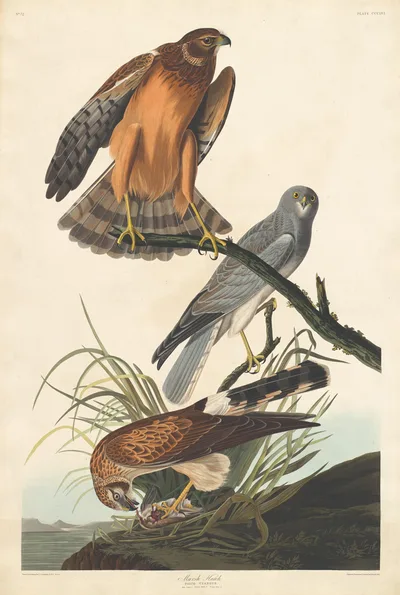
Plate 71 shows the bird Audubon called the Winter Hawk. He used the chapter to argue that each hawk has its own look, voice and habits, and that a practised observer can name a distant hawk as easily as an old friend recognised by his walk. On that basis he insisted the Winter Hawk and the Red-shouldered Hawk, plate 56, were distinct species.
He was wrong. The Winter Hawk, Falco hyemalis of Gmelin and the Winter Falcon of Alexander Wilson, is the immature Red-shouldered Hawk, which is browner and streaked below rather than barred with rufous. Audubon's mistake was common in his day, when many hawk plumages by age were not yet sorted out. The plate is still a careful portrait of a young bird of the species.
Audubon described the Winter Hawk hunting the meadows and marshes along rivers, watching from a perch or a haystack and dropping on frogs, its favourite food. He saw one wait at the water's edge for a bullfrog that had escaped into the water. These habits fit the Red-shouldered Hawk, which feeds heavily on amphibians and snakes in wet woodland. The species is common in the eastern United States and California and is listed as Least Concern.
In Audubon's words
Its haunts are the extensive meadows and marshes which occur along our rivers. There it pounces with a rapid motion on the frogs, which it either devours on the spot, or carries to the perch, or the top of the hay-stack, on which it previously stood. If it seizes a small frog, it swallows it whole and at once; but if a large one, it first tears it to pieces. The appetite of the Winter Hawk may be said to be ravenous. It seldom gives up eating, when food is plentiful, until it has gorged itself so as to seem on the point of being suffocated. At such times, it flies heavily, but removes farther at once from a person who pursues it, than when its stomach is empty, as if at one effort to ensure its safety, and afterwards enjoy the digestion of its food in quiet.
John James Audubon, Ornithological Biography, vol. 1 (1831), “The Winter Hawk”. Read the full chapter.