Northern Bobwhite (Plate 76)
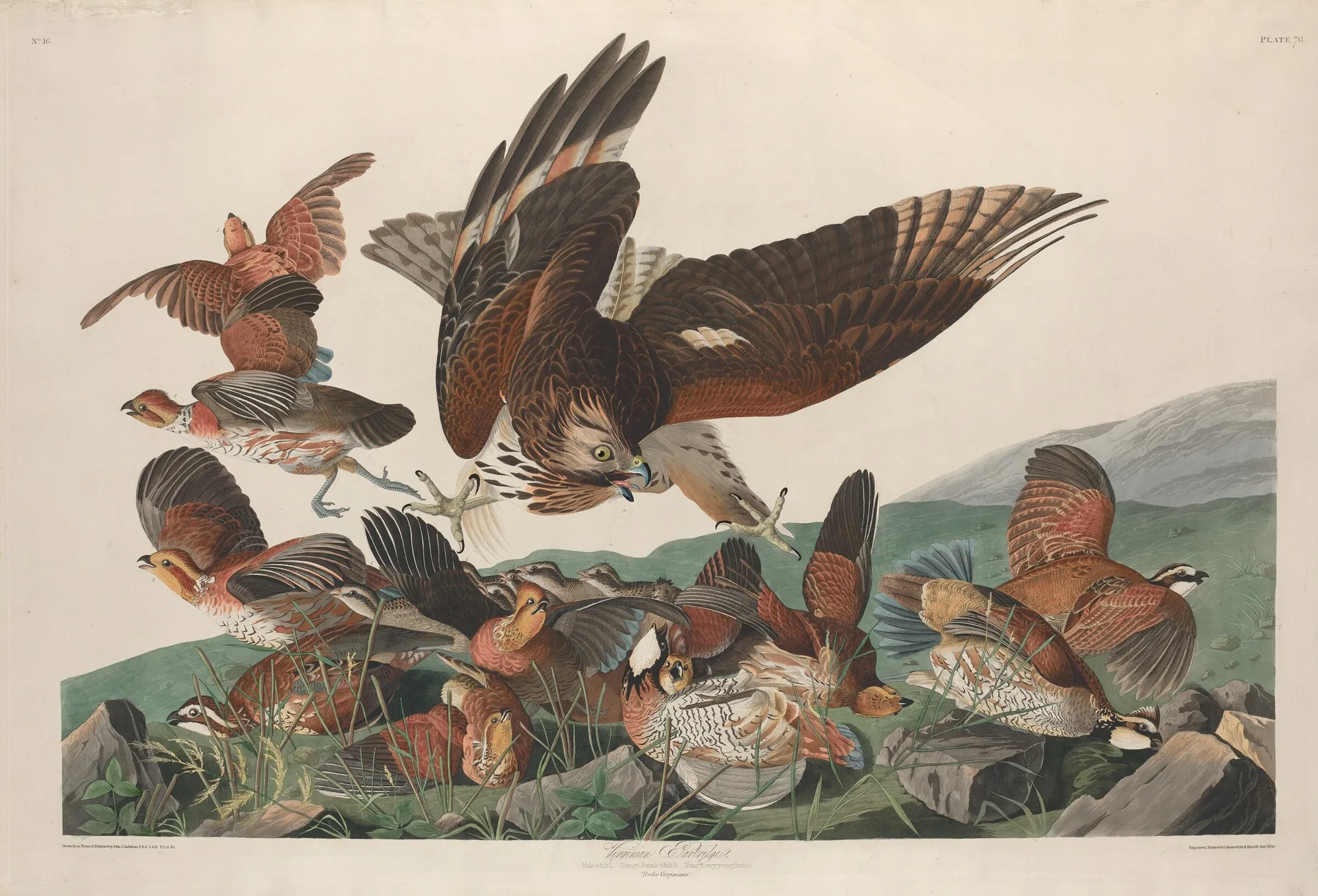
Audubon's “Virginian Partridge”, The Birds of America, plate LXXVI
Click or press Enter to enlarge
Open the full-resolution image (4499 px, National Gallery of Art)
| Plate | 76 (LXXVI) |
|---|---|
| Audubon's name | Virginian Partridge |
| Modern names | Northern Bobwhite, Red-shouldered Hawk (immature) |
| Scientific names | Colinus virginianus, Buteo lineatus |
| Status | Least Concern, Near Threatened |
| Engraved by | Robert Havell, after Audubon's watercolor |
| Date | 1830 |
| Medium | Hand-colored engraving and aquatint on Whatman wove paper |
| Size | plate: 64.8 x 96.8 cm (25 1/2 x 38 1/8 in.) sheet: 67 x 100.5 cm (26 3/8 x 39 9/16 in.) |
| Collections | Turkeys, Grouse and Game Birds, Hawks, Eagles and Falcons |
| This impression | National Gallery of Art, Washington, 1945.8.76; Gift of Mrs. Walter B. James |
About this plate
Plate 76 is one of Audubon's most dramatic compositions. A covey of Northern Bobwhites, males, females and young, scatters in panic on the ground as a young hawk drops on them from above. The hawk is usually identified as an immature Red-shouldered Hawk. The scene shows the birds in every posture, from crouching to bursting into flight.
Audubon noted that the bird was called Quail in the East and Partridge in the West and South. He described autumn movements in which flocks crossed the Ohio from the northwest, with weak birds falling into the river and swimming for shore, and he used this to answer a Philadelphia critic who had laughed at his claim that Wild Turkeys could swim. He also explained how parties on horseback whistled up coveys and drove them into nets.
The Northern Bobwhite is named for the male's clear bob-white whistle. It lives in brushy fields, open pine woods and farm edges from the eastern United States to Mexico and Cuba. It has declined by more than 80 percent since the 1960s as farms became cleaner and larger, old fields grew into forest and fire-maintained pine savanna was lost. It is listed as Near Threatened and is the focus of large habitat programmes across the South.
Birds on this plate
- Northern Bobwhite Colinus virginianus: Audubon's Virginian Partridge (males, females and young). Near Threatened
- Red-shouldered Hawk (immature) Buteo lineatus (young hawk attacking the covey). Least Concern
In Audubon's words
This species performs occasional migrations from the north-west to the south-east, usually in the beginning of October, and somewhat in the manner of the Wild Turkey. For a few weeks at this season, the north-western shores of the Ohio are covered with flocks of Partridges. They ramble through the woods along the margin of the stream, and generally fly across towards evening. Like the Turkeys, many of the weaker Partridges often fall into the water, while thus attempting to cross, and generally perish; for although they swim surprisingly, they have not muscular power sufficient to keep up a protracted struggle, although, when they have fallen within a few yards of the shore, they easily escape being drowned. I have been told by a friend that a person residing in Philadelphia had a hearty laugh on hearing that I had described the Wild Turkey as swimming for some distance, when it had accidentally fallen into the water.
John James Audubon, Ornithological Biography, vol. 1 (1831), “The Virginian Partridge”. Read the full chapter.