Belted Kingfisher (Plate 77)
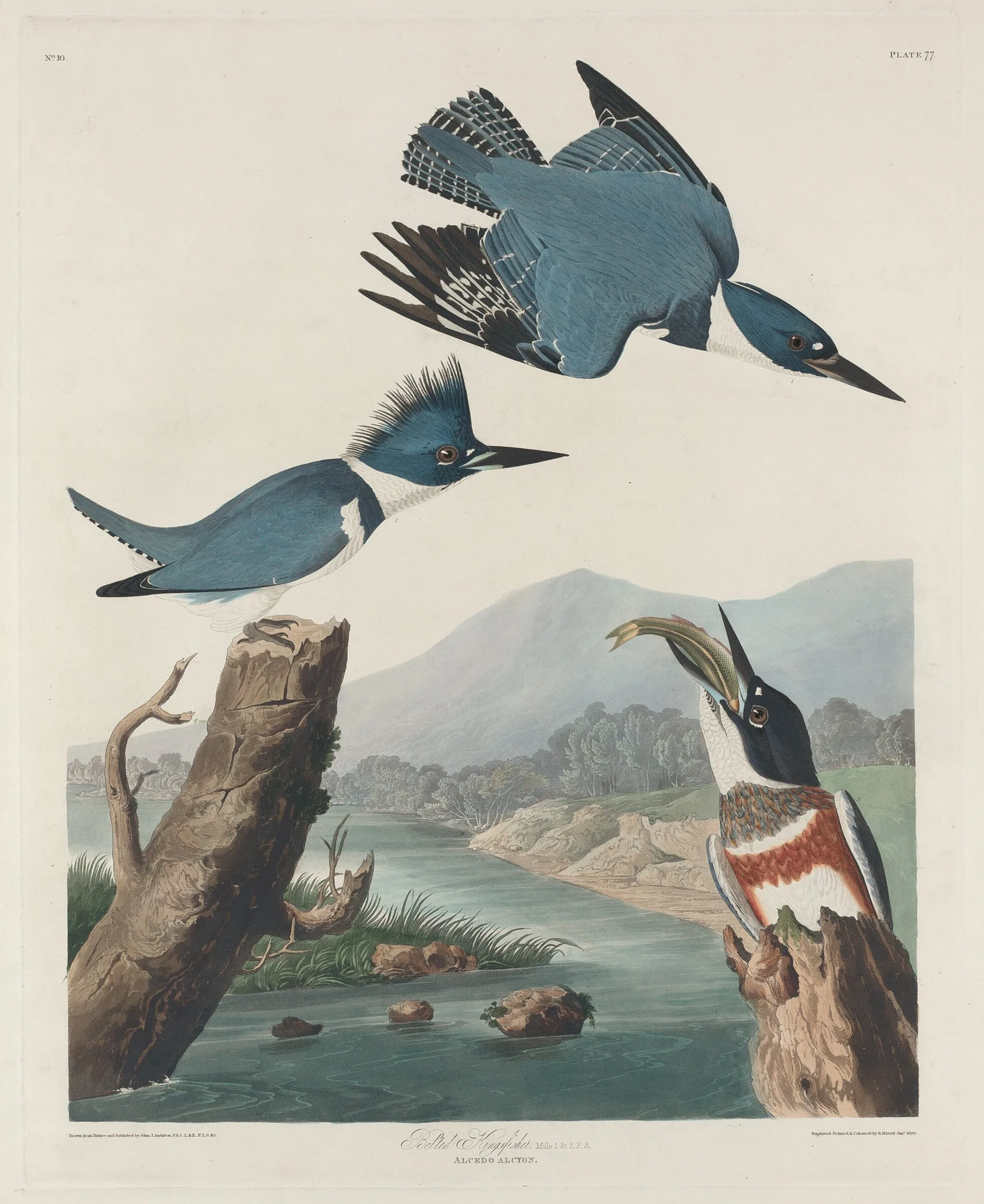
Audubon's “Belted Kingsfisher”, The Birds of America, plate LXXVII
Click or press Enter to enlarge
Open the full-resolution image (3144 px, National Gallery of Art)
| Plate | 77 (LXXVII) |
|---|---|
| Audubon's name | Belted Kingsfisher |
| Modern name | Belted Kingfisher |
| Scientific name | Megaceryle alcyon |
| Status | Least Concern |
| Engraved by | Robert Havell, after Audubon's watercolor |
| Date | 1830 |
| Medium | Hand-colored engraving and aquatint on Whatman wove paper |
| Size | plate: 65.5 x 52.6 cm (25 13/16 x 20 11/16 in.) sheet: 100.5 x 67.5 cm (39 9/16 x 26 9/16 in.) |
| Collections | Songbirds |
| This impression | National Gallery of Art, Washington, 1945.8.77; Gift of Mrs. Walter B. James |
About this plate
Plate 77 shows a male and female Belted Kingfisher, slate blue above with a ragged crest and heavy dagger bill. Audubon pointed out that the name fits the female better than the male, since only she has the second, rusty band across the belly. He said he would rather have called it the United States' Kingsfisher, because it was the only kingfisher on the inland streams of the Union.
He explained that the chapter was long because the bird was common and he had watched it often. He described pairs digging burrows in steep banks, the female flushed from the nest while her mate rattles and circles in alarm, and young birds following their parents along a branch and begging with open bills for fish. He had always seen adults swallow fish before entering the burrow.
The Belted Kingfisher breeds across nearly all of Canada and the United States wherever there is clear water with fish and an earth bank for a nest tunnel, which can be several feet long. It hovers and plunges headfirst for small fish, then beats them on a perch before swallowing. Northern birds migrate south as far as Central America and the Caribbean. It is widespread and listed as Least Concern.
In Audubon's words
The Belted Kingsfisher!—Now, kind reader, were I infected with the desire of giving new names to well-known objects, you may be assured that, notwithstanding the partly appropriate name given to this bird, I should call it, as I think it ought to have been called, the United States' Kingsfisher. My reason for this will, I hope, become apparent to you, when I say that it is the only bird of its genus found upon the inland streams of the Union. Another reason of equal force might be adduced, which is, that, although the males of all denominations have, from time immemorial, obtained the supremacy, in this particular case the term Belted applies only to the female, the male being destitute of the belt or band by which she is distinguished.
John James Audubon, Ornithological Biography, vol. 1 (1831), “The Belted Kingsfisher”. Read the full chapter.



