Brown-headed Nuthatch (Plate 125)
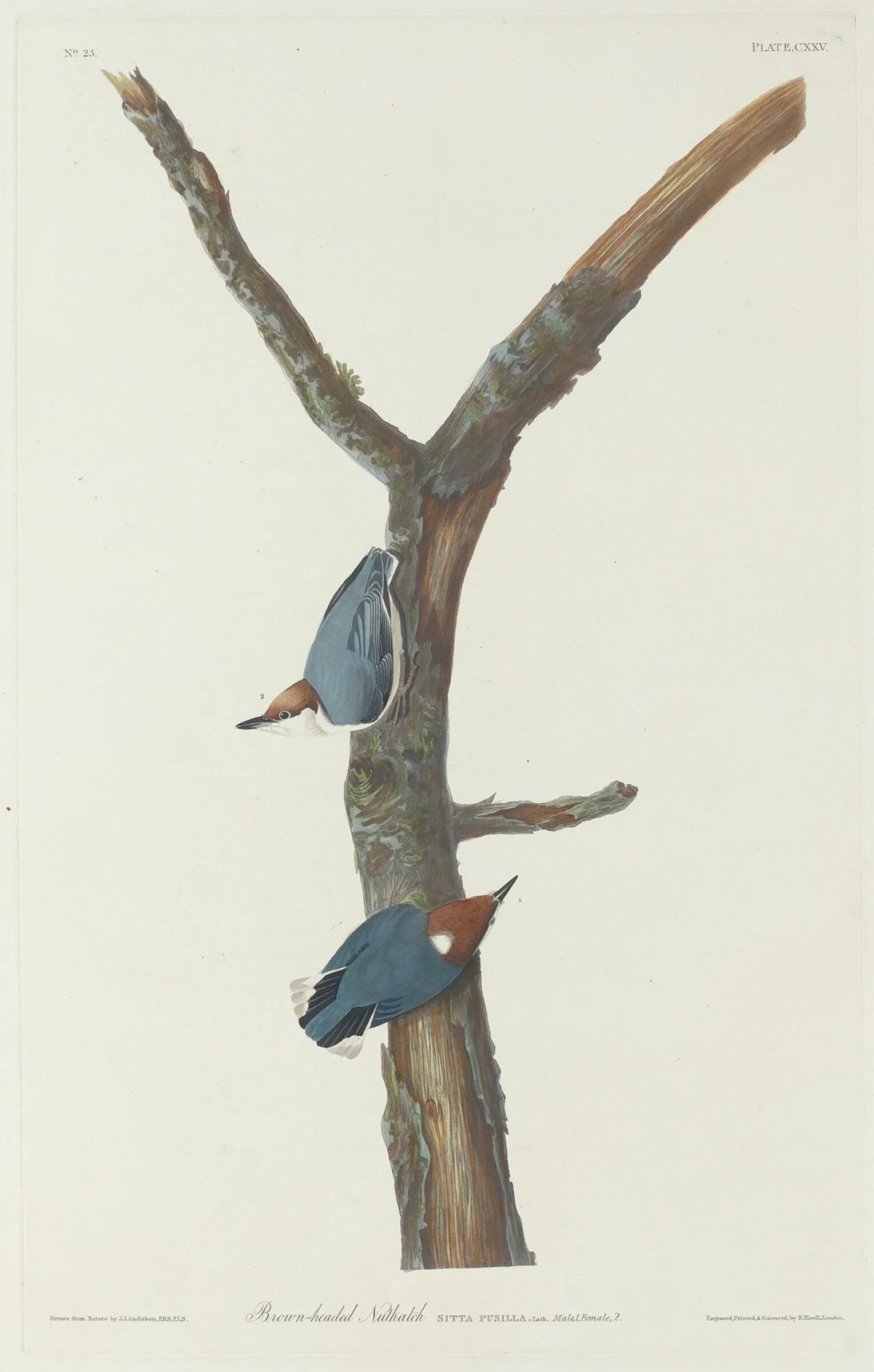
Audubon's “Brown-Headed Nuthatch”, The Birds of America, plate CXXV
Click or press Enter to enlarge
Open the full-resolution image (2445 px, National Gallery of Art)
| Plate | 125 (CXXV) |
|---|---|
| Audubon's name | Brown-Headed Nuthatch |
| Modern name | Brown-headed Nuthatch |
| Scientific name | Sitta pusilla |
| Status | Least Concern |
| Engraved by | Robert Havell, after Audubon's watercolor |
| Date | 1831 |
| Medium | Hand-colored engraving and aquatint on Whatman wove paper |
| Collections | Songbirds |
| This impression | National Gallery of Art, Washington, 1945.8.125; Gift of Mrs. Walter B. James |
About this plate
Plate 125 shows a male and a female Brown-headed Nuthatch, tiny grey birds with brown caps and a pale spot on the nape, climbing in the head-down way of nuthatches. Audubon noted that the sexes look alike, the female a little paler.
Audubon used Latham's name Sitta pusilla, which is still in use. He correctly called it the smallest nuthatch in the United States. Its squeaky calls, which he wrote as deut, deut, dend, dend, have been compared to a rubber duck.
The Brown-headed Nuthatch is a resident of open pine forests in the southeastern United States, from Delaware to East Texas and Florida. It depends on mature pines and dead snags for nest holes, so it has declined where longleaf and other pine forests were cleared. It is one of the few birds known to use tools, prying off bark with a flake of bark held in the bill. It is listed as Least Concern.
Audubon wrote that the bird lived all year in the pine woods of the South and was rarely seen east of Maryland. He described pairs digging their own nest hole in a low stump, laying four to six eggs, and flocks of fifty or more moving with woodpeckers, Brown Creepers and chickadees through Florida in November and December. The chapter is followed in the book by an episode, The Squatters of Labrador.
In Audubon's words
During the breeding period they move in pairs, and are constantly chattering. Their notes resemble the syllables deut, deut, dend, dend, and although not musical are not disagreeable, particularly when heard in the woods in which they usually reside, and where at that season a mournful silence intimates the wildness of the place. When the young have left the nest they continue together, and move from tree to tree with the activity of their parents, who join them when the succeeding broods are able to find food for themselves. Towards winter they associate with the smaller species of Woodpeckers, the Brown Creeper, and the Southern Black-headed Tit. These birds pursue their avocations with so much cheerfulness that the woods echo to their notes. I have seen a congregation of these Nuthatches, amounting to fifty or more, thus perambulating the Floridas in the months of November and December.
John James Audubon, Ornithological Biography, vol. 2 (1834), “The Brown-headed Nuthatch”. Read the full chapter.



