American Pipit (Plate 80)
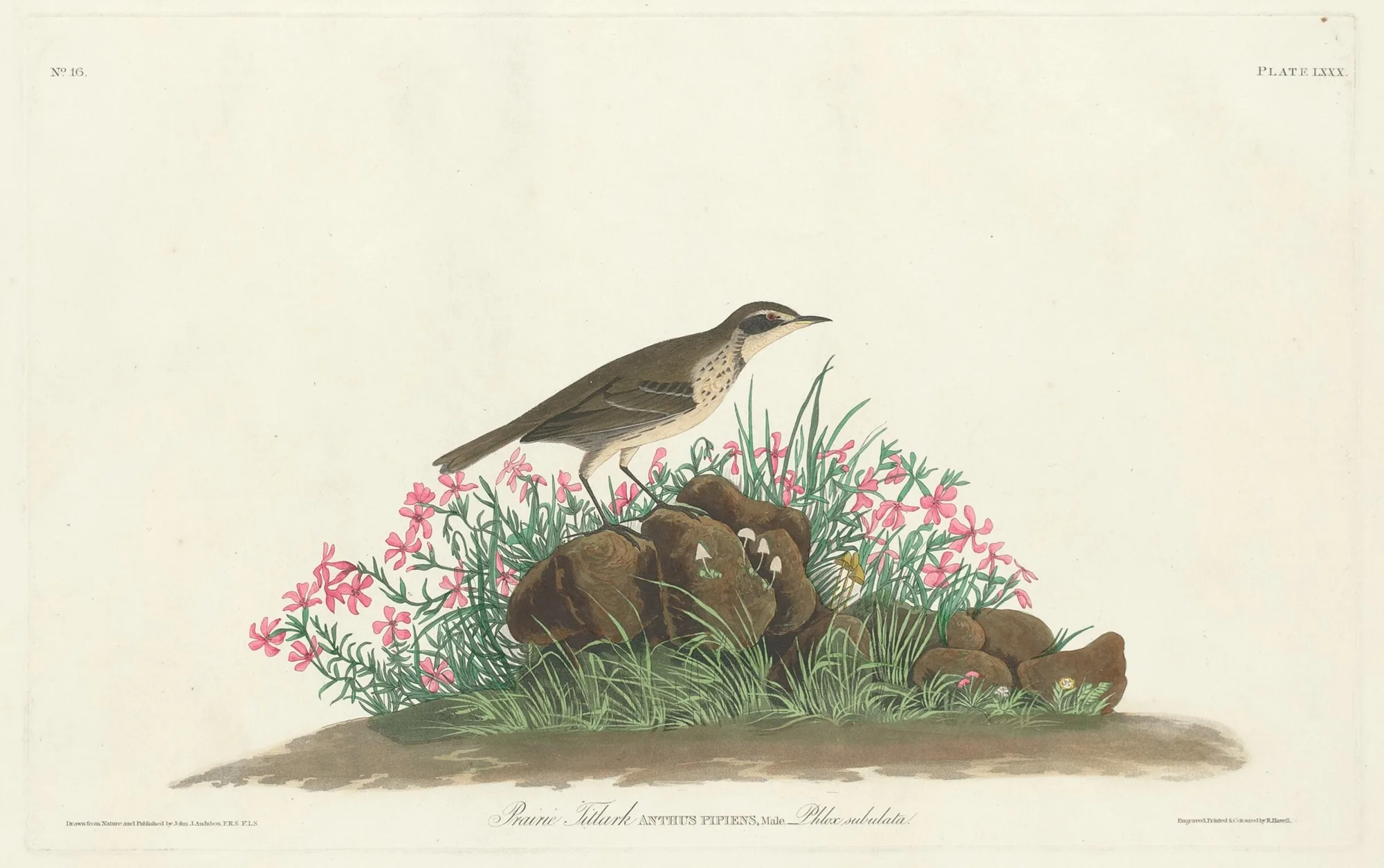
Audubon's “Prairie Titlark”, The Birds of America, plate LXXX
Click or press Enter to enlarge
Open the full-resolution image (2646 px, National Gallery of Art)
| Plate | 80 (LXXX) |
|---|---|
| Audubon's name | Prairie Titlark |
| Modern name | American Pipit |
| Scientific name | Anthus rubescens |
| Status | Least Concern |
| Engraved by | Robert Havell, Jr., after Audubon's watercolor |
| Medium | Hand-colored engraving and aquatint on J. Whatman paper |
| Collections | Songbirds |
| This impression | National Gallery of Art, Washington, 1944.6.1; Gift of Martha Hogan |
About this plate
Plate 80 shows a single Prairie Titlark, a slim, streaky brown ground bird with a thin bill and white outer tail feathers. Audubon wrote that he shot two on a prairie of the North-western States in October, from a group of five that had been running ahead of him along a footpath.
He thought them a new species, distinct from the Brown Titlark, because of their notes and plumage, and named them Anthus pipiens. They are now considered American Pipits in fall plumage, which in October is duller and more buff than in spring. His note that the birds seemed in imperfect plumage fits that reading. He described their jerky, looping flight and their habit of running briskly and wagging the tail at each stop.
The American Pipit breeds on Arctic tundra and on alpine meadows above treeline in the Rockies and other western mountains, and in northeastern Asia. In migration and winter it moves through open fields, mudflats, beaches and plowed ground across the United States and Mexico, often in loose flocks that call a thin pip-it as they flush. The species was formerly lumped with the Water Pipit of Eurasia. It is listed as Least Concern.
In Audubon's words
I shot two of these birds whilst traversing one of the extensive prairies of our North-western States. Five of them had been running along the foot-path before me, for some time. I at first looked upon them as of the Common Brown Titlark species (Anthus Spinoletta), but as they rose on the wing, the difference of their notes struck me, and, shooting at them, I had the good fortune to kill two, which I discovered, on examination, to be of a new and distinct species, although in the general appearance of their plumage they were very nearly allied to the Brown Titlark. The rest I pursued in vain, and was forced to abandon the chase on account of the approach of night, and the necessity of preparing for rest after a long walk.
John James Audubon, Ornithological Biography, vol. 1 (1831), “The Prairie Titlark”. Read the full chapter.
Other impressions of this plate: The Metropolitan Museum of Art.



