Carolina Parakeet (Plate 26)
Audubon's “Carolina Parrot”, The Birds of America, plate XXVI
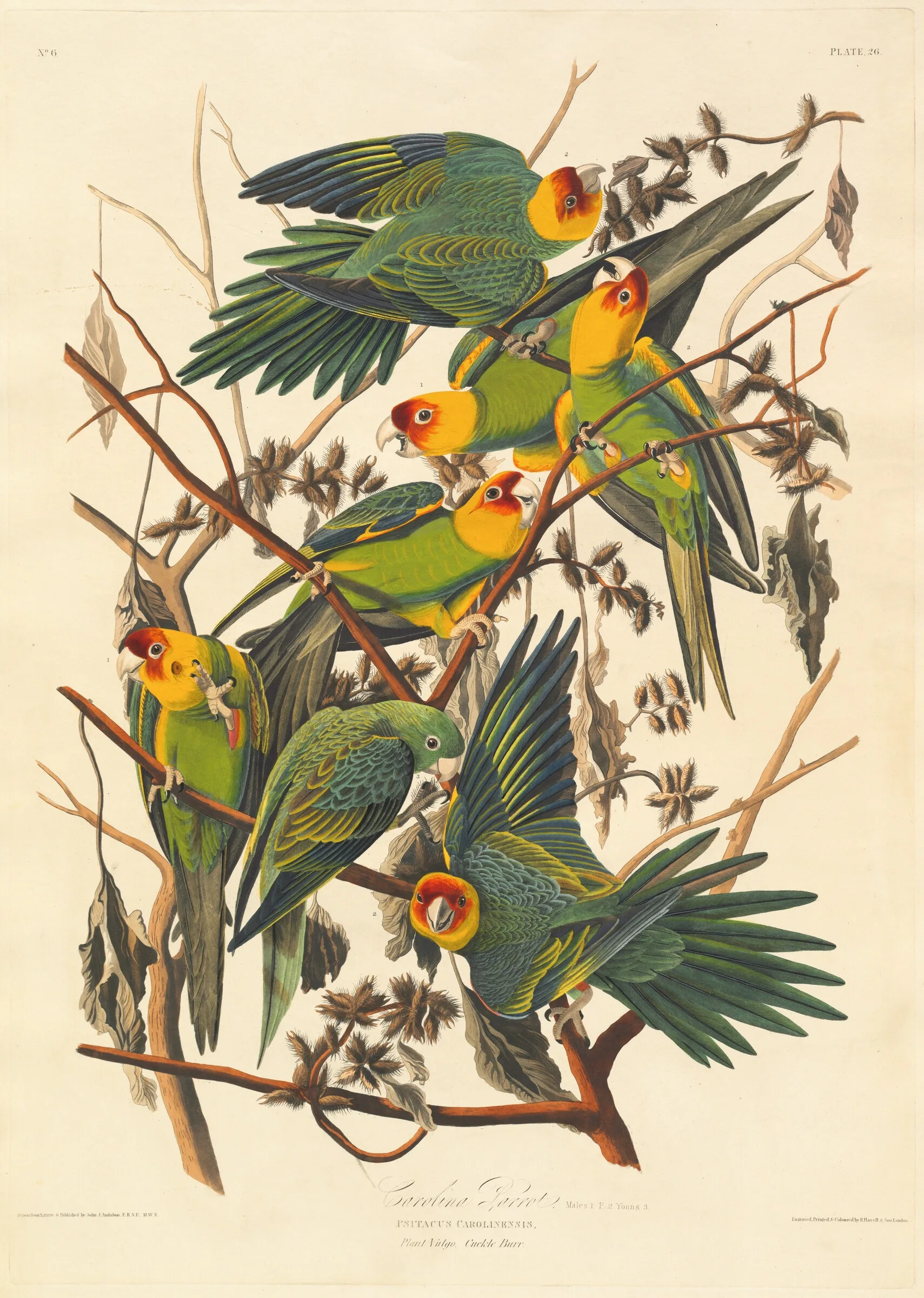
Click or press Enter to enlarge
Open the full-resolution image (6888 px, National Gallery of Art)
| Plate | 26 (XXVI) |
|---|---|
| Audubon's name | Carolina Parrot |
| Modern name | Carolina Parakeet |
| Scientific name | Conuropsis carolinensis |
| Status | Extinct |
| Engraved by | Robert Havell, after Audubon's watercolor |
| Date | 1827 |
| Medium | Hand-colored engraving and aquatint on Whatman wove paper |
| Size | plate: 84.3 x 60.2 cm (33 3/16 x 23 11/16 in.) sheet: 99.7 x 66.7 cm (39 1/4 x 26 1/4 in.) |
| Plants and setting | Cockle-bur (Xanthium) |
| Collections | Songbirds, Extinct Birds |
| This impression | National Gallery of Art, Washington, 1945.8.26; Gift of Mrs. Walter B. James |
About this plate
Plate 26 shows seven Carolina Parakeets climbing and feeding on a plant of Cockle-bur. Adults have green bodies, yellow heads and orange-red faces. Young birds have green heads. Audubon pointed out the seven figures himself and described how the birds pluck a bur, turn it in one foot, split it with the bill and drop the shell. The plate was engraved by Robert Havell in 1827.
Audubon wrote that flocks stripped grain stacks, orchards, mulberries and pecans, so farmers shot them in great numbers. Wounded birds called, and the rest of the flock returned to the spot, so whole flocks could be killed. He shot a basketful in a few shots to choose his models for this plate. He also noted that their numbers were already falling fast and that some districts that had once been full of them now had very few.
The Carolina Parakeet, Conuropsis carolinensis, was the only native parrot of the eastern United States. It ranged from the Gulf coast north to the Ohio valley and beyond. Clearing of bottomland forest, shooting for crop protection, the feather trade and capture for cages all reduced it. Disease from poultry may also have played a part.
The last known captive bird, a male named Incas, died at the Cincinnati Zoo in February 1918. Reports from Florida swamps continued into the 1920s and 1930s, but none were confirmed. The species is now listed as Extinct.
In Audubon's words
The gun is kept at work; eight or ten, or even twenty, are killed at every discharge. The living birds, as if conscious of the death of their companions, sweep over their bodies, screaming as loud as ever, but still return to the stack to be shot at, until so few remain alive, that the farmer does not consider it worth his while to spend more of his ammunition. I have seen several hundreds destroyed in this manner in the course of a few hours, and have procured a basketful of these birds at a few shots, in order to make choice of good specimens for drawing the figures by which this species is represented in the plate now under your consideration.
John James Audubon, Ornithological Biography, vol. 1 (1831), “The Carolina Parrot”. Read the full chapter.
Carolina Parakeet (Plate 26): the story behind one of the most famous plates in the collection →