Wild Turkey (Plate 1)
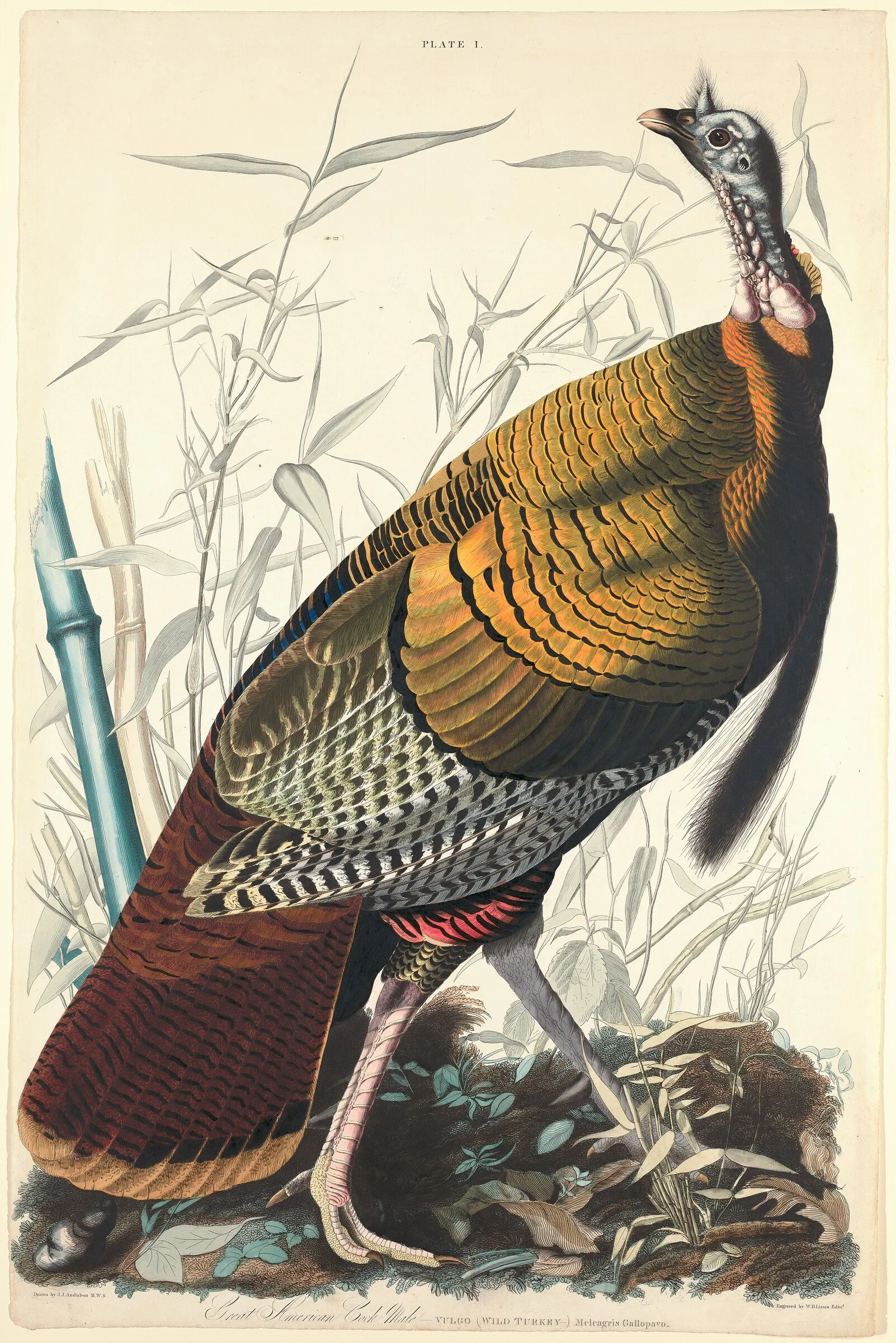
Audubon's “Great American Cock”, The Birds of America, plate I
Click or press Enter to enlarge
Open the full-resolution image (5060 px, National Gallery of Art)
| Plate | 1 (I) |
|---|---|
| Audubon's name | Great American Cock |
| Modern name | Wild Turkey |
| Scientific name | Meleagris gallopavo |
| Status | Least Concern |
| Engraved by | William Home Lizars, after Audubon's watercolor |
| Date | 1827 |
| Medium | Etching and engraving with hand coloring on Whatman paper |
| Size | sheet: 99 x 64.5 cm (39 x 25 3/8 in.) |
| Plants and setting | Cane (Arundinaria) in the background |
| Collections | Turkeys, Grouse and Game Birds |
| This impression | National Gallery of Art, Washington, 1945.8.1; Gift of Mrs. Walter B. James |
About this plate
Plate 1 shows a single adult gobbler at life size, walking through a stand of cane with its head lowered and turned back over its shoulder. The bird fills almost the whole sheet. It was the first subject issued in The Birds of America, engraved in 1827 by William Home Lizars in Edinburgh before the work moved to Robert Havell in London.
Audubon called it the Great American Cock and paired it with Plate 6, the Great American Hen and Young. In the Ornithological Biography he gave the turkey his longest opening chapter, describing its fall movements toward the bottom lands of the Ohio and Mississippi, the separate flocks of gobblers and hens, and the strutting and fighting of males in spring.
The modern name is unchanged: Wild Turkey, Meleagris gallopavo. Audubon noted that it was the source of the domestic turkey, which is correct, although domestication took place in Mexico from a southern form of the species. He wrote that by the 1830s it was very rarely seen east of Pennsylvania, and that in the Great Pine Forest in 1829 he found only a single dropped tail feather.
Hunting and forest clearing reduced the species to a small fraction of its former numbers by the early twentieth century. Restocking and protection programs restored it across most of the United States, and the IUCN now lists it as Least Concern. Audubon based his account mainly on many years of observation in Kentucky and Louisiana.
In Audubon's words
If the call of the female comes from the ground, all the males immediately fly towards the spot, and the moment they reach it, whether the hen be in sight or not, spread out and erect their tail, draw the head back on the shoulders, depress their wings with a quivering motion, and strut pompously about, emitting at the same time a succession of puffs from the lungs, and stopping now and then to listen and look. But whether they spy the female or not, they continue to puff and strut, moving with as much celerity as their ideas of ceremony seem to admit. While thus occupied, the males often encounter each other, in which case desperate battles take place, ending in bloodshed, and often in the loss of many lives, the weaker falling under the repeated blows inflicted upon their head by the stronger.
John James Audubon, Ornithological Biography, vol. 1 (1831), “The Wild Turkey”. Read the full chapter.
Wild Turkey (Plate 1): the story behind one of the most famous plates in the collection →