American Pipit (Plate 10)
Audubon's “Brown Lark”, The Birds of America, plate X
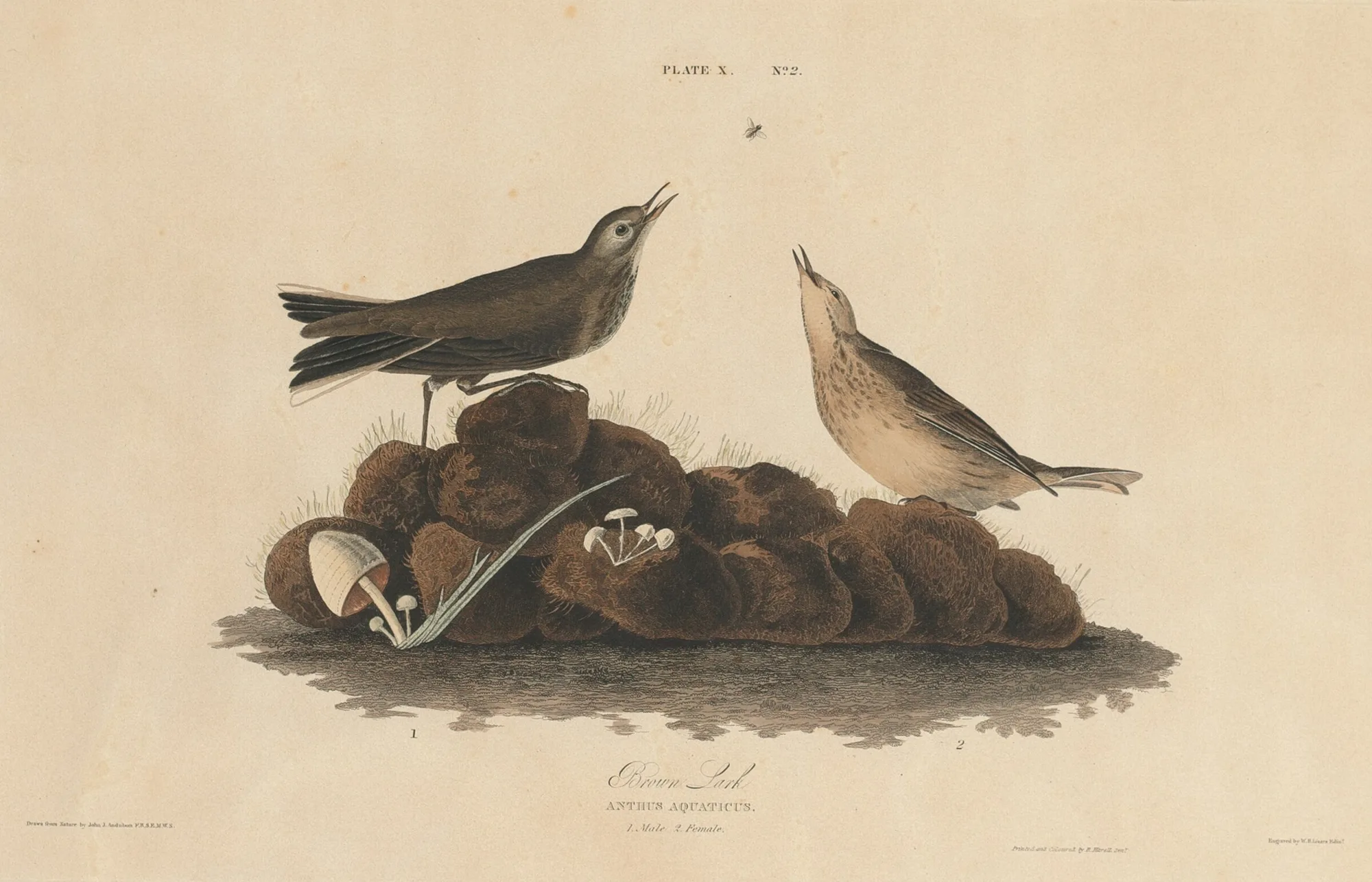
Click or press Enter to enlarge
Open the full-resolution image (2539 px, National Gallery of Art)
| Plate | 10 (X) |
|---|---|
| Audubon's name | Brown Lark |
| Modern name | American Pipit |
| Scientific name | Anthus rubescens |
| Status | Least Concern |
| Engraved by | William Home Lizars, after Audubon's watercolor |
| Date | 1827/1830 |
| Medium | Hand-colored engraving on wove paper |
| Size | plate: 32.6 x 52.2 cm (12 13/16 x 20 9/16 in.) sheet: 63.3 x 95.7 cm (24 15/16 x 37 11/16 in.) |
| Collections | Songbirds |
| This impression | National Gallery of Art, Washington, 1991.117.2; Collection of Dr. and Mrs. George Benjamin Green |
About this plate
Plate 10 shows a male and female American Pipit, plain brown birds with streaked buff underparts. The plate carries the title Brown Lark, while the Ornithological Biography chapter calls the bird the Brown Titlark. It was engraved in Edinburgh by William Home Lizars, dated 1827 to 1830. It was the last of the first ten plates he cut before engraving of the series passed to Robert Havell in London.
Audubon wrote that the bird occurred everywhere he had travelled in the United States but that he never saw it in summer or found it breeding. He described wheeling flocks that swept over old fields and prairies before landing, running lightly on the ground, wagging the tail, and walking almost under grazing cattle for insects. He recorded arrival in Louisiana in mid October and departure in early March.
Audubon thought the bird was identical with the Water Pipit of Europe and used the name Anthus spinoletta. That view held for a long time. The American Pipit, Anthus rubescens, was split as a separate species in 1989. It is also called the Buff-bellied Pipit.
Audubon caught some on board ship on the Newfoundland Banks, on his passage from France to the United States, when tired birds landed and ate biscuit crumbs. The species breeds on Arctic and alpine tundra and winters on fields and shores across the southern United States and Mexico. It is listed as Least Concern.
In Audubon's words
When in the interior of the country, they resort to the old fields, and the vast prairies, as well as the ploughed lands, seldom in flocks of less than ten or a dozen, and not unfrequently by hundreds. Now, they are seen high, loosely moving in short reiterated undulations, inspecting the ground below; now, they come sweeping over and close to it, and seem about to alight, when, on the contrary, their ranks close in an instant, they wheel about, and rise again into the air. These feats are often repeated six or seven times, when at last, satisfied as to their safety, or the abundance of food in the spot, they alight, and immediately run about in quest of food.
John James Audubon, Ornithological Biography, vol. 1 (1831), “The Brown Titlark”. Read the full chapter.



