Yellow-billed Cuckoo (Plate 2)
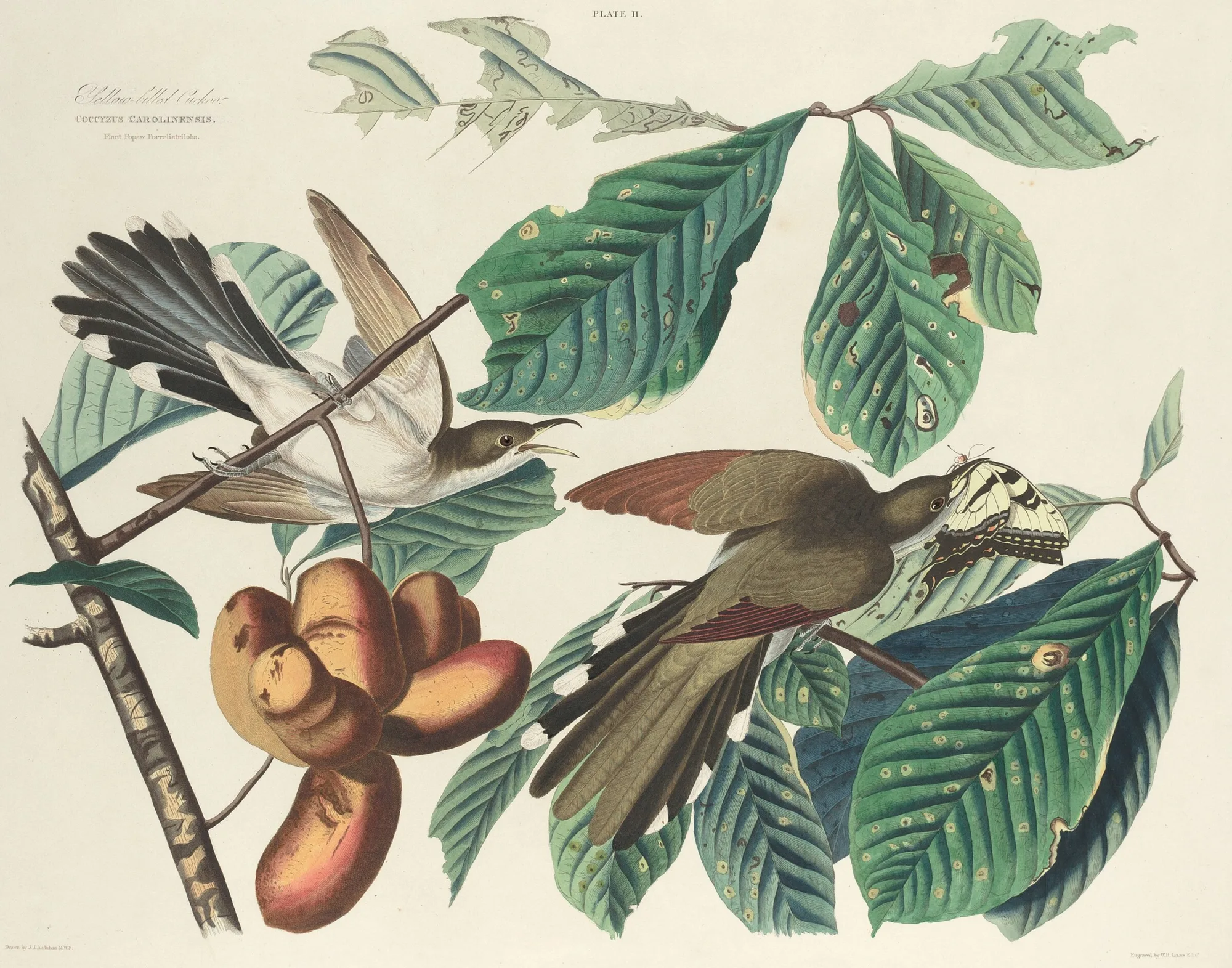
Audubon's “Yellow-billed Cuckoo”, The Birds of America, plate II
Click or press Enter to enlarge
Open the full-resolution image (3360 px, National Gallery of Art)
| Plate | 2 (II) |
|---|---|
| Audubon's name | Yellow-billed Cuckoo |
| Modern name | Yellow-billed Cuckoo |
| Scientific name | Coccyzus americanus |
| Status | Least Concern |
| Engraved by | William Home Lizars, after Audubon's watercolor |
| Date | 1827 |
| Medium | Etching and engraving with hand coloring on Whatman paper |
| Plants and setting | Papaw (Asimina triloba), with leaves and fruit |
| Collections | Songbirds |
| This impression | National Gallery of Art, Washington, 1945.8.2; Gift of Mrs. Walter B. James |
About this plate
Plate 2 shows a pair of Yellow-billed Cuckoos on a branch of Papaw. Both birds are posed among the leaves. The tree carries leaves and the large oblong fruit, which Audubon says he drew from nature. The plate was engraved by William Home Lizars in Edinburgh in 1827.
Audubon opened the chapter with a complaint about naturalists who drew bills and feet carelessly, and asked readers to judge his own figures against living birds. He then described the cuckoo's rapid, silent flight, its arrival in the southern states in March, and its habit of stealing and sucking the eggs of smaller birds.
The bird keeps its name: Yellow-billed Cuckoo, Coccyzus americanus. Audubon recorded its folk names. Most Americans called it the Cow Bird from its call, the Dutch farmers of Pennsylvania the Rain Crow, and French settlers in Louisiana the Coucou. He watched it crossing the Mississippi at many points in one day from a steamboat.
The species breeds across much of the United States and southern Canada and winters in South America. It is listed as Least Concern overall, although the western population that nests in streamside woodland is federally listed as threatened in the United States. The Papaw, Asimina triloba, grows in rich bottom land from the Gulf states to Pennsylvania.
In Audubon's words
On the other hand, early in March, the greater number enter our southern boundaries singly, the males arriving first, and the females a few weeks after. They do not fly in a continued line, but in a broad front, as, while travelling with great rapidity in a steam-boat, so as to include a range of a hundred miles in one day, I have observed this Cuckoo crossing the Mississippi at many different points on the same day. At this season, they resort to the deepest shades of the forests, and intimate their presence by the frequent repetition of their dull and unmusical notes, which are not unlike those of the young Bull-Frog. These notes may be represented by the word cow, cow, repeated eight or ten times with increasing rapidity. In fact, from the resemblance of its notes to that word, this Cuckoo is named Cow Bird in nearly every part of the Union. The Dutch farmers of Pennsylvania know it better by the name of Rain Crow and in Louisiana the French settlers call it Coucou.
John James Audubon, Ornithological Biography, vol. 1 (1831), “The Yellow-billed Cuckoo”. Read the full chapter.



