Magnolia Warbler (immature) (Plate 50)
Audubon's “Swainson's Warbler”, The Birds of America, plate L
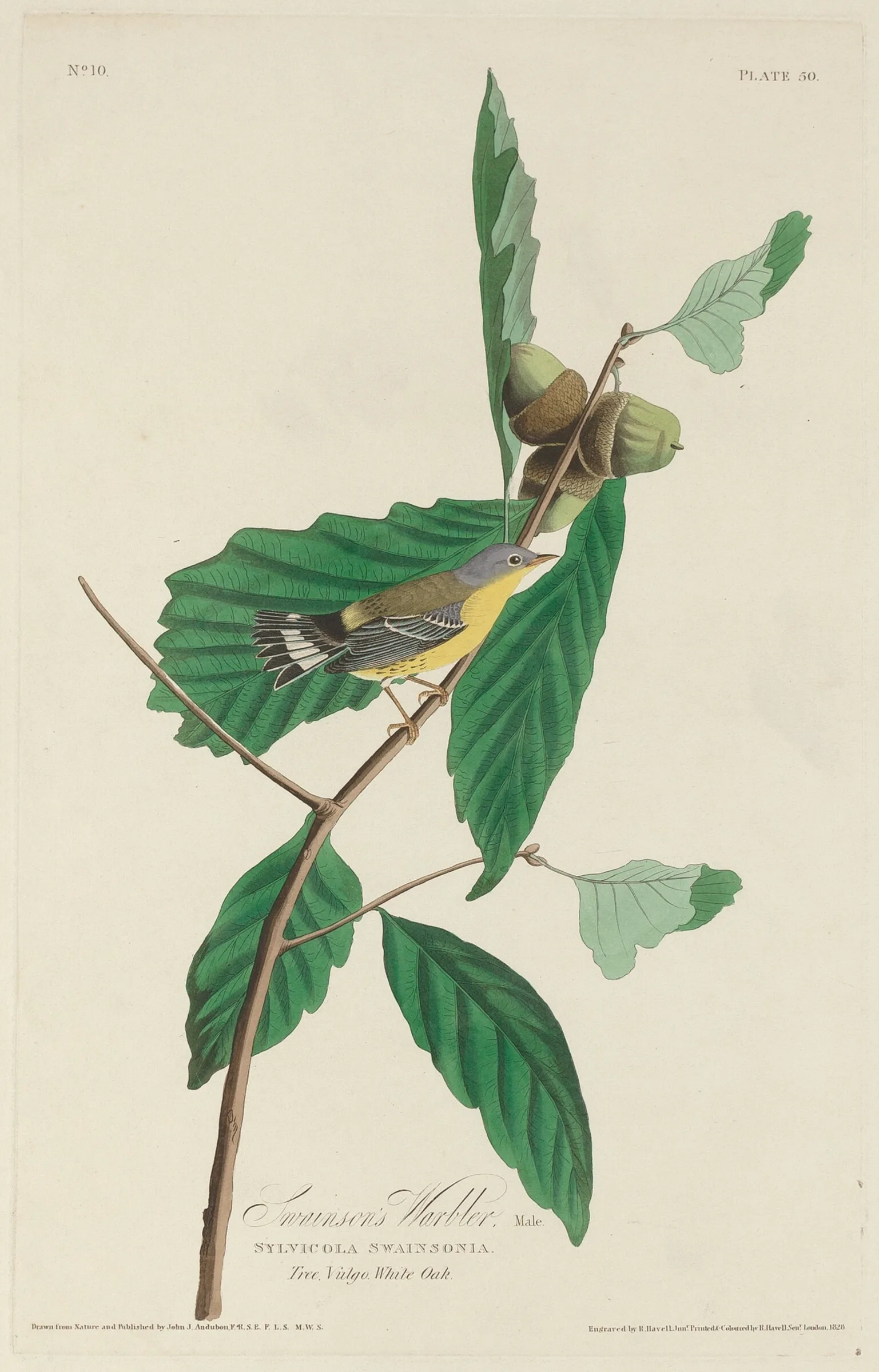
Click or press Enter to enlarge
Open the full-resolution image (2559 px, National Gallery of Art)
| Plate | 50 (L) |
|---|---|
| Audubon's name | Swainson's Warbler |
| Modern name | Magnolia Warbler (immature male) |
| Scientific name | Setophaga magnolia |
| Status | Least Concern |
| Engraved by | Robert Havell, after Audubon's watercolor |
| Date | 1828 |
| Medium | Hand-colored engraving and aquatint on Whatman wove paper |
| Collections | Songbirds |
| This impression | National Gallery of Art, Washington, 1945.8.50; Gift of Mrs. Walter B. James |
About this plate
Plate 50 shows a single young male warbler, grey and olive above and yellow below, with faint streaks. The engraved title reads Swainson's Warbler, but Audubon explained in the Ornithological Biography that this was a mistake. While he was away from London, one drawing was substituted for another, and this one was engraved and named after his friend William Swainson. The NGA dates the plate to 1828 and the engraver as Robert Havell.
Audubon wrote that the bird was really the young of the Black and Yellow Warbler, Sylvia maculosa, and was meant to go on the plate showing the adult male and female. He postponed any account of its habits until that plate and gave only a description of the immature plumage. He added that Swainson would excuse the error, since he had given his name to a fine new species.
The Black and Yellow Warbler is today's Magnolia Warbler, Setophaga magnolia. The real Swainson's Warbler, Limnothlypis swainsonii, a plain brown warbler of southern canebrakes, was discovered by John Bachman in South Carolina in 1832 and named by Audubon in a later plate. That is the beautiful new species he mentions.
The Magnolia Warbler breeds in young conifer forest across Canada and the northeastern United States and winters in Mexico, Central America and the Caribbean. It is listed as Least Concern.
In Audubon's words
This little bird was by mistake engraved, and named after my friend W. SWAINSON, Esq., during my absence from London, one drawing having been accidentally substituted for another. It is in reality the young of the Black and Yellow Warbler, and was intended to form part of the Plate which will represent the adult male and female of that species. My good friend will, I know, excuse this mistake, as I have honoured a beautiful new species with his name.
It being more consistent with my present arrangement to give a full account of each species, as it is represented in the Plate allotted to it, and its different states of plumage, as much as this object can be attained, you will permit me, kind reader, to postpone the habits of this species until you see the whole group together. In the mean time, I shall confine myself to a description of the immature state of plumage as represented in my illustrations.
John James Audubon, Ornithological Biography, vol. 1 (1831), “The Black and Yellow Warbler”. Read the full chapter.



