Marsh Wren (Plate 100)
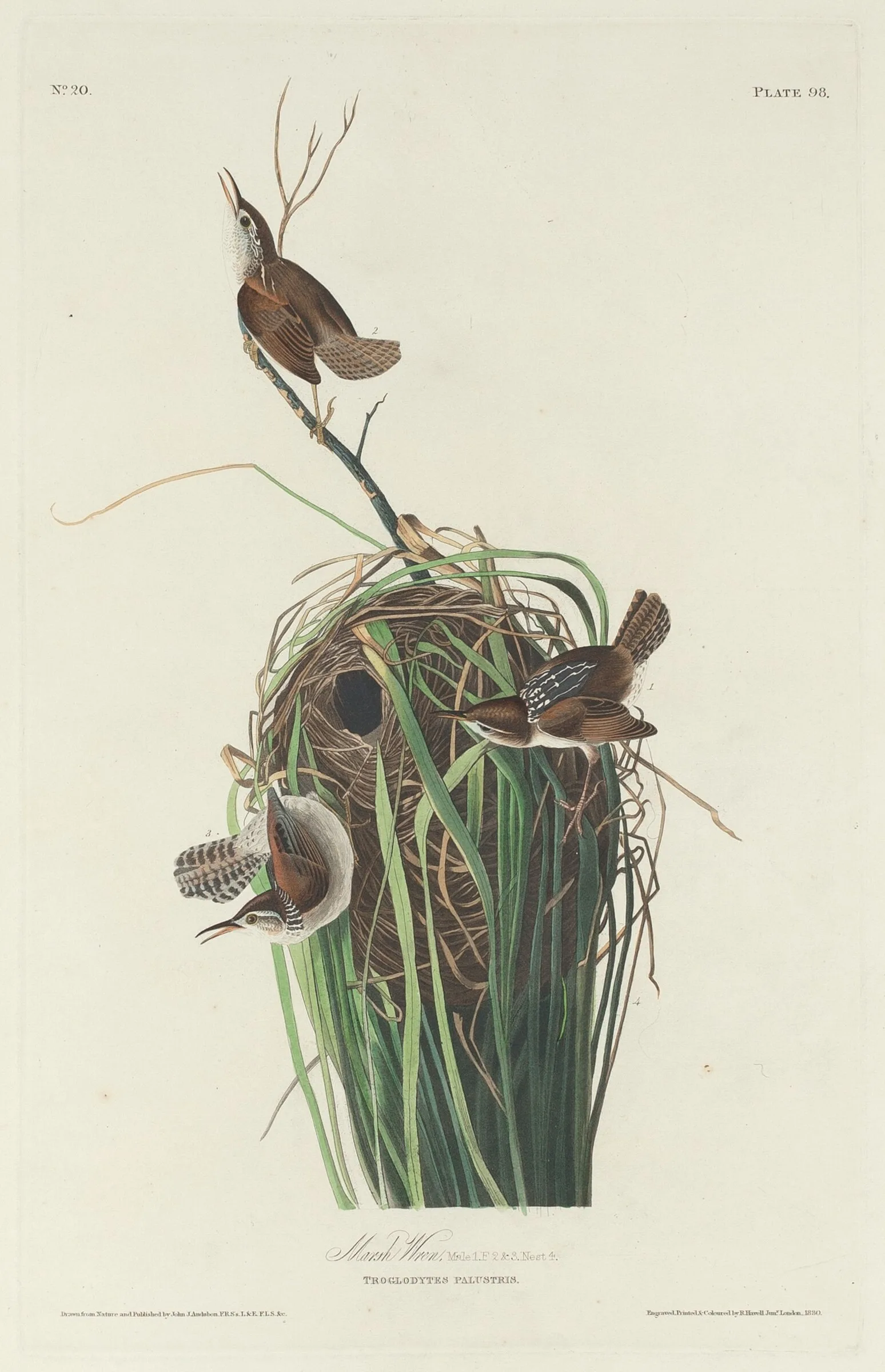
Audubon's “Marsh Wren”, The Birds of America, plate C
Click or press Enter to enlarge
Open the full-resolution image (2472 px, National Gallery of Art)
| Plate | 100 (C) |
|---|---|
| Audubon's name | Marsh Wren |
| Modern name | Marsh Wren |
| Scientific name | Cistothorus palustris |
| Status | Least Concern |
| Engraved by | Robert Havell, after Audubon's watercolor |
| Date | 1830 |
| Medium | Hand-colored engraving and aquatint on Whatman wove paper |
| Plants and setting | Marsh sedges holding the woven nest |
| Collections | Songbirds |
| This impression | National Gallery of Art, Washington, 1945.8.98; Gift of Mrs. Walter B. James |
About this plate
Plate 100 shows a male and female Marsh Wren with their nest, a woven ball of dry grass, about the size and shape of a coconut, bound into living sedge stems with a small side entrance. Audubon described the inner lining of fine grass and noted that the entrance usually faced southwest. The engraved numbers of plates 98 and 100 were misnumbered on the Havell edition, so some collections, including the National Gallery of Art, list the White-bellied Swallow and the Marsh Wren under each other's numbers.
Audubon found Marsh Wrens in great numbers from April to October in the marshes where rivers meet the sea along the Atlantic coast, and wintering on the southwest coast of Florida and the mouths of the Mississippi. He called it a homely little bird that lives entirely among sedges and flags, and described its rattling song, like a rusty hinge, sung from the top of a tall weed before it dives into cover. He said its quick movements among the stems made it easy to mistake for a mouse.
The Marsh Wren breeds in cattail and bulrush marshes and tidal reeds across much of North America. Males build many unused dummy nests in their territory, sometimes more than twenty, and females choose among them. Males also often destroy the eggs of neighbouring Marsh Wrens and Red-winged Blackbirds. Eastern and western birds differ in song and may be separate species. It is listed as Least Concern.
In Audubon's words
It is a homely little bird, and is seldom noticed, unless by the naturalist, when searching for other species, or by children, who in all countries are fond of birds. It lives entirely amongst the sedges, flags, and other rank plants that cover the margins of the rivers, and the inlets of the sea. Its flight is very low and short, and is performed by a continued flirting of the wings, but without the motions of the tail employed by the Great Carolina Wren. Its song, if song I can call it, is composed of several quickly repeated notes, resembling the grating of a rusty hinge, and is uttered almost continuously during the fore part of the day, the performer standing perched on the top of a tall weed, from which, on the appearance of an intruder, it instantly dives into the thickest part of the herbage, but to which it returns the moment it thinks the danger over, and renews its merry little song.
John James Audubon, Ornithological Biography, vol. 1 (1831), “The Marsh Wren”. Read the full chapter.



