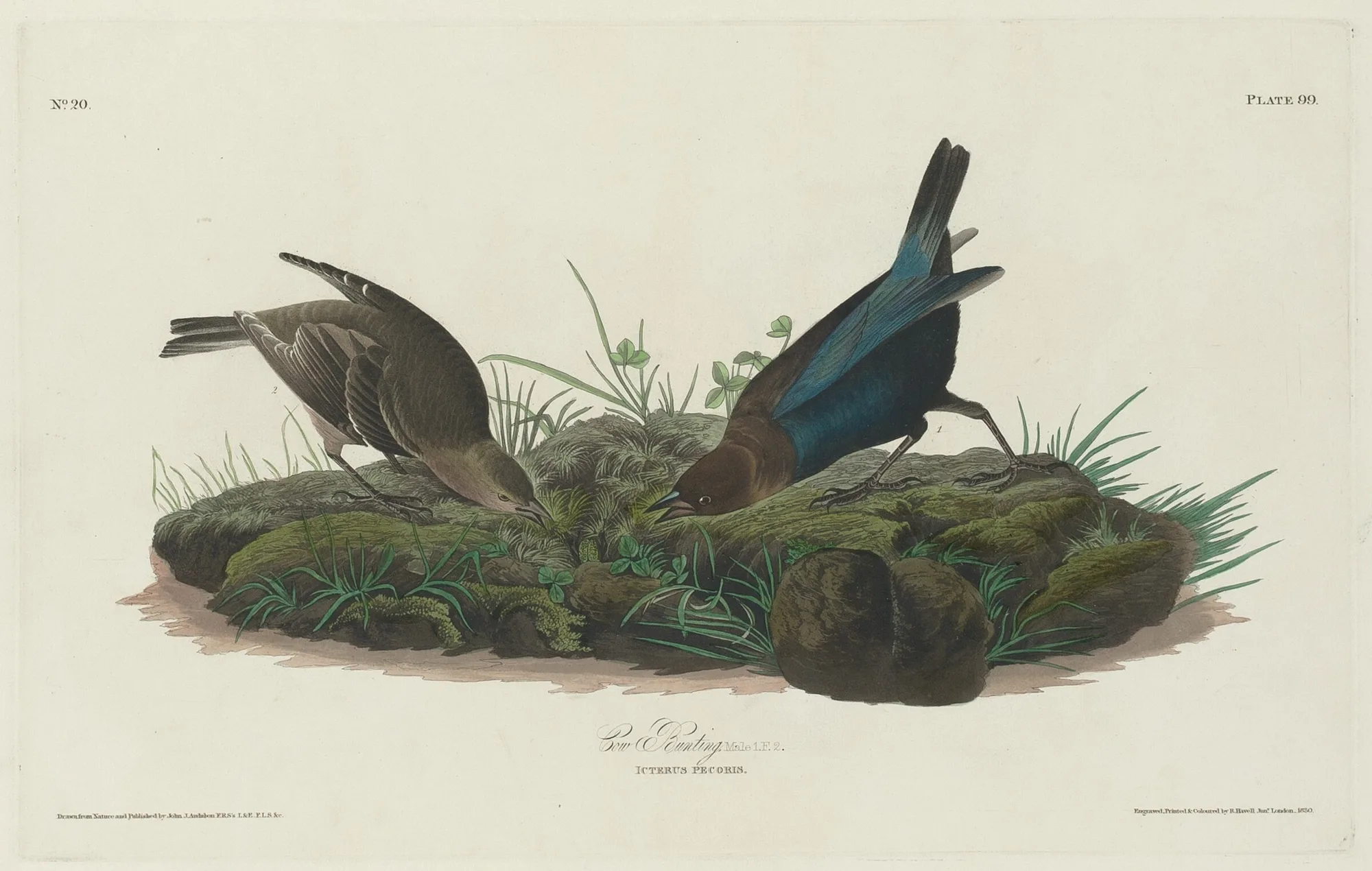
Brown-headed Cowbird (Plate 99)
Audubon's “Cow Bunting”, The Birds of America, plate XCIX
Click or press Enter to enlarge
Open the full-resolution image (2452 px, National Gallery of Art)
| Plate | 99 (XCIX) |
|---|---|
| Audubon's name | Cow Bunting |
| Modern name | Brown-headed Cowbird |
| Scientific name | Molothrus ater |
| Status | Least Concern |
| Engraved by | Robert Havell, after Audubon's watercolor |
| Date | 1830 |
| Medium | Hand-colored engraving and aquatint on Whatman wove paper |
| Collections | Songbirds |
| This impression | National Gallery of Art, Washington, 1945.8.99; Gift of Mrs. Walter B. James |
About this plate
Plate 99 shows a male and female Brown-headed Cowbird. The male is glossy black with a brown head; the female is plain grey-brown. Audubon titled the chapter the Cow-pen Bird, after its habit of feeding around cattle pens and among livestock.
He opened with a long reflection on the seed and the egg, arguing that nature's apparent oddities serve a purpose. He then turned to the cowbird's breeding. He observed that males and females arrive together in spring but do not form pairs or court like other birds, and that the female lays her eggs in the nests of other species, leaving the young to be raised by foster parents. He had already described the Blue-gray Gnatcatcher, plate 84, as a frequent host.
The Brown-headed Cowbird is a brood parasite. Females lay dozens of eggs a season, usually one per nest, in the nests of more than two hundred host species. Many hosts raise the cowbird chick at the cost of their own young. Cowbirds originally followed bison herds on the Great Plains and spread east as forests were cleared for farms and pasture. In places they threaten rare hosts such as Kirtland's Warbler, and are controlled there. The species is listed as Least Concern.
In Audubon's words
The males and females arrive together; but contrary to the general practice among the feathered tribes, these birds do not pair. The males seem to regard the females with little interest. The numberless acts of endearment, the many carollings, joyous flights, and bursts of ecstatic feeling, which other birds display at the commencement of the breeding season, are entirely dispensed with. When a particular intimacy takes place between two individuals of different sexes, it soon ceases, and the same individuals mate with others. The sexual attachment intended for the benefit of the young brood does not take place, because in this species the young are not to be reared by their parents, but to be left to the care of birds of other kinds. The Cow-pen Buntings, in fact, like some unnatural parents of our own race, send out their progeny to be nursed.
John James Audubon, Ornithological Biography, vol. 1 (1831), “The Cow-pen Bird”. Read the full chapter.



