Red-tailed Hawk (Plate 51)
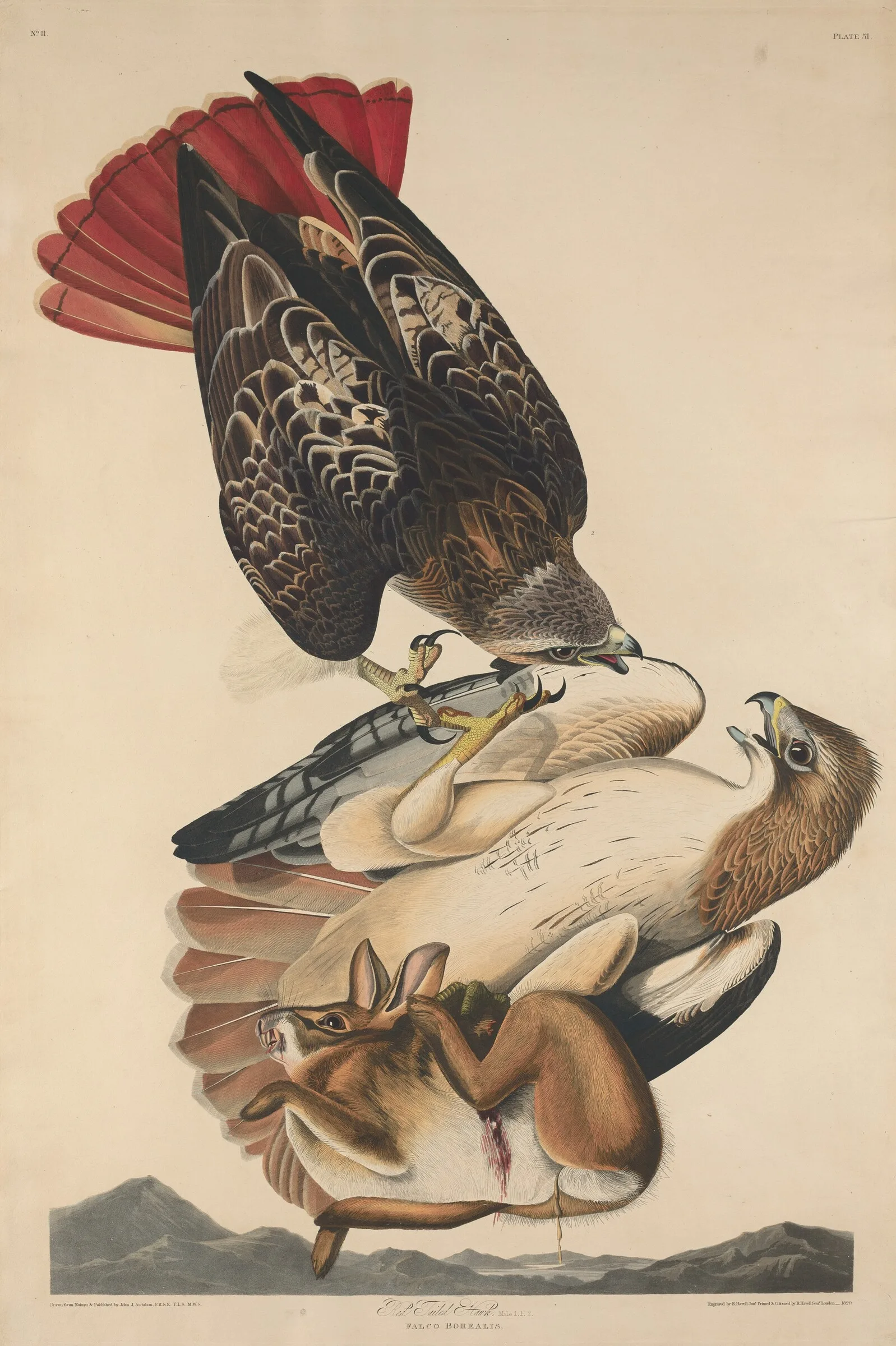
Audubon's “Red Tailed Hawk”, The Birds of America, plate LI
Click or press Enter to enlarge
Open the full-resolution image (4907 px, National Gallery of Art)
| Plate | 51 (LI) |
|---|---|
| Audubon's name | Red Tailed Hawk |
| Modern name | Red-tailed Hawk |
| Scientific name | Buteo jamaicensis |
| Status | Least Concern |
| Engraved by | Robert Havell, after Audubon's watercolor |
| Date | 1829 |
| Medium | Hand-colored engraving and aquatint on Whatman wove paper |
| Collections | Hawks, Eagles and Falcons |
| This impression | National Gallery of Art, Washington, 1945.8.51; Gift of Mrs. Walter B. James |
About this plate
Plate 51 shows a pair of Red-tailed Hawks grappling in the air over a hare that one of them holds. One bird is turned on its back with talons raised. The adult's brick-red tail is clearly shown. The plate was engraved by Robert Havell in 1829.
Audubon described the Red-tail as a year-round resident, more common in the southern states. He wrote of it sailing across whole plantations without a wingbeat while calling a long, mournful kae. He also described it circling until it looked like a white dot in the sky and then diving on a partridge or young hare. He told a long story of a farmer who, after losing poultry, shot the female hawk at her nest and felled the huge oak to take the young.
Audubon used Gmelin's name Falco borealis. The modern name is Red-tailed Hawk, Buteo jamaicensis. The species varies a great deal, from pale prairie birds to dark western forms and the Harlan's Hawk of Alaska, which Audubon later described as a separate species.
The Red-tailed Hawk is the most common large hawk in North America. It breeds from Alaska and Canada to Panama and the Caribbean and hunts rodents in open country, along roads and in cities. It was once heavily shot as a hen hawk but is now protected and listed as Least Concern.
In Audubon's words
At other times, as if not assured that his observations have been duly made, he rises in circles over the same field to an immense height, where he looks like a white dot in the heavens. Yet from this height he must be able to distinguish the objects on the ground, even when these do not exceed our little partridge or a young hare in size, and although their colour may be almost the same as that of surrounding bodies; for of a sudden his circlings are checked, his wings drawn close to his body, his tail contracted to its smallest breadth, and he is seen to plunge headlong towards the earth, with a rapidity which produces a loud rustling sound nearly equal to that of an Eagle on a similar occasion.
John James Audubon, Ornithological Biography, vol. 1 (1831), “The Red-tailed Hawk”. Read the full chapter.