Common Raven (Plate 101)
Audubon's “Raven”, The Birds of America, plate CI
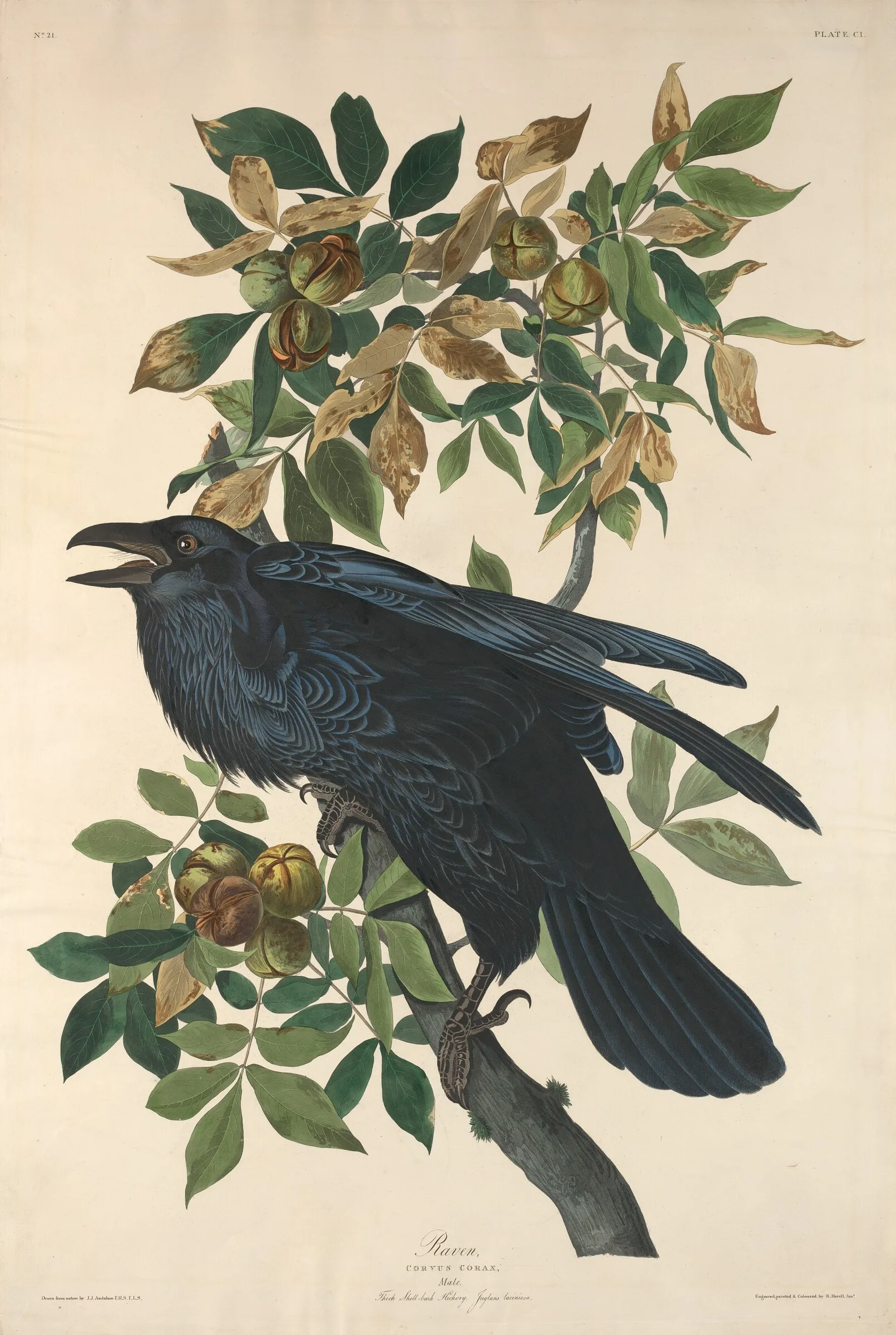
Click or press Enter to enlarge
Open the full-resolution image (4692 px, National Gallery of Art)
| Plate | 101 (CI) |
|---|---|
| Audubon's name | Raven |
| Modern name | Common Raven |
| Scientific name | Corvus corax |
| Status | Least Concern |
| Engraved by | Robert Havell, after Audubon's watercolor |
| Date | 1831 |
| Medium | Hand-colored engraving and aquatint on Whatman wove paper |
| Size | plate: 96.2 x 64.7 cm (37 7/8 x 25 1/2 in.) sheet: 99.6 x 66.4 cm (39 3/16 x 26 1/8 in.) |
| Collections | Songbirds |
| This impression | National Gallery of Art, Washington, 1945.8.101; Gift of Mrs. Walter B. James |
About this plate
Plate 101 shows a single male Common Raven, glossy black with a heavy bill and shaggy throat feathers. It opens the second volume of the plates, and Audubon began its chapter with a preface to the second volume of the Ornithological Biography, describing the forests, coasts, rivers and mountains he had travelled to study American birds.
Audubon described the raven in the United States as partly migratory and found it mainly among mountains, steep river banks, the rocky shores of lakes and the cliffs of thinly settled islands. He wrote with feeling about a pair's courtship flights high in the air, their calls to each other, and their cliff nest on a ledge above breaking waves. He believed raven pairs stayed together for life and described the parents feeding the young with half-digested food and guarding them from Peregrines and Gyrfalcons.
The Common Raven is the largest songbird in the world and one of the most widespread, found across North America, Europe, Asia and North Africa. It is known for problem solving, play and a large vocabulary of calls. In the eastern United States it was driven back to remote mountains and coasts in the nineteenth century and has since spread back into much of its old range. It is listed as Least Concern.
In Audubon's words
There, through the clear and rarified atmosphere, the Raven spreads his glossy wings and tail, and, as he onward sails, rises higher and higher each bold sweep that he makes, as if conscious that the nearer he approaches the sun, the more splendent will become the tints of his plumage. Intent on convincing his mate of the fervour and constancy of his love, he now gently glides beneath her, floats in the buoyant air, or sails by her side. Would that I could describe to you, reader, the many musical inflections by means of which they hold converse during these amatory excursions! These sounds doubtless express their pure conjugal feelings, confirmed and rendered more intense by long years of happiness in each other's society. In this manner they may recall the pleasing remembrance of their youthful days, recount the events of their life, express the pleasure they have enjoyed, and perhaps conclude with humble prayer to the Author of their being for a continuation of it.
John James Audubon, Ornithological Biography, vol. 2 (1834), “The Raven”. Read the full chapter.



