Black-throated Blue Warbler (Plate 155)
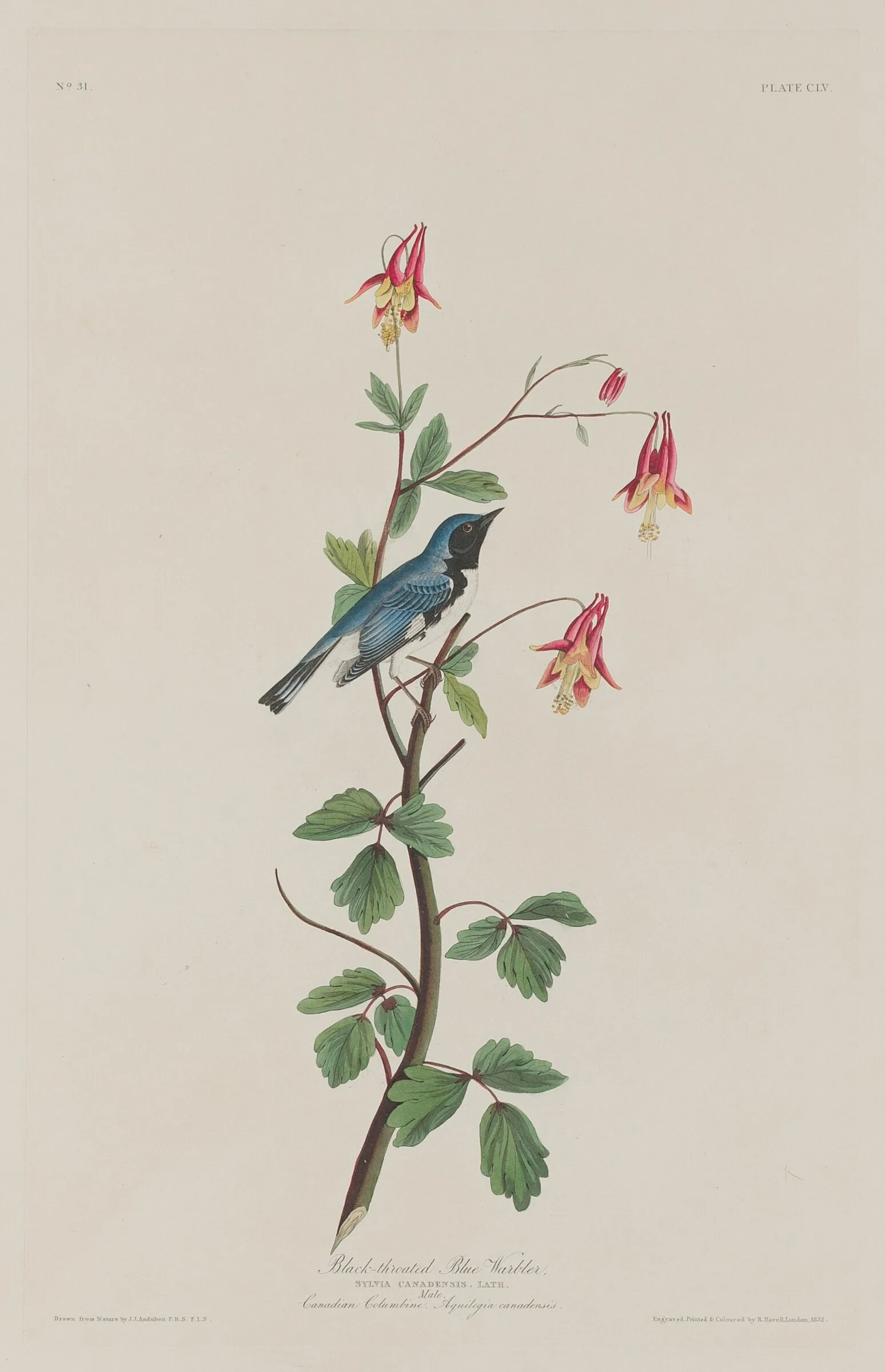
Audubon's “Black-throated Blue Warbler”, The Birds of America, plate CLV
Click or press Enter to enlarge
Open the full-resolution image (2478 px, National Gallery of Art)
| Plate | 155 (CLV) |
|---|---|
| Audubon's name | Black-throated Blue Warbler |
| Modern name | Black-throated Blue Warbler |
| Scientific name | Setophaga caerulescens |
| Status | Least Concern |
| Engraved by | Robert Havell, after Audubon's watercolor |
| Date | 1832 |
| Medium | Hand-colored engraving and aquatint on Whatman wove paper |
| Plants and setting | Wild columbine (Aquilegia canadensis) |
| Collections | Songbirds |
| This impression | National Gallery of Art, Washington, 1945.8.155; Gift of Mrs. Walter B. James |
About this plate
Plate 155 shows a male Black-throated Blue Warbler, deep blue above with a black face, throat and sides and a white belly, on a stem of wild columbine, Aquilegia canadensis, with its red and yellow flowers. Audubon wrote that the bird now and then alights on low plants like this one to search for insects.
Audubon used Latham's name Sylvia canadensis. The bird is now Setophaga caerulescens. The female is olive-brown, so different from the male that Audubon published females in plate 148 as a separate species, the Pine Swamp Warbler.
The Black-throated Blue Warbler breeds in the shrubby understorey of hardwood and mixed forest from southeastern Canada and the Great Lakes through New England and down the Appalachians, and winters mainly in the Greater Antilles. It is a well-studied species and is listed as Least Concern.
Audubon wrote that he saw it in spring and autumn across the South and found it more common in the swamps of the Great Pine Forest of Pennsylvania, upstate New York, Maine and the Magdalen Islands. In Labrador he found only one, dead and dried in a crack in a rock. Professor McCulloch of Pictou, Nova Scotia, gave him a nest and eggs collected by his sons. In the book the chapter is followed by the episode The Florida Keys.
In Audubon's words
Proceeding eastward, we find it more numerous, but residing only in the depth of the morasses and swampy thickets. I saw many individuals of the species in the Great Pine Forest of Pennsylvania, after which I traced it through the upper parts of the State of New York into Maine, the British Provinces, and the Magdaleine Islands, in the Bay of St Lawrence. In Newfoundland I saw none, and in Labrador only a dead one, dry and shrivelled, deposited like a mummy in the fissure of a rock, where the poor bird had fallen a victim to the severity of the climate, from which it had vainly endeavoured to shelter itself.
John James Audubon, Ornithological Biography, vol. 2 (1834), “The Black-throated Blue Warbler”. Read the full chapter.



