Blue Jay (Plate 102)
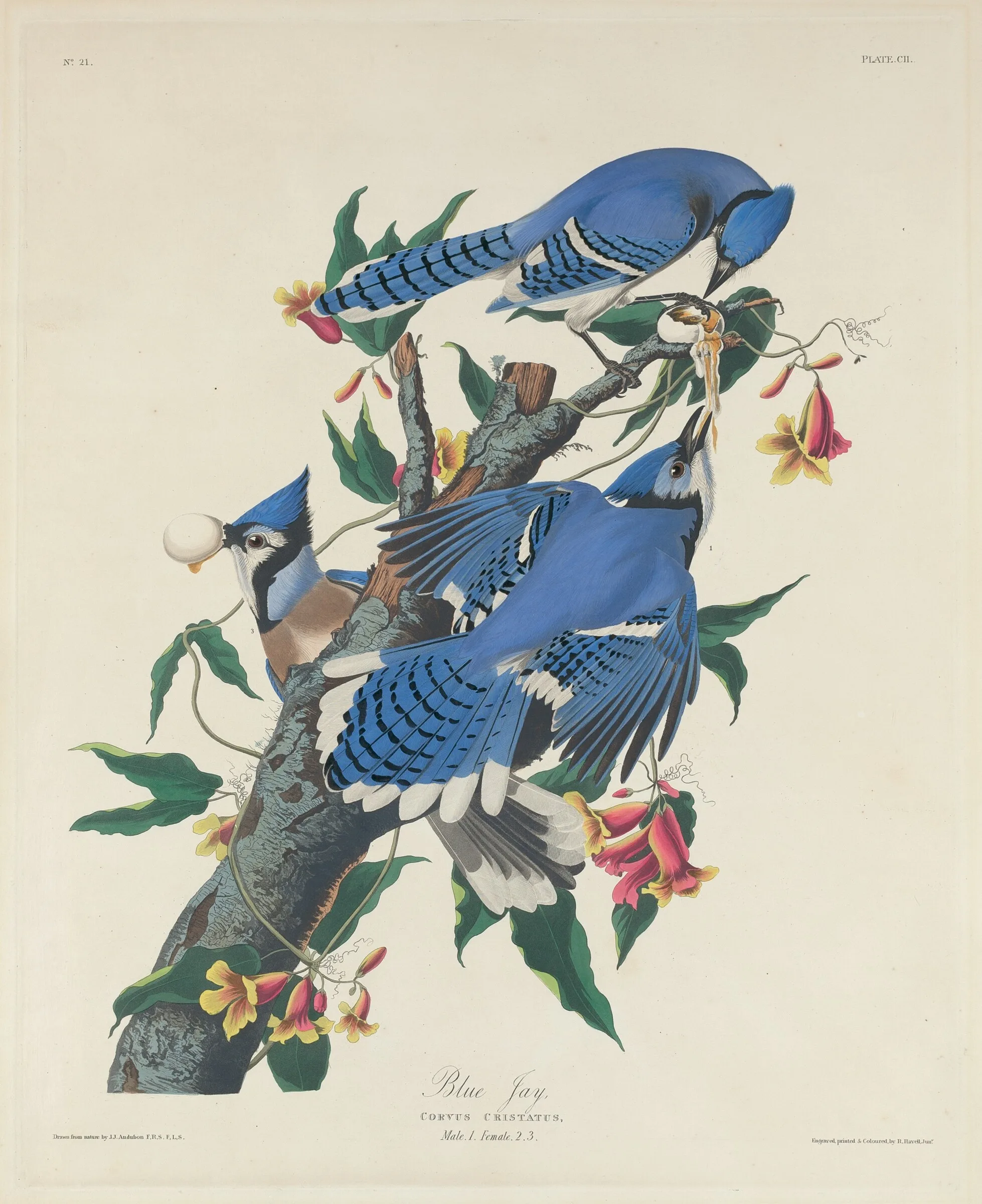
Audubon's “Blue Jay”, The Birds of America, plate CII
Click or press Enter to enlarge
Open the full-resolution image (3241 px, National Gallery of Art)
| Plate | 102 (CII) |
|---|---|
| Audubon's name | Blue Jay |
| Modern name | Blue Jay |
| Scientific name | Cyanocitta cristata |
| Status | Least Concern |
| Engraved by | Robert Havell, after Audubon's watercolor |
| Date | 1831 |
| Medium | Hand-colored engraving and aquatint on Whatman wove paper |
| Size | plate: 65.3 x 55.2 cm (25 11/16 x 21 3/4 in.) sheet: 100 x 67 cm (39 3/8 x 26 3/8 in.) |
| Collections | Songbirds |
| This impression | National Gallery of Art, Washington, 1945.8.102; Gift of Mrs. Walter B. James |
About this plate
Plate 102 shows three Blue Jays, each with an egg stolen from another bird's nest, which they are sucking or breaking open. Audubon invited the reader to look at the plate and see these rogues and thieves enjoying their plunder, and said their beauty hid a mischievous character.
He described the jay's range from Canada to the Gulf, its raids on corn cribs, and its perfect imitation of the cry of the Sparrow Hawk, which sent small birds diving for cover. In Louisiana he found it so common that planters soaked corn in poison to kill it. He wrote that jays mob foxes, raccoons and owls with loud calls, and that in South Carolina they preferred to nest in live oaks. In the Florida Keys he did not see a single one.
The Blue Jay lives in forests, towns and suburbs across eastern and central North America. It does take eggs and nestlings, but most of its diet is acorns, nuts, seeds and insects. It buries thousands of acorns each autumn, and those it fails to recover help oak forests spread. Its blue colour, like that of the Indigo Bunting, is structural rather than pigment. Some birds migrate in large daytime flocks along lakeshores and coasts. It is listed as Least Concern.
In Audubon's words
Reader, look at the plate in which are represented three individuals of this beautiful species,—rogues though they be, and thieves, as I would call them, were it fit for me to pass judgment on their actions. See how each is enjoying the fruits of his knavery, sucking the egg which he has pilfered from the nest of some innocent dove or harmless partridge! Who could imagine that a form so graceful, arrayed by nature in a garb so resplendent, should harbour so much mischief;—that selfishness, duplicity, and malice should form the moral accompaniments of so much physical perfection! Yet so it is, and how like beings of a much higher order, are these gay deceivers! Aye, I could write you a whole chapter on this subject, were not my task of a different nature.
John James Audubon, Ornithological Biography, vol. 2 (1834), “The Blue Jay”. Read the full chapter.
Blue Jay (Plate 102): the story behind one of the most famous plates in the collection →



